 Loading the Sample
What this isSkip to the Table of Contents
55 years after writing the fable that started the field of IA, Richard Saul Wurman returns with a new story about everything that came before AI, and what comes next.
Volume One Begins before before, ankles-deep in the mud at the end of an ice age 333,000 years ago with the first step in mankind’s dance with tech and talk: the map.
Our hero the ’Commish sees it all: jumping backwards in time and all over the earth to see how it came to be that everything talks to everything else.
The rest of the first book is an elaboration of what’s discovered in Chapter 1, including Wurman’s Five Operatives for making information understandable.
Volume Two Is where the fable grows tentacles.
Like the octopuses in the first book, it reaches out from the fable to connect everything it touches.
Designed to be read, not just searched, the second book includes an archive of RSW’s previous works of speculative fiction plus a glossary, timeline, maps, and a LATCH-based index to both volumes to unlock discovery through the lenses of Location, Alphabet, Time, Category and Hierarchy.
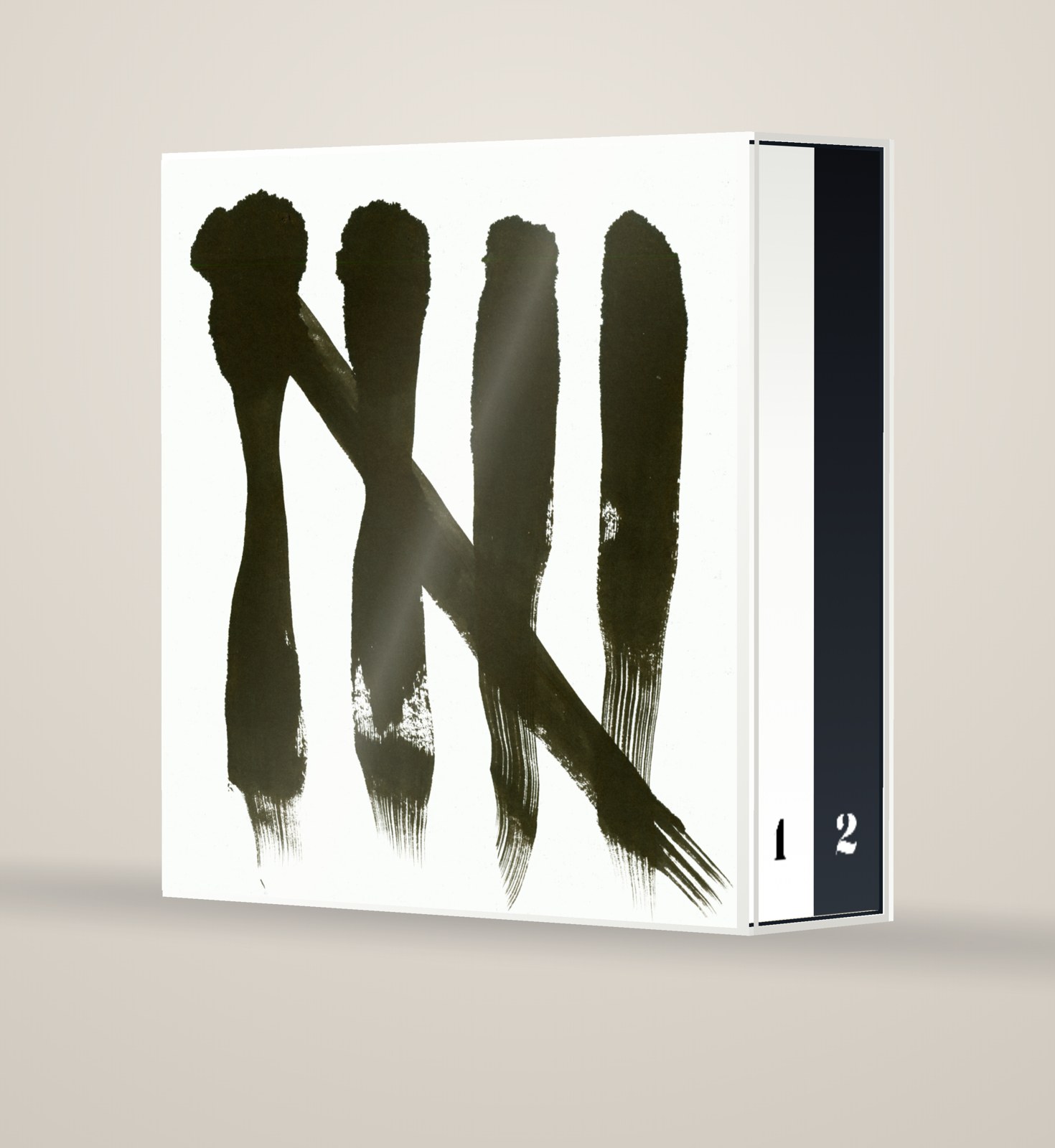
Two volumes in a slipcase
An Explanation
Pour the whole human story through a funnel with two spouts.
Out of one runs conversation. Out of the other runs technology.
Everything that matters happens where the two streams meet.
Right now you can have a conversation with a machine. You ask, it answers; creating patterns of understanding. A screen. A map.
And while it’s talking to you, it’s talking to other machines too, quietly and constantly, faster than you can follow.
Now look at your own day.
Almost all of it is these two things: you’re talking to somebody, or you’re using some gadget to talk to them better.
Talk and tools have fed each other forever. We want to talk, and we want to understand, so we build a better way to talk. The new tool changes what we can say, so we say more, and build again with increased learning and speed.
Cave walls. The first written word. A letter carried by horse, then by train, then thrown through the air. A catalog you could furnish a house from. A phone book you let your fingers walk through. Now a machine that talks back.
It will change again. It’s a do-si-do that never stops.
That is this book: a 333,000-ish year long tango of tools and talk.
And it’s a fable: a friendly, made-up way of telling how all that chatter turned, over the ages, into a machine that talks back.
Before Before
You don’t remember any of it, but the first room you were ever in was a room full of questions.
Somebody was screaming. Somebody was counting the minutes between contractions, out loud, because counting was the only thing left to do. Somebody was waiting to hear whether it was coming sideways, or backwards, or at all. The positions were grotesque and nobody apologized for them. The nurses and the doctors had heard all of it before; how they keep that job is its own question.
The whole business used to take place on a mud floor, and in much of the world it still does.
Then you arrived. Somebody held you up: slippery, not heavy, upside down, trailing blood and mucus, and for one long moment you were not a baby at all.
You were a question mark.
Boy, question mark. Girl, question mark. Alive, question mark. Dead, question mark. Breathing, question mark. Five fingers, five toes, five on each appendage, question mark. Big? Small? And, from somewhere behind the held-up question mark: how is the mother?
A supposed-to-be sterile, actually filthy room of questions: your first address!
Everything in that room was true. Almost none of it, yet, was factual. The boy or the girl of it, the alive of it, the five-on-each-appendage of it.
The facts arrived one confirmation at a time. The truth got there first.
And you answered the room the only way you could. You screamed. It was your first turn in the long conversation, and they spent the next ten years asking you to take it down a notch.
Your first breath was equipment for your first and forever job. Conversation is not one need among the others. It is the petri dish the others grow in. It is demonstrably what you’re here for.
Table of Contents · for the whole two-volume book
Entries in red are the selections for the printed RSW5 Sample.
333,000 BCE – 2033 CE
Before Before
1. A Fable
Preamble to Fable Part 1
Blombos Cave, South Africa · Summer Solstice 330,974 BCE
ONE
The Important Thing Is Always About To Happen
City of What-If · Christmas Eve, 1976In which the ’Commish is taken from a pretzel cart, crated, and parachuted into exile; and the only witness is sealed in a closet with his bells
TWO
The Dark Doesn’t Get To Keep What It Wins
City of What-If · Winter Solstice, 1976In which the octopuses lend a shell that visits yesterdays, and its first trip is spent on a warning and a promise
THREE
The Tango Of Tools & Talk
Olduvai Gorge, Tanzania · Summer Solstice, 2.7 Million Years AgoIn which he watches the 2.7-million-year dance of tools and talk, one leap at a time, and tells the octopuses everything
FOUR
Everything Takes Place Some Place
Kapingamarangi · Christmas Break, 2027In which a petrified pretzel proves he was real, and graduate students bring him home the long way, on purpose
FIVE
All Roads Lead To Death
City of What-If · Hanukkah, 2028In which he beats the never-wrong machine with an eraser, outlaws his own statue, and rides the blue bridge into Will-Be
2. Some Quilts
Preamble to Some Quilts
Kapingamarangi atoll · 55 years ago
Part 1
Cartography
Everything takes place some placeMapping and Cartography in Metropolitan Areas
Essay · 1988
Part 2
Comparison
You only understand relative to something you already understandDesign for Understanding
Essay · 1988
Part 3
Arrangement
The creative organization of information creates new informationLocation · Alphabet · Time · Category · Hierarchy
Five essays
Part 4
Instructions
The key to making things understandable is to know what it’s like to not understandDestructions
Why Instructions Fail and How We Respond · draft book chapter, previously unpublished
Part 5
Access
Public information should be made publicThe Public Environment
Essay
3. The Question
Preamble to The Question
Friday Night, A Restaurant
What Even Is A Question?
Five parts and a bibliography
4. Opposites
Preamble to Opposites
Stockholm · 1922
Part 1
Self / Other
Confessions of a BioQuant
Part 2
Private / Public
Time Over Two for the City Over Two
Part 3
Letters / Numbers
Siblings Raised in Separate Rooms
Part 4
What / How
The Hand Makes Its Own Case
Part 5
Sound / Silence
Leave Some Space
The Last Laugh
The Pretzel Vendor and the mothballed Last Word
The One Right Way
2.7m BCE – 2027 CE
1. Prior Fables
From Could-Be to Will-Be, the words the fable made up and the words it borrowed
3. The Index
Five doors, one for each letter of LATCH
L
by Location
Equal Earth, all at the same scale
T
by Time
Timeline of Tools & Talk · 333 entries, 2.7 million years to 2027
4. Bonus Material
5. Endnotes
The Numbered marginalia, in the order they appear, readable in full
Where you are
Volume 1, Chapter 1
Overall Fable Arc
Once upon a time, the self-appointed Commissioner of Curiosity & Imagination was cancelled by the despicable Doctor Indelible, whose goons kidnapped him and dumped on a island at the far end of the Pacific.
The only witness was put in a closet.
Every day, with a shell the octopuses lent him, he leapt backward in time: three days, to warn the friend in the closet; eighty thousand years, to a shore at Blombos where someone was grinding ochre; two million seven hundred thousand, to Olduvai, where tools and talk began; and back and back again, watching hominins become what we are one hand and one word at a time, the dance that never finishes, never once allowed to change a step.
And then one day, the closet rusted open and the witness walked out not a day older, holding a petrified pretzel; the graduate students who dated it followed it to the island and brought the exile home the long way, by Narai, Angkor, Khajuraho, Rome, El Castillo and London.
Until finally, in a showdown with his old nemesis at the DUM conference, a lasting detente is achieved between a supercomputer, a pencil eraser, and two words: not yet.
And ever since, he has been east of the bridge, in the country that has not happened yet: the one leap the shell could never make, so he rode.
Before Before
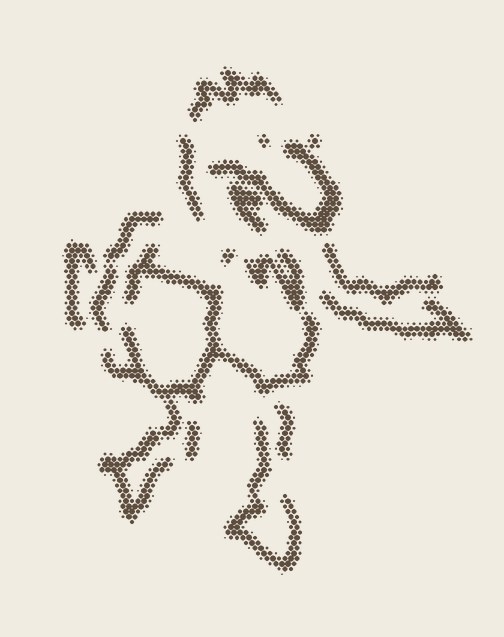
Sure, he’s unkempt, but The Commissioner of Curiosity & Imagination can seem abrasive even when he shaves & puts on a clean shirt.
Which is seldom.
By his own admission, he is less intelligent than most of the people he interrupts.
Nobody elected him.
He just showed up one day & started walking around the City of What-If as if he’d always been in charge;
taking unto himself certain rights & responsibilities that were not his.
He’s been the ’Commish ever since.
The sort of fellow who will always tell you, in a manner that embarrasses no one, when there’s a booger hanging from your nose.
He has never once used deodorant.
He wafts into a room with a faint rum-musk that the people closest to him come to expect just before they see his face.
People who aren’t yet close to him tend to want to be because he always & only tells the truth.
He joins everybody in the desire to have an understanding God.
Conversation is his church. Understanding is his religion.
The ’Commish first appeared in 1975, & then again in 1976, 1993 & 2008 in prior works of speculative fiction by Richard Saul Wurman (b. 1935).
As you’ll come to see, he thinks a good question is worth more than a brilliant answer.
A Fable · Volume 1 · Chapter 1 · Preamble
Summer Solstice 330,974 BCE
Nobody was very old.
That should be said first, because it matters.
Nobody was very old & nobody had been anywhere & the brains in their heads were the size-equivalent of a few dozen walnuts & they were happy.
They were happy because the ice was melting.
It had been cold for a long time. Cold in the way that cold is when you have no word for it, when there is only the feeling in the body & the body’s response, which was to stay still. But the cold was ending.
This was approximately Christmas, 330,974 years before the common era, though of course nobody called it Christmas & nobody had an era to be common to.
The ’Commish, by the way, is both here and not here. Five minutes ago, he was sitting on a beach in Kapingamarangi, an atoll in the Federated States of Micronesia, where he had been in exile for 55 years. The afternoon sun was low.
The octopuses were hunting in the tide pools beside him, as they did every afternoon & he was holding in his mouth a small object they had given him. They called it ora gai oti; a name that is impossible to say right without first placing ora gai oti in your mouth.
When you speak the words with the thing between your teeth, you jump backward in time to any place or event you care to imagine. The cephalopods had been doing this for longer than anyone knew. It was their only tool, & it was in his mouth & not a beak. How that came to be is a story that belongs a little further into this book, & it is worth the wait.
He had said the words. He had thought of mud. & here he was.
The ice was melting & what was left was mud.
mud.
Mud.
MUD!
Mud. Mud up to their ankles. Mud in every crack & wrinkle. Mud between their toes, which were wider than your toes because they spent their lives gripping the ground & mud on their hands, which were not so different from your hands except that nobody had told them what hands were for.
They were sloshing in it. They were kicking it. They were packing it into the gaps between the sticks of their lean-tos & some of them were dragging more sticks over to where they would be bringing the fire later in the day & the sticks left lines in the mud & where two sticks had been dragged in different directions the lines crossed.
Somebody noticed.
We don’t know who. We never know who noticed first; that is one of the permanent frustrations of this kind of history.
But somebody looked down at the crossing of two lines in the mud & then looked at somebody else & their eyes, which were bright, met. They were bright because curiosity makes eyes bright & it has been making them bright for as long as there have been eyes, which is longer than there have been words to describe what curiosity feels like.
The ’Commish, watching from 333,000 years in the future with the shell clicking gently against his teeth, leaned forward. He recognized the look.
He had seen it in the eyes of the Pretzel Vendor, & of the head librarian at Could-Be U, who watched him the way other people watch weather, & in the eyes of the various pubers (he called them pubers) who were following Headmaster Foote into the grand portico in front of his office at What-If City Hall, on the morning of the last day he ever spent in it.
The look right before the lightbulb goes off.
What they saw in the crossing of the lines was a shape. An X.
& what they did next was put a finger in the center of it, in the place where the lines met & they made it known to each other. A raising of arms. A sound that had something word-like about it, though it was not yet a word. Their finger in the crossing was the word.
& the word was
Everything takes place some place. You have to know where you are before you can know anything else. Where am I? Where is the fire? Where is the animal that wants to eat me?
The hairy sapiens took the shape back to where they were from. They drew it on the ground, the two lines of the X & one of those lines pointed toward where the fireball went down in the evening & somebody who was perhaps twelve Earth-years young, or perhaps twelve Earth-years old, depending on how you measure a life that had no calendar, placed a roundish stone at the end of that line.
Then placed another roundish stone at the other end.
Stone to stone. The half-circle through the air. The invisible half-circle through the air from where the fireball rose to where it fell. They had made east & west, though they had no names for these directions & would not have them for a very long time. From stone to stone was a day.
An observation of time & place collectively; & an invention of cartography & astronomy simultaneously.
The next time they got together, they talked about this phenomenon. Where the mountains were. Where the water collected when the flat land dipped. Where the dangerous animals came from & where they went & when the ice, which was retreating but had not yet fully retreated, became water or stayed ice or broke apart in ways that could kill you.
They acknowledged these things with lines & sticks & grunts & mudra, which is a word for gesture that would not be invented for another few hundred thousand years but which describes precisely what they were doing with their hands.
They were drawing the world on the world.
The ’Commish, who was weeping a little now, as he sometimes did when he was delighted, felt the shell shift in his mouth & the scene began to thin. He was coming back.
The tide pools of Kapingamarangi were reassembling around him, the octopuses going about their hunting, the late afternoon light doing what late afternoon light does on an atoll in the South Pacific.
One of the octopuses paused & looked at him with an eye that was older than language.
This is a fable, he said, once he had taken the small shell from his mouth & placed it carefully on the rock beside him, that begins in conversation, ends in technology & repeats itself over 333,000 years. About a thousand times.
Not the way a story repeats, with branches & choices, he added, to nobody who needed telling. The way a snow globe repeats. Somebody shakes it, & everything that was always in there falls again, a little differently, on the same small town.
The octopus returned to its hunting. It had heard all this before.
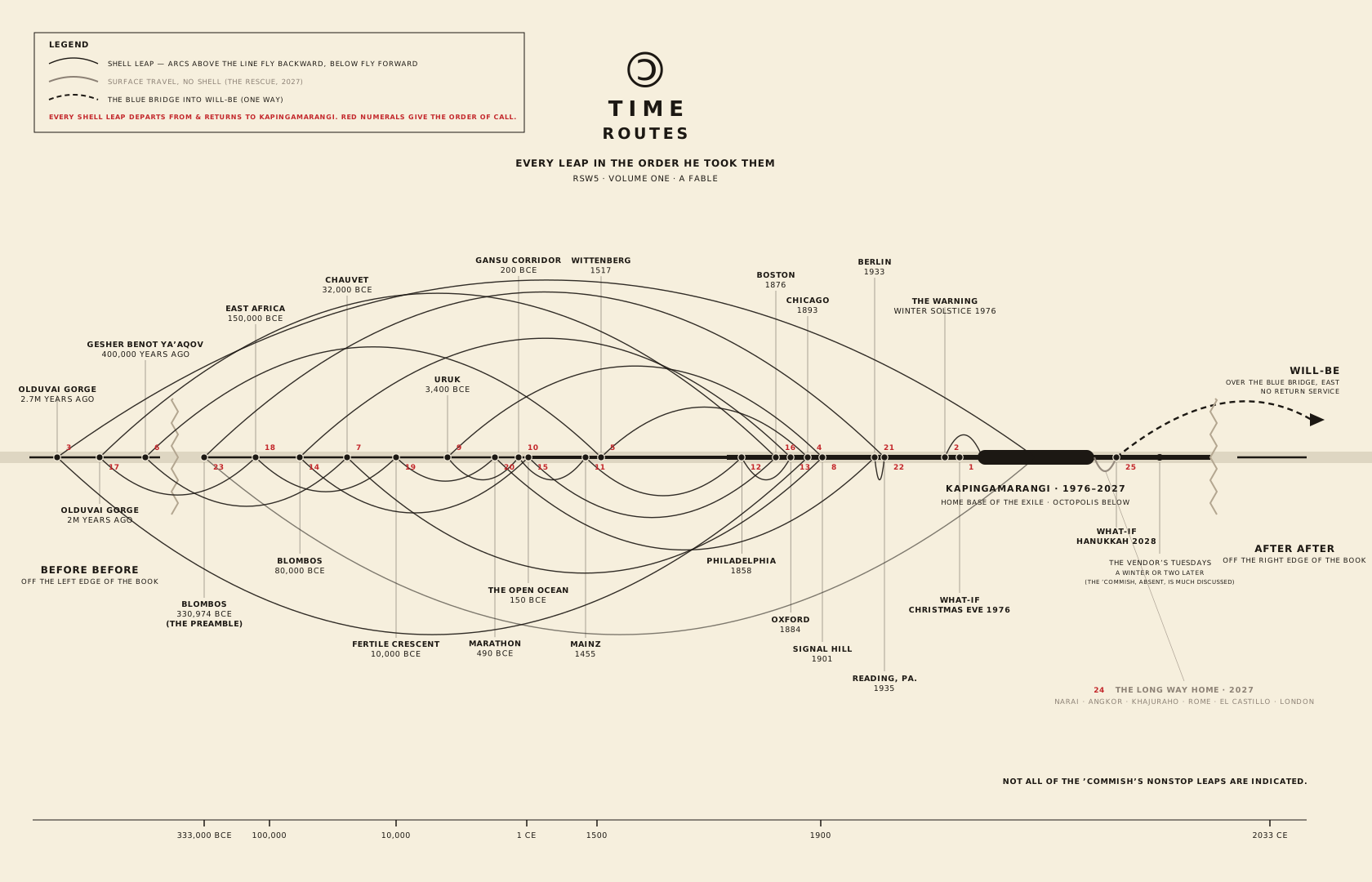
CCI Time Routes Diagram
Where you are
Volume 1, Chapter 1, Part 1
Story Arc
Once upon a time, a self-appointed question-asker made an enemy of the most powerful man in town.
Every day, he ate lunch at the same pretzel cart, and over the years the Pretzel Vendor became his closest friend.
And then one day, he was taken at night, nailed into a packing crate, and parachuted onto a tiny Pacific atoll. The Vendor saw it happen, so they locked him in a closet to keep him quiet.
The island turned out to be inhabited: by octopuses, squid, and cuttlefish. They took him in and gave him their one tool. It is a small shell that carries its holder back to any day already past, to watch but never to change.
And ever since, he has been learning to use the shell, planning to reach the friend in the closet and tell him to hold on.
A Fable · Volume 1 · Chapter 1 · Part 1
City of What-If in the Land of Could-Be
Christmas Eve, 1976
The morning of the day this book has been trying to get to began with a meeting.
It was a planning commission hearing, in the big cold room at What-If City Hall where the city fathers sat in a row under portraits of earlier city fathers, on the morning of Christmas Eve, 1976, with the garlands already up & half the room wishing it were elsewhere. The Mayor’s Aide took the minutes. He took them the way he did everything, worriedly.
The expert witness that morning was Doctor Indelible, tenured professor of urban planning at Could-Be U & the City of What-If’s head planner, two jobs & one opinion, & the opinion was up on an easel for everyone to see: beautiful drawings — the narrator will not pretend otherwise — of the last unpaved reach of the river.
Because the riverfront, you may as well know now, was already gone. That fight had been fought some years back, & lost outright & in daylight, & the tide poured full of concrete, & the trucks given the run of the place where the gulls had been. What remained was the upstream reach: the last of the open water, the bend where the herons still stood around like unemployed committee members. The Doctor’s drawings called what came next finishing the river. Ten more lanes of found right-of-way. Culverts. Completion. The city fathers nodded along, because the drawings were beautiful & because nodding is warm exercise in a cold room.
The ’Commish was in the room. He was always in the room; attending things nobody made him attend was most of what the job was. He sat through the whole presentation without a sound, which the Mayor’s Aide noted in the minutes as unusual, & when the city fathers asked, the way you ask at the end of a meeting everyone wants out of, whether there were questions, he raised one finger.
One question. About the word finishing, he said. You finish a meal. You also finish a wounded animal. Before we vote, I’d like the record to show which finishing is on the agenda this morning.
Nobody answered him. The Mayor’s Aide wrote it down, & then stopped writing, & looked at what he had written.
The vote did not happen. Votes have a way of not happening once a room has heard itself think; the matter was tabled to January, out of respect for the holidays, the chairman said, & everybody filed out past the beautiful drawings.
On his way out the ’Commish stopped in front of them & studied them a long moment, & then said to the Doctor the worst thing anybody said to him that year, which was: These are wonderfully drawn, & meant it, because he was incapable of not meaning things. Then he went out into the morning to find the rest of his day.
Whether the morning’s business & the evening’s business were the same business, the narrator has opinions & no proof, & this is a fable, not a deposition. All the narrator will swear to is the order of events: the question was asked in the morning, the vote was moved to January, & the van came that night.
It was, though nobody had told him so & he would not have believed them, the last hour of the ’Commish’s last day in public office.
He did not believe in last days. He never carried a watch. He believed, on principle, that the important thing was always about to happen, & on this one occasion the principle was exactly right & gave him no warning at all.
There was a cart in the alley behind City Hall. On the lid of the cart hung two short strings of brass bells that rang whenever the lid came up, which was often, because it was cold & the steam wanted out.
Behind the cart stood the Pretzel Vendor, parked in that exact spot for longer than either of them cared to count, who had stopped charging the ’Commish years ago on the theory that a man who pays you only in conversation is an interlocutor who, if the pretzels are good, will rarely if ever interrupt you.
The bells rang. A pretzel came up out of the steam. The Vendor laid a stripe of mustard down it without being asked, folded it into a square of waxed paper with a napkin underneath, & handed the whole warm business across.
The ’Commish took it the way he took everything, mid-sentence.
He got the mustard on his thumb & half the pretzel into himself in the first three bites & was working on a thought about the lights, about how a city lights the longest nights precisely because the light is the thing that is losing, which is a thought you have already heard him have, because he had it for 55 years afterward & it started here, with his mouth full, in an alley, three nights past the shortest day of his last year home.
Then — & the narrator is sorry, because it was a good pretzel & a better conversation — then a van came up the alley with its lights off, & kept them off, & rolled to a stop with the particular politeness of a thing that does not want to be remembered.
There was no plate on the front of it & no writing on its sides: nothing to read at all, which the ’Commish noticed, because noticing was the one thing he could not switch off, not even then. A van with nothing to say has generally thought hard about what saying anything would cost.
The men who got out of it were not interested in being noticed.
They were Doctor Indelible’s, though the ’Commish did not yet have the Doctor’s name to hang on them; they moved like men who had been told exactly one thing to do & nothing about why, & they did it.
They took the ’Commish by both arms while the rest of the pretzel was still in his hand. His term in office & his snack ended in the same motion. The waxed paper went one way. The half he had not eaten went the other, onto the cold pavement, mustard-side up. The napkin went down beside it.
Those two things would not stay long on the cold pavement. They would go into the dark with the one man who thought to keep them, & wait there 55 years, & come back into this story at the end of it wearing lab coats & calling themselves evidence. Hold onto the pretzel & the napkin. They are how anyone ever proved he was real.
There was the small matter of the witness.
The Pretzel Vendor had seen the whole of it from behind his own steam: the dark van, the dead lights, the men, the arms.
He was, in that instant, the single living record that the Commissioner of Curiosity & Imagination had ever stood in that alley at all, which made him, to the men from the van, a problem with a simple shape.
What the Vendor did, in the few seconds before they reached him, was stoop & take up off the pavement the half the ’Commish had not finished, & the mustard napkin beside it, & shut them in his fist; because a pretzel vendor does not leave a pretzel on the ground, & because it was the last warm thing his friend had touched, & either reason would have done.
There was a third reason, but it belongs three days back, & the narrator is not allowed there yet.
The men did not think to take them off him. They were a snack. You do not confiscate a snack.
What the Vendor did not do, in any of this, was look surprised; & nobody thought to wonder why, that night or for fifty years after.
The Doctor’s goons did not hurt him. The narrator will give them that much & not one inch more.
They walked him, & his banged-up cart, & his bells, the short distance to a janitor’s closet built into the back wall of City Hall, & they put all of it inside, the man & the cart & the half-pretzel shut in his fist & the cooling smell of mustard, & they shut the door, & then the biggest of the goons did the thing that turns a shut door into a sealed one: he took the handle in both hands & wrenched until it broke away, & after that the door had nothing left to be opened by.
Then the van pulled away with its lights still off, & the alley was empty. If there was a sound left in it, no person could have heard it: two strings of brass bells behind a sealed door, still swinging a little, ringing smaller & smaller in the dark, too muffled now for any ear but a dog’s, or a bat’s; ringing for a customer who was no longer there, & for a city that had already begun, that very night, to forget it had ever had him.
The forgetting was nobody’s plot, & the Doctor gets no credit for it. It was the ordinary disease of familiarity, which numbs a body to whatever is always there; & the ’Commish had been always there, & then he wasn’t, & the numbness closed over the spot before anyone thought to press on it.
That is where it would have ended. A man in a closet runs out of the three things the law of threes allots him, & the City of What-If goes quietly back to getting MORE of what it already had too much of.
Nobody in What-If seemed to notice the resumption of MORE. The city’s noticer-in-chief had been nailed into a packing crate & parachuted onto a desert island, & his one aide-de-camp, the man with the bells & the mustard, had been rendered seemingly & similarly unavailable by the despicable Doctor.
The crate came down under its parachute on Kapingamarangi, an atoll in the Federated States of Micronesia so small & so far that a man could be left on it the way you leave a thing you mean to lose. The landing loosened the nails, & the ’Commish let himself out & stood up on the wet sand. Whether he came out talking, or singing, or simply applauding the parachute, the accounts differ, & he never cared to settle them.
Reef, lagoon, coconut palm, & a sky with far too much room in it, & not one person to interrupt.
So he interrupted the octopuses.
They were hunting the tide pools when he wandered down, & he sat at the edge of the water & started talking to them, because talking to whoever was nearest was the only trade he ever had.
& the octopuses, & the squid, & the cuttlefish who kept their company, talked back, in chrome & copper & the slow furl of an arm, & the conversation got better by the hour, until it was the best of his life.
Which began to break his heart.
Because a cuttlefish lives a year, an octopus not much longer. But a hominin goes on & on like suction cups down a tentacle; so that a man who loves these creatures has signed on to bury them, & their children, & their children’s children, while he sits on the sand not aging fast enough to be any use about it.
He tried to have the talk with them: about finitude, about how he would still be there cracking coconuts & labeling all their little beaks long after they were gone; & he did not get far, being, the narrator must report, openly in tears, which the octopuses found interesting, having none of their own to spend.
The octopuses were not sentimental. A creature that lays a hundred thousand eggs & dies before they hatch cannot afford the practice. But they kept accounts, & they could see that what he was spending on them — the tears, the talk, the whole concernful sadness of him — was real spending, at real cost, & they found it strangely compelling. So they settled the account in the one coin they had.
That is when his friends showed him the one tool they owned.
It looked like an ordinary seashell. They called it ora gai oti, a name you cannot say right without first putting ora gai oti in your mouth; & when you speak the words with it between your teeth you go to any place & any yesterday you can picture, & when you speak them backward, ito iag aro, you come home.
It was how the cephalopods of Kapingamarangi had been living as long as they pleased for longer than anyone had thought to count.
Two rules rode with the shell, & the narrator will say them once & stop explaining, because the octopuses never explained anything. It goes only backward; the one direction it will not carry a body is the direction everybody asks about first.
& it visits; it does not edit. What happened, happened. The shell will set you down inside of it, warm & particular & real enough to smell the mustard, but it will not let you move one stone of it. Whatever you do back there turns out to have been part of the story all along, which is either a comfort or a horror depending on the day, & the ’Commish, across 55 years, took it as both.
But the showing was not a handing-over. It could not have been. An octopus has no hands to hand a thing over with; an octopus has eight arms & some sixteen hundred suction cups, & nothing in that entire inventory has ever handed anything off in its life. Suction is a commitment. Letting go is the part they never learned. What an octopus does instead is let you watch the thing being used until your wanting it & your understanding it arrive at the same moment, which is, so far as the narrator has ever been able to confirm, the entire octopus theory of a fair trade.
So before the shell went into the ’Commish’s hand, they took him to the city.
He had not known there was a city. Hominin science would not know for decades yet, & when it finally found one very like it (off the coast of a continent the octopuses decline to name) it would call the place Octopolis, & publish papers expressing surprise that the famous loners of the sea had gone & built themselves a town. The octopuses of Kapingamarangi have read the papers. Do not ask the narrator how. They were not surprised. Surprise, as has been said, is not a thing they spend.
Their own Octopolis sat down the lagoon side of the reef, in water so clear the ’Commish could lie face-down on the surface & see the whole of it: streets of shell, dens of shell, walls & doorsteps & middens of shell, a municipality paved & roofed with the empties of ten thousand years of dinners. A city built entirely out of what its citizens had finished with. He wept a little into the lagoon about that, where it did not show, & the lagoon held him up anyway.
Then — & this was the thing they had brought him to see — two octopuses came out of two doorways & met in the middle of the street & began the mingle.
They braided arms first. Not all eight & eight at once; two & two, then more, the way you & a friend might start with a handshake & forget to stop. Then the colors began. One ran a weather of chrome & the other watched it, & then the other ran the same weather back, but corrected, the way you repeat a stranger’s name to be sure you have it. Then stripes. Then a slow copper thing like a sunset being agreed upon. Each one wearing the other’s patterns, trading skins, running each other’s storms, faster & faster, until the weather on the two of them was one weather & you could no longer say whose storm it had been first.
It looked, from the surface, like an argument being lost by both sides.
It looked like a conversation being won by both sides, said the ’Commish, who was after all floating right there, & who has never once let the narrator get away with anything.
It looked like a conversation being won by both sides.
& when the weather agreed — & the octopuses know the moment it agrees, & will not be hurried to it, & the narrator has heard of mingles called off at the last color with no hard feelings on either skin — when the weather agreed, they were, for the purposes of what came next, one animal wearing two skins. That is the mingle. It is not the journey. It is the part the octopuses hold matters more than the journey: the part where you make sure of each other.
What came next took a minute & lasted, the narrator is given to understand, a good deal longer than that.
One of the two took up a shell, ora gai oti, out of a doorstep of ordinary shells where no hominin eye could ever have picked it. & the other turned & walked home down the street on all eights, & went into its den, & pulled the door to. & then the neighbors came out, & this is the detail the ’Commish made the narrator promise to keep: the neighbors piled shells over the door. Gently. Two or three apiece, the way you might bring covered dishes. They piled the door shut until the den was a hill, & then one of them settled down on top of the hill & sat.
Because when two who have mingled make the meld, & one of them leaps, the mind of the other forks. Most of it goes along on the journey. What stays behind is just enough to keep the heart going & the colors gray: a house with the lamps lit & nobody home. & the sea is full of things that check houses for exactly that. So the body of the one who goes along without going must be kept someplace safe. Not hidden: kept. Tended. Sat upon by a neighbor. It is the whole of the arrangement, & the octopuses regard it as the plainest good sense, & they are right.
The traveler put the shell in its beak & was gone. The gray one lay in the dark under the dish-shells, dim & slow, its one visible arm the color of a cloudy day.
& then the traveler was back, between one wave & the next, the way the shell does it, & the neighbors took the hill down shell by shell, & the door opened, & the gray one came out, & the gray went out of it like morning coming into a room. & the two of them stood in the street & ran the whole weather once through, backward, which is how you say thank you in that city, & went in to their suppers.
The ’Commish came up for air. He had been coming up for air all along, the narrator supposes, but this was the first one anybody heard.
He had questions. Of course he had questions; he was himself.
Do they have to be near each other, he asked. The two. The same water?
No, they told him, in copper. Distance is a land idea. The water is all one room.
Could you carry me? he asked. Could I carry you?
& here the colors went kind & went firm at the same time, the particular shade of a friend saying no. Like carries like, they told him. Octopus with octopus. Cuttlefish with cuttlefish; & the cuttlefish confirmed this with a chrome flare from the margins, where they had been watching the demonstration like family at a wedding. Squid with squid. The mingle must run on the same skin, & the meld goes only where the mingle has been. There is no exception. The oldest of them ran a brief brown pattern that the ’Commish understood to be the story of somebody, long ago, who had tried, & the pattern ended, & nobody ran it again.
So: hominin with hominin, & no other way.
& the ’Commish floated on his back in the lagoon of Kapingamarangi & did the arithmetic that you, reader, have already done. His species does not mingle in chrome. His species mingles in talk, & the mingle, done properly, takes about thirty years & a great deal of mustard. There was exactly one person alive whose weather already agreed with his; & the men in the van had already walked that person into a den, & pulled the door to, & piled the whole of City Hall on top of it like a neighbor on a hill, & wrenched off the handle, & thought — the narrator wants this said while the city of shells is still in view — thought they were winning.
Without his having to ask — & the not-having-to-ask was the better half of the gift — they pressed one into his hand, & in no time at all he was doing as they did.
He noticed two things & asked after neither, which for him was a kind of miracle. The first: every time he came home from a leap he looked, to the ones who had stayed behind, as if he had been to the barber, or the dentist, or somewhere with warm towels; as if the shell rolled a man’s clock back a little each time it carried him.
The second: ora gai oti fit a cephalopod beak exactly, the way a key fits the one lock it was filed for. Octopus pockets, he said, delighted, & held the shell up to the late sun, & decided, for once in his interrupting life, to let a question alone.
On the evening of the demonstration he had looked west a long time, toward where the closet was, half the world & 55 years away, & said, to a man who could not hear him yet: Hold on. I am going to learn to drive this thing.
He drove it alone for years before he would risk a passenger. But that is ahead of the story, & the narrator has already said too much about the closet.
What he chose to do with the very first trip it ever bought him is the next part, & it is the kindest thing in this whole book.
Where you are
Volume 1, Chapter 2, Part 2
Nonfiction · Volume 1 · Chapter 2 · Part 2 · Comparison
Richard Saul Wurman · AIGA Journal of Graphic Design · Vol. 6, No. 2 · pp. 1, 16 · 1988
Twenty-six years ago I produced a book called Cities: A Comparison of Form and Scale, a very simple, single-idea publication. Out of white plasticine, my students and I modeled cities and towns of the world — contemporary and historic — all on the same scale.
We photographed them from above and put them into a big book so that one could see relationships between scale and size. The clarity and strength that came from this exercise far exceeded my expectations. This visual comparison of the cities of the world taught me that you only understand something relative to what you already understand.
In the next few years, there will be a transition from beauty-driven to information-driven graphics. It is a mistake to think that every graph or chart, such as those in the many re-designed American newspapers, represents information because they don’t.
We are surrounded by all these things that look like information is supposed to look, but do not inform nor are they expressed in the appropriate form.
It is easy to look at information, but information is frequently not so easy to understand. The prime task of graphic designers, and indeed, of writers, too, is to understandably communicate. Even a simple idea made clear has tremendous power.
As designers, our task is difficult because of the prevailing idea that information graphics is anything that looks like information, rather than that which truly informs. Take the word information and see that the word inform is its root. And take the word inform and see that the word form is its root.
If things don’t inform, I would say that they are not information although they may look like information.
USA Today’s weather map meets all the popular criteria of informational graphics and yet it is a bad map. It looks the way we were taught that information should look. It has three dimensions and multi-colors (where they are not needed), and it is full of numbers (redundant information).
What it wants to be is a comparative map that informs, and to be so, it must represent not only temperature, but comparative human comfort.
Ninety degrees in New York City is not 90 degrees in Phoenix and therefore cannot be on the same contour. Taking other factors into account — wind chill or humidity, as well as temperature — a weather map could reflect relative levels of comfort around the country.
But we have been conditioned to accept faulty and inadequate information because nothing better is at hand.
Information made understandable and allowed to perform becomes handsome, particularly when its primary purpose is not beauty. I have a great belief in the value of graphics that perform well — not only function, but perform.
It is really silly to have the job of making things understandable as a specialty. It should be the rule, not the option.
But many designers who do not specialize are seduced only by aesthetic beauty.
So, a number of otherwise workable maps have been gussied up with cliff-like shore lines (making them three-dimensional), shadowed roads, and misused color.
By floating them in space, putting them on angles, and using other conventional devices, they say, “I don’t inform, but I am so friendly and stylish that it is okay to look at me.” This gets in the way of understanding.
Two years ago, the AIGA held a competition called “Functional Graphics,” a misleading title at best. Judgments were based not on performance but on appearance; entries were O.K. if they looked the part. I am not faulting the jury because I do not know how we would evaluate the performance of “functional” graphics in the given time, but if that show couldn’t set the standard, what can we expect from others?
My interest in function comes from my background as an architect. In the past, an antiseptic way of describing architecture was “form follows function.” To me, function is something basic, like digestion, but performance is like the interpretation of Shakespeare; it is the art of satisfying a need.
Function is a basic requirement, and it doesn’t require artfulness.
It is a word that has to do with something being adequate; it is a basic term. That is why I take exception to the title of the competition. To appreciate it, one must elevate it to an art form, and then it becomes the art of information, not the function of information. The term “functional graphics” is a put-down.
The end result of functionalism as an aesthetic from the 1920’s wound up in the architecture of the Centre Pompidou in Paris. It expresses the way one would fantasize a building to function. It is like a Hollywood model of the way a Donald Duck building would perform. But a building doesn’t function that way, and the architecture of the Centre Pompidou is patently dishonest. I can understand the seduction of doing that. I can see in my own work the error of trying to make things look more informative than they are: in making presentations so that some piece of information will be taken more seriously.
What interests me is more elusive than theories and rules.
It is trying to figure out the morphology, the structure, of a body of data; trying to discover the organizing principles so that I can navigate my path through it; so that I can allow others to find their own paths, so that the relationships within it are not prescribed, but occur in the mind of the person using it.
It all sounds a bit mystical but it is really no more than following personal interests rather than the rule book.
I am particularly interested in the idea of indices and tables of contents, and how they work as an outline which invites readers to put the contents and connections together in their own head and draw their own conclusions.
This might be called a tinker-toy approach: the little pieces fit together. That was my approach with ACCESS guides and in the redesign of the Pacific Bell SMART Yellow Pages — to apply the guiding principles of time, the fundamental issues of proximity, or spatial relationships as a focus on subject matter driven by interest, location, connections, tasks, and time of day. The result is accessibility to information.
We all seem to suffer from the phenomenon I call information anxiety. It springs from several false notions, such as it is better to say “I know” than “I don’t know,” “answering a question is better than asking one,” or “you learn from success.”
Good questions lead to good answers. In asking the question, you learn. When you answer the question and have already found the answer, there is no growth. One learns by examining what doesn’t work. One learns from failure.
Learning is remembering what you are interested in.
My father told me, “Don’t learn what is in the Encyclopedia Britannica, learn how to use it.” The idea that the fashioning of an educated person can be accomplished by knowing 1,000 or 10,000 facts is absurd.
The following story is therefore apropos: Let’s say I contact Avanti, a company that makes life-like stuffed animals, and ask them to make a set of 260 full-sized stuffed dogs. I ask them to make a male and a female of each breed accepted into the American Kennel Club. When they arrive, I have this extraordinary bevy of stuffed dogs. I stand them on a large floor facing every which way, and I say to the people standing there, “You organize them smallest to largest; the tallest to shortest; by popularity in the U.S.; by actual population; by when they were accepted into the American Kennel Club; by length of tail,” etc., etc.
At the same time, we tie ribbons around their necks, colored according to which of the six different major categories the dog belongs to: sporting dogs, hounds, working dogs, terriers, toys, and non-sporting, so that as they are arranged in various groups, I can also see what classification of dog they are. We add ribbons made of flags from the countries of origin.
Why is this such a revealing story? Because every time the dogs are arranged in a different way, I start seeing new information created by relationships independent of the subject of the arrangement.
I can see that the most popular dogs are perhaps big dogs, or which dogs came most recently into the club, or how few of the little dogs have ever been champions. I am able to see relationships that are independent of each of the rather arbitrary organizations of those 260 animals.
The creative organization of information creates new information. The dogs never change.
There are only three businesses that have to do with communication: the transmission business (telephone, television, the delivery of data); the storage business (which is experiencing an exploding technology of data compression such as laser disc technology, CDROM, CDi, and CD video); and the understanding business. The transmission business represents a river of data, and the storage business is like a reservoir that the river flows into.
Yet this reservoir is held back by a huge dam and very little understanding is getting through. Enter the understanding business. There’s no corporation in the understanding business. Writers, even good writers, serve the twin gods of accuracy and style — not understanding; graphic designers serve the single god of looking good.
We are drowning in data. This has resulted from the combination of slightly better transmission and enormously better storage, and is exacerbated by the lack of attention from any profession, field, corporation, business, government, organization, or institution on understanding that data.
So, while we have data being transmitted slightly more efficiently and being stored enormously more efficiently, there is not an increased level of understanding coming out of that mix.
The understanding business, brought about by this extreme situation, is going to be born out of necessity; out of the black hole of American corporations and businesses. Until now, it hasn’t existed, but in the next five to ten years it will exist in a big way. And there are just two reasons why. People have finally started to recognize this incredible backed-up volume of stuff, in incomprehensible form, that has to be dealt with somehow, and, secondly, there is a lot of money to be made in understanding.
Where you are
Volume 1, Chapter 1, Part 5
Story Arc
Once upon a time, a returned exile walked into the sold-out DUM conference, where the Last Word, the machine that is never wrong, was about to be crowned.
Every day, the city had been trading in its questions for answers, and calling this progress.
And then one day, he beat the perfect machine with a fruitful mistake, a pencil eraser and two words: not yet.
Until finally, once again offered the keys to the city, he refused — outlawing his own statue in the process, and leaving behind a cardboard box and one good question instead.
A Fable · Volume 1 · Chapter 1 · Part 5
City of What-If in the Land of Could-Be
Hanukkah, 2028
It had been a year & change since the graduate students & the pretzel vendor brought the ’Commish back home.
What-If had not been idle in his absence, & it had not gone quiet since his return. The Commission of Curiosity & Imagination was rebooted, though you would not find its one employee behind his desk at City Hall; you would find him anywhere but. Out roaming the streets of What-If, looking for people to interrupt.
The Urban Observatory was lit again too; that had been the first errand of the return year, before the unpacking. & it came back the way it had first come, not by decree but by crowd: the graduate students swept out the boarded-up hall, the maps went back up, the drums turned, & inside a month the What-Ifians were once more walking in off the street to see their city plainly, & wondering aloud how they had ever been talked into doing without it. The Doctor’s riverfront was on display in there now, at scale, under a small card that said only: approved while the lights were out.
The first person he interrupted was Will Bittaker, keeper of the Architectural Archives at Could-Be U, who looked up from his ledger to find the ’Commish emptying his pockets onto the reading-room desk.
A shell. A fist of napkins, folded soft & never reread. A saucer-sized photograph of a single red dot. A pretzel gone to stone.
For the collection, the ’Commish said. Accession them. Every one. Today, with a date & a number & my name spelled right.
Bittaker, who knew exactly whose name that was (& who had spent a quiet decade helping the Doctor’s people see to it that the name turned up in fewer & fewer places), said nothing, & reached for a pen.
Objects are stubborn, the ’Commish said, mostly to himself, as the shell went into its grey acid-free box. Harder to disappear than a sentence. Maybe this makes me a little harder to erase next time.
He did not say which next time. Bittaker did not ask.
But somewhere in his 55 years away the city had fallen in love, & it had fallen in love with a machine.
Doctor Indelible, Ph.D., had built a thing that only & always gave the correct answer, & he called it the Last Word. You asked it anything & it answered at once, correctly, in an ink that could not be lifted or erased.
He had not built it from nothing. Down in the basement of Could-Be U there had lived, since before the exile, a room-sized machine the head librarian had been forced to invent for one purpose: keeping track of the ’Commish. Every clipping, every proclamation, every corner of the city the man had turned up in & interrupted somebody — it all went in, & she called the machine ENIAC, & it never once predicted where he would turn up next, which she considered its finest feature & proof that it was paying attention.
The year after the van, with nothing left in the city for it to keep track of, the Doctor bought it for scrap. He spent the next fifty years teaching it to stop being surprised. That is the entire recipe for a Last Word: take a machine that was built to follow a question around, & starve it of the question.
The city could not get enough, which was the whole of the trouble, & the ’Commish knew the trouble’s name, because a tired Pope had pressed it into his hand in a bakery line outside Rome: there is an enslavement to MORE, & the master is a word, & now the master had a body & a maintenance contract.
The reckoning got scheduled (because everything in What-If gets scheduled now) for the DUM conference.
It had been a different conference once, wearing the same three letters in the opposite order. The ’Commish had started it himself, back before the exile, & named it MUD — Mankind’s Understanding Deployed — the three days each winter that bracket the solstice — the day before, the day of, & the day after — when the brightest people alive came to What-If to aim everything mankind understood at everything it didn’t, yet. A celebration of the not-yet-understood. You stood up at MUD to say what you didn’t know, out loud & on purpose, & the joke of the name was the whole admission fee: the brightest people alive, flocking to a thing called MUD.
The Doctor did not steal it & did not buy it. With the ’Commish gone there was nothing to take; there was only a name lying in the road. He turned it around. MUD became DUM — Don’t Undo Me — which is the nearest thing to a prayer the Doctor ever wrote, & the conference became its own opposite: the same three days each winter — the Doctor never once moved it off the solstice — when the brightest people alive came to What-If to close the case. Field after field, a speaker walked to the podium, crowed about what was already understood, drove it to an indelible answer to that field’s questions, & sat down to the applause. What was settled was celebrated. What was not yet understood was not on the program. Same stage. Same letters, walking backward.
The building itself, to its credit, refused to lie. It had been designed by Gary Frank (Frank, to the one man in the hall who had loved him for 55 years), & it did the thing Frank’s buildings do: leaning & folding & throwing the afternoon around like something poured while laughing that set before anyone could tell it to behave.
A usefully wrong building. Not one of its walls stood where the drawings had promised. Hold onto that. It comes back.
The house was sold out. The Doctor took the stage in a suit with no wrinkle in it & no future in it either, & he made the Last Word sing: capitals, coastlines, the melting point of tin, the gross figures of nations, the day & the hour each person in row F would die.
Every answer climbed the great screen behind him & set there in that indelible ink.
“This,” said the Doctor, “is the end of the question.” & the crowd, which was tired, which was so very tired of not knowing things, let out one long breath together.
“No more wondering. No more being wrong. No more of the old man’s maybe. I give you the answer: all of them, forever, & none of them erasable.” He found the ’Commish in the front row the way you find a hair in your soup. “Unless our Commissioner of Curiosity has thought of a question my machine cannot answer.”
The ’Commish stood up slowly, palm-frond scarf trailing him, & the narrator wants it on the record that he did not look like a man with a trick.
He looked old, & a little damp, & exactly like someone who has sold his ignorance for a living & made rent.
I haven’t got one, he said; a question it can’t answer. That was never the problem with it. Ask it anything. It’ll be right every time.
It put me in mind of a fellow I dropped in on once, a long way back & a long way east.
The ’Commish had once walked, he told them, a stretch of road in old Attica, where an innkeeper named Procrustes kept a famous iron bed & made every passing traveler the same famous promise: that the bed fit its guest perfectly, every time, without a single exception.
& it did. It fit every last one of them. If the guest came up short, Procrustes kept a rack, & he stretched the man until his feet reached the rail. If the guest ran long, Procrustes kept an axe, & he took off whatever hung past the end. Either way, you fit the bed exactly. Nobody who ever lay down in that inn failed to fit the bed.
He let that sit.
That is the Doctor’s machine. That is what a thing that is never wrong actually is. It does not fit its answer to the world; it fits the world to its answer, & it keeps a rack & an axe for the parts that fall short or won’t stop. Ask it anything & you will fit the bed perfectly. The only question worth asking in old Attica is the one no guest ever thought to ask in time: what did you cut off me to make me fit?
He turned to the hall. Somebody up there. A real one. Not a capital or a coastline. Something that’s actually keeping you up.
A long pause, & then a woman near the back stood & said her question, which was that she had got herself turned around in a grief she could not find the edges of & did not, anymore, know the way home.
The Doctor’s machine answered instantly. It gave her coordinates: her exact latitude & longitude, correct to the centimetre, the true compass bearing of her front door, the distance in metres. Every number was right. The machine set it in permanent ink.
The woman stood holding the perfect truth & looked more lost than before she had asked.
May I, the ’Commish said, not really a question. Go down to the river. Keep it on your right. Walk until the bridges start to feel like yours again, & one of them will be, & you’ll be home before you’ve worked out how.
He shrugged. Probably the wrong way. Longer, for certain. The machine’s route is shorter & truer & I would not wish it on you. I gave you one true thing to hold, the river, & lied about the rest, so you’d trust me enough to start walking. That’s a map. The other thing is a fact with your address on it.
The woman was already moving up the aisle toward the doors. The room watched her go & felt, all at once, the difference between an answer & a help.
Mo stood next, & she did not have a question. She had a receipt. She named her department out loud — comparative religion, ruled counterfactual by the thing on the stage & struck from the course catalogue at Could-Be U, most of her degree still in her hands with nowhere to put it — & she asked the machine, evenly, whether the ruling stood.
The ruling stood. Invented, the machine said. Unfounded. Contrary to the record. Every word of it correct, & the ink already set.
Watch what it just did, the ’Commish said, & he was not smiling now. She asked it about true & it answered her about factual, & it cannot hear the canyon between the two words. Every story in her syllabus was made up. So is the map in your pocket. So is this city’s name. A made-up thing is false the way a map is false: on purpose, to carry you somewhere you could not have gotten dragging the whole territory behind you. A machine that cannot tell a lie from a lie-that-carries-you has no business grading anybody’s gods.
Mo wrote nothing down. She had been carrying that sentence for two years; she had only needed to hear it said where the machine could hear it too.
The Doctor said the machine was never wrong, & that wrong was wrong, & that the old man had simply lied.
I did, the ’Commish agreed cheerfully. Usefully. Which your machine cannot do, because it cannot do the other thing either. & here he reached into his pocket & took out, of all the weapons in the world, a small pink eraser, worn round at one corner.
The Doctor actually stepped back. He had spent a lifetime in staples & nails & inks that would not wash out, & the eraser was the one object on earth built to insult him.
The ’Commish walked to the great screen, reached up to the line that gave the hour of a stranger’s death, & rubbed. The supposedly-permanent ink came away under the eraser the way everything comes away in the end, & where the answer had been there was a soft grey smudge.
& the ’Commish took a pencil & wrote two words over top of the smudge: not yet.
An answer you can’t erase is an answer that can’t be wrong, he said, & an answer that can’t be wrong can never learn that it was, & a thing that can’t learn is already dead, no matter how loud it is. Your machine has reached every answer there is. It has arrived. It has nowhere left to go. That isn’t wisdom. That’s a destination, & the name of that destination is the plainest fact there is: all roads lead to death.
He let the room sit in it.
All roads lead there, if you let the asking stop. Lights on. Nobody home. The Doctor built you a temple to it & charged you admission & called the admission MORE.
He set the eraser on the lip of the stage.
Ask it what we should want, he said. Go on. Not what is. What we should want. What comes next. What’s worth the trouble.
The Doctor, who could not help himself, asked. The machine answered at once, confident, exact, indelible. & the ’Commish reached up & erased that too.
No. That’s a guess in a uniform. The only honest answer to what comes next is YET: we don’t know yet, & the not-knowing-yet is the whole engine of being alive. Your machine cannot say yet. It must answer now, & forever, & in ink. Mine is one word & a worn eraser, & it can afford to wait, because it knows there is no last word. There never was. That’s the good news. You’ve been sold the one lie the universe doesn’t stock.
It should have been a triumph, & for a minute it was. The Doctor stood unplugged at his own podium with nothing left to say that wasn’t already behind him on a screen, going grey.
& then the hall did the thing the ’Commish had been dreading the whole long walk up the aisle. It turned to him.
5,550 tired faces turned to the old damp man with the eraser & decided, all together & without a vote, that he would do: that they would lean on him now, ask him everything, that he could be the new Last Word, the kind one, the one who lies usefully & says yet & smells faintly of rum. Some of them began to stand.
No, he said, & it landed harder than anything the Doctor had managed all night. That is the same trap with a nicer face. The minute I let you lean on me, I set, like ink. I become the thing I just rubbed out. No. You don’t get an oracle today. You get a worse deal, & a better one.
There was, he said, one last piece of official business, & it would be the final act of the rebooted Commission of Curiosity & Imagination, which he meant to leave exactly as understaffed as he had found it.
Before I go, a law. Write it down, spell my name right. The Statute of Statue Limitations.
The narrator will stop a moment to admire it, because the ’Commish admired it, & a man is owed the enjoyment of his own joke on the way out the door. A statute is a law. A statue is a man held still in bronze so the weather & the pigeons can have him. & a statute of limitations is the quiet mercy by which the law agrees, after long enough, to stop holding your past against you; to let the thing lapse; to let you be forgotten. He wanted all three at once, & being the ’Commish, he took all three.
No statue of me. Not a bust, not a plaque, not a fountain, not a wing with my name cut in the lintel. Nothing in bronze, nothing in marble, nothing chosen for the one reason that it doesn’t change. You want to keep me, keep a pencil.
That morning he had stood in Will Bittaker’s archive making his small stubborn objects harder to lose. That night he meant to make himself easier to. There was no contradiction in it; he had simply never confused the things he had wondered at with the man who did the wondering. Keep the napkins. Keep the shell, the red dot, the pretzel gone to stone. Do not keep him.
There was a question he had carried his whole term & never settled, & the narrator has it on good authority he carried it over the blue bridge with him on his way out of town: whether performance purchases permission. Whether the only reason nobody ever clawed back the rights & responsibilities he had taken unto himself was that he kept being good enough at using them.
He did not know. He passed the law anyway, in case the answer was yes — so that when the performing stopped, there would be nothing standing around pretending the permission had been permanent.
A statue, he told them, was the Doctor’s own trick run slower & with worse maintenance: a person fixed in place, never wrong because never again let to move, an answer to the question of who he had been, cast so it could not be lifted. Doctor Indelible had wanted the Last Word in ink. A statue is the Last Word in bronze.
Set me in metal & I lose the one thing I beat your machine with tonight, which is the freedom to be wrong out loud & take it back. A thing that can’t change its mind is the deadest thing there is, however good the likeness. I told you already where every road ends. A statue is just getting there early, on purpose, & inviting the birds. I’d sooner walk.
So it passed, unopposed, there being no one left in the building with the standing to stop it, & being, like most of his laws, only the obvious thing said out loud & written down. In the City of What-If, by order of its last Commissioner of Curiosity & Imagination, no likeness of the ’Commish may be set in any material chosen for permanence, world without end. Keep him in pencil or do not keep him at all.
In place of the monument he had just outlawed, he had them bring up the box.
It was not much of a box: a single carton he had marked “MISC” in his own hand, which from a man who had organized information for a living was practically a joke. Everything else. Maybe. He left it behind, & what was inside it is the business of the last chapter of this book.
A few things in a box, he said, & one question. I’ll give you only the one, because one good question will outlast every brilliant answer in that machine, & you can carry it the rest of your lives & never use it up.
He told them the question. The narrator is not going to write it down here; it belongs to whoever is reading this, & anyway you already half know it, the way you half know the river is on your right.
The Pretzel Vendor was waiting at the back of the hall with a paper sack, warm, the real thing at last, 55 years late. They did not say much.
Maria stood near with her notebook, & he saw that on the open page she had written, in her careful hand, both numbers, & left the space between them, & in the space, lightly, in pencil, the word yet. He tapped the page once, approving, & did not correct a thing.
Then — there is one last then, & then the narrator will hand him over to the chapter that comes after — then he went out the doors Frank had hung slightly wrong on purpose, & did not go back to City Hall, & was, within the hour, gone from the City of What-If altogether.
How he went, & who was driving, & what waited on the far side of the old blue bridge (east, into the land of Will-Be he had been pointing at his whole life without once saying its name) belongs to the closing chapter of this book, & the narrator will not spend it here.
He will say only this: the man who had just beaten a machine in front of 5,550 people, & forbidden them to cast him in anything harder than memory, was content, for once, to climb into a sidecar & let a machine do the steering, because the whole point of where he was going was that it had not happened yet, & a route you can be sure of is only ever a route into the past.
Every road leads to the same place, & he knew it better than anyone, & had said so all night. He simply preferred the road that was still being built. This is what the dot knew when it set out on its walk.
He did not look back. He never looked back at the napkins either, & a person is a kind of napkin: the naming is the keeping. He had named it all, including, last of all, the one thing he had refused to let them name him.
Behind him, in a wrong & beautiful building, 5,550 people stood around a box, a question, & a worn pink eraser, & no statue, & nowhere to put one, & somewhere a machine that could not be wrong went on being right, all alone, in the dark, forever, which is the longest sentence in any language, & the loneliest, & is not, the ’Commish would want you to know, the same thing as being alive.
Nonfiction
Richard Saul Wurman · marginalia_md/049-the-ibm-selectric-as-institutional-signal.md
On the typewriter IBM put on sale on July 31, 1961, the letters did not hang on bars that swung up and struck the paper. They lived on a sphere the size of a golf ball, a chrome-plated plastic element 1⅜ inches (35 mm) across carrying 88 characters, which tilted and spun to bring each one to the page. The paper did not move either. On the typebar machines that had furnished offices since 1873 the platen carried the page under the keys and was thrown back by the right hand at the end of every line. On this one the platen stayed put, the sphere traveled along it, and the carriage return became a key like any other.
The hands noticed first. The touch was light, and the machine no longer lurched between lines. Typists who had managed 50 words a minute on a manual and 90 on an electric reported 120 and more. A champion typist IBM hired to tour the country typed at 150 words a minute with cups of water balanced on the backs of her hands. The machine itself could place a character every 20 milliseconds, 186 words a minute, a pace no person has sustained; it was built with that headroom so that it would never be the thing that waited. For the first time the limit was the fingers.
Eighty-eight characters was one alphabet. The point of the sphere was that it came off. Changing it took a few seconds, and for about $15 (some $150 in current dollars) a typist could keep two or three more in the drawer: Courier, drawn for IBM by Howard Kettler (1919 • 1999) in 1955; Prestige Elite, narrower, twelve characters to the inch; Letter Gothic, without serifs; Orator, large and all capitals, for speeches and for the overhead transparencies that preceded slides; Script, which imitated handwriting. A page could carry two faces, or italic words set into roman, which until then had required a print shop.
The smaller of the two models weighed 31 pounds (14 kg), listed at $395, and ran with a low, continuous motor hum under the strike of the keys. An American secretary of the period earned about $3,375 a year, so the machine on her desk represented roughly six weeks of her wages. It was hers in a way few office objects were. Service technicians recalled that the executive whose letters it produced did not touch it, and that a typist could tell when someone had, because the margin stops had moved.
The sphere was not the first shape tried. Horace Beattie (1909 • 1993) had patented a mushroom-shaped type element for an accounting machine, and Thomas Watson Jr. (1914 • 1993) is reported to have laughed at the drawing and asked whether Beattie had been drinking when he made it. The ball occurred to Beattie, by his own account, while he was changing a lightbulb at home in Lexington, Kentucky. A working prototype existed by 1954. Seven more years passed before Leon Palmer (1910 • 1995), who came to hold most of the patents, had the aiming mechanism, a linkage called a whiffletree, reliable enough to ship.
Eliot Noyes (1910 • 1977), whom Watson had retained to give the company a visual character to rival Olivetti’s, drew the housing. The brief in his office, as the designer who detailed the form later described it, was to express a machine with no carriage return: a closed, rounded body with nothing sliding out of it. It came in eight colors.
By 1986 some 13 million had been sold. The daisy-wheel and electronic machines that replaced the line were quieter and lighter still, and typists disliked both qualities enough that makers added a small magnet to knock against the frame at every keystroke, restoring a sound the mechanism no longer required. The hands kept what the machine had taught them longer than anyone kept the machine.
Where you are
Volume 1, Chapter 4, Part 4
Nonfiction · Volume 1 · Chapter 4 · Part 4 · What / How
A sculptor at work for an hour does not seem to be following instructions.
Her left hand turns the clay. Her right hand presses, pulls, withdraws, returns. The clay is becoming a face she did not entirely plan. Asked, later, what she had been thinking, she will say something modest: I was just figuring it out as I went. What she does not say, because she has been told her whole life that hands aren’t where thinking happens, is that her hands had been thinking the face into being. Her mind was watching them. The watching was the conversation.
The going story has the polarity reversed. The mind, on the going story, is the what: where the design originates. The hand is the how: the obedient instrument that carries the design out into matter. Ideas live in heads. Hands deliver them.
The arrangement runs the modern workplace. It assigns the engineer to design and the technician to build. It pays one more than the other. It tells the child who is good with her hands that office work is the better work.
The sculptor’s hour proves it false.
Begin where the hand began.
The hand that traces letters began by drawing pictures.
The hand that counts began by pointing at things.
Before writing, before arithmetic, the hand was already an instrument of meaning: grasping, indicating, shaping the air into significance.
The word instrument in that last sentence is already a small concession. It puts the hand in the how column and treats meaning as something the hand is mostly transporting.
The mudra traditions of South and Southeast Asia have a different view.
In the configuration of fingers and palms, these traditions found something worth pausing on: a gesture that is not a vehicle for meaning but is itself the meaning. A how that is also a what. A seal that does not stand for the thing but is the thing.
The Sanskrit word translates as seal or mark, and the term is precise in a way English speakers may miss.
When wax is pressed into the shape of a signet ring, the resulting impression is not a picture of the ring. It is not a description of the ring. It is the ring’s identity, made visible, made portable, made legally binding.
A mudra works the same way.
The gesture seals intention into form, stamps the invisible with visible shape, makes the unmeasurable measurable through the geometry of the body. The compassion of abhaya mudrā is not delivered by the gesture the way a letter delivers a message. The compassion lives in the gesture. They are the same event.
When an image of the Buddha depicts his right hand reaching downward, fingers extended toward the earth, the gesture carries a specific name and a specific meaning.
This is bhūmisparśa mudrā, the earth-touching seal, recalling the moment when Siddhartha Gautama (c. 563 BCE • 483 BCE) summoned the earth goddess as witness to his enlightenment.
When the palms press together at chest level, fingers pointing upward, the gesture is añjali mudrā, the universal greeting of reverence found across Hindu, Buddhist, and Jain traditions.
Each configuration of the hands constitutes a word in a vocabulary as precise as any alphabetic script, encoding concepts that verbal language approaches only with difficulty: compassion, fearlessness, the turning of the wheel of dharma, the union of wisdom and method.
The traditions don’t bother asking what the gesture really means, as if the meaning lived somewhere behind the fingers waiting to be unpacked. The gesture, they say, means itself.
The antiquity of mudras in South Asian practice is hard to establish with precision, but references in the Vedas suggest that hand gestures were employed to regulate stress, rhythm, and intonation in ritual chanting well before the common era.
Just as the alphabet emerged from the need to capture the ephemeral flow of speech in enduring marks, and just as numerical notation emerged from the need to fix fleeting quantities in stable symbols, mudras emerged from the need to embody transient states of consciousness in reproducible forms.
The meditator who arrives at a moment of insight wishes to come back. The gesture becomes a key: not to a state hidden behind a door, but a key that is itself the door, and the entering, and the room.
The elaboration of mudra systems in Buddhism appears to have developed alongside the emergence of Buddha images themselves, beginning in the Gandharan sculpture of the first century CE.
Before this period, Buddhist art represented the Buddha symbolically, through a bodhi tree, a wheel, an empty throne, rather than anthropomorphically.
The transition from symbol to figure posed a challenge: how to depict not just a historical person but a being who had transcended ordinary consciousness.
Mudras provided the answer.
The hands became signs of spiritual attainment, immediately recognizable to informed viewers, distinguishing one moment in the Buddha’s life from another, one aspect of enlightenment from another.
The body, having achieved liberation, now communicated that achievement through its posture.
The sculptors faced a representational problem and arrived at an ontological solution. They showed his hands in bhūmisparśa, and the gesture was the enlightenment, made present, made carvable, made transmissible through stone.
The what and the how folded into a single configuration of fingers.
The five principal mudras of Buddhist iconography correspond to the Five Dhyani Buddhas of the Mahayana tradition, each associated with a particular direction, element, color, and transformation of a human delusion into wisdom.
Dhyāna mudrā, the meditation gesture, presents both hands resting in the lap, right atop left, thumbs touching to form a triangle representing the Three Jewels: the Buddha, the Dharma, and the Sangha.
The triangle, empty at its center, suggests the void from which all form arises, the silence that underlies all sound.
Amitābha, the Buddha of Infinite Light, typically displays this gesture, and the posture is said to have been Siddhartha’s own as he meditated under the bodhi tree before achieving enlightenment.
The hands, in this configuration, do nothing. They simply are.
Their stillness speaks. The mudra traditions have been holding dhyāna for two and a half millennia, and the gesture has not run out of things to say.
Abhaya mudrā, the gesture of fearlessness, raises the right hand to shoulder height, palm outward, fingers upward.
The gesture predates Buddhism. An open, raised hand signals peaceful intentions in cultures worldwide, from ancient Rome to the contemporary courtroom.
In Buddhist iconography, the gesture commemorates the occasion when the Buddha calmed a rampaging elephant that had been intoxicated and set upon him by the jealous Devadatta.
The open palm becomes a seal of protection, an embodied promise that no harm will come.
Vitarka mudrā, the gesture of discussion or instruction, brings the thumb and forefinger together in a circle while the remaining fingers extend upward.
This configuration represents the turning of the wheel of dharma, the Buddha’s first teaching after enlightenment.
The circle formed by thumb and forefinger signifies perfection, endless, without beginning or terminus, like the law of dharma itself.
The wheel does not turn somewhere offstage while the hand makes a sign about it. The wheel turns in the configuration of the fingers. The hand is the dharma, briefly.
What mudras share with letters and numbers is the principle of combinatorial power through symbolic reduction.
The classical Indian dance traditions of Bharatanatyam and Kathak employ approximately five hundred distinct hasta-mudrās, hand gestures that convey meanings ranging from concrete objects to abstract emotions.
These five hundred derive from combinations and variations of a much smaller set of basic positions, just as the infinite variety of written language derives from combinations of a few dozen letters, and all of mathematics from ten digits and a principle of position.
The hand, with its five fingers capable of independent movement, its palm that can face upward or downward or outward, its capacity for gesture in three-dimensional space, is an expressive instrument of extraordinary range.
The mudra traditions take this capacity and systematize it, turning intuitive gesture into codified vocabulary.
A Bharatanatyam dancer performing the gesture for deer is not pointing at a deer. The dancer is not even depicting a deer. In the moment of the gesture, the deer is in the dancer’s hand, and the dancer’s hand is the deer, and the audience watches a deer briefly inhabit a human extremity before yielding to a lotus, a peacock, a god.
The architect Louis I. Kahn (1901 • 1974) observed that all material in nature is light that has been spent, and that this crumpled mass called material casts a shadow, and the shadow belongs to light.
Kahn’s whole sensibility leaned toward the both/and.
He famously asked what a brick wanted to be; proposing that the brick had its own what inside it, that the arch was already in the brick before any architect arrived, that the architect’s job was not to impose ideas onto matter but to listen to what matter already wanted to say.
Mudras work at an analogous threshold. The hand is material: flesh, bone, tendon. What the gesture signifies is immaterial: enlightenment, compassion, the cessation of fear. The configuration of fingers casts, as it were, a semantic shadow, a meaning that belongs to the gesture and exceeds it.
What the brick wanted to be, the hand also wants to be: the seal, the gesture, the what itself.
The practitioner who holds dhyāna mudrā for extended periods reports a shift in consciousness that the position seems to bring on.
Whether this effect derives from symbolic association, from subtle energetic shifts, or from the general benefits of focused attention remains an open question.
What seems clear is that the body’s arrangement shapes the mind’s condition. Form, even the transient form of a gesture, takes part in the formless. The gesture and the state arise together, encountered from two angles.
In the Vajrayana traditions of Tibet and Japan, mudras take on esoteric significance, combined with mantras and visualizations in rituals intended to dissolve the boundary between practitioner and deity.
The hands, in this context, are not making signs. They are becoming, momentarily, the hands of a buddha.
The gesture seals the transformation.
Just as a signature seals a contract, binding the signer to its terms, a mudra seals an intention, binding consciousness to its object.
The Sanskrit root of the word, mud, means to delight, to be pleased. The binding, in other words, is not a constraint. It is a fulfillment, a release, a small gladness folded into the hand.
The seal is not a lock. It is a key. And the key is not separate from the door.
Across the Himalayas and Southeast Asia, local traditions have elaborated upon the classical mudras, adapting them to particular narratives and devotional contexts.
The walking Buddha of Thai and Lao iconography often displays abhaya mudrā with both hands raised, a regional variation without clear precedent in Indian sources.
Cambodian sculptors developed distinctive variants in the Angkorian period, and Japanese Shingon Buddhism codified an extensive catalog of mudras corresponding to the mandalas of its esoteric tradition.
Each regional tradition claims continuity with the Buddha’s own gestures while introducing variations suited to local sensibilities, just as alphabets have branched and differentiated while keeping their phonemic logic, just as number systems have adopted different bases while preserving the principle of position.
A what that traveled five thousand miles and twenty centuries arrived in different hands. The hands held it differently. The what was none the worse for the variation, because the what was never something the hands were carrying. The what was what the hands were doing.
The hand that grasps, that points, that shapes the air, that rests in stillness: a body seeking expression and finding it where it already lives, in the configuration of itself.
What the hand holds, what it shapes, what it releases: language written in motion and held in stillness, fluent in registers no mouth can reach.
The what/how arrangement has work it does in the world. It runs assembly lines. It writes job descriptions. It separates managers from makers. It serves certain purposes adequately, and other purposes less so.
It does not need to come along here.
Dhyāna keeps holding. Right atop left, thumbs touching. Two and a half thousand years, and the gesture has not gotten tired of being itself.
Credits
This is a work of fiction and of non-fiction by Richard Saul Wurman.
It was told to, translated, and embellished by Dan Klyn.
The book object was designed by Richard Saul Wurman, Amy Espinosa, and Dan Klyn.
Contacts:
Richard Saul Wurman Office: 786.540.1111 Cell: 401.499.6655 Email: rsw@wurman.com
Dan Klyn Cell: 616.300.4248 Email: dan@5book.info
Nonfiction · Back Endpapers
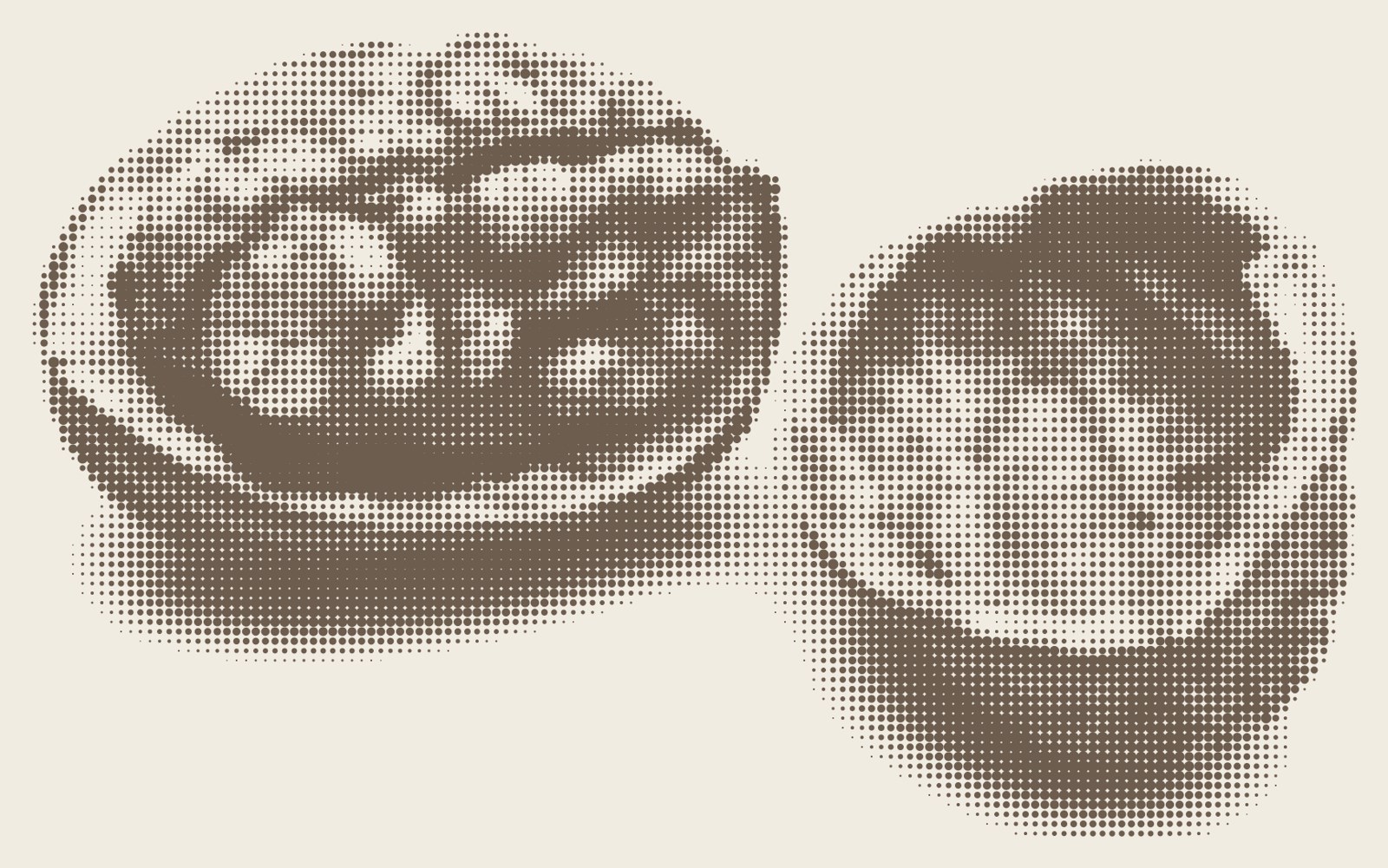
The standard unit of cranial capacity is the cubic centimetre, a convention inherited from Paul Broca (1824 • 1880), who weighed wet brains at autopsy in Paris during the 1860s, and from Samuel Morton (1799 • 1851), who a generation earlier had filled more than a thousand skulls with lead shot at the Academy of Natural Sciences in Philadelphia. Neither man would have thought to express his findings in walnuts. The idea has a certain appeal nonetheless. A small unshelled English walnut occupies roughly 40 cubic centimetres (2.4 cubic inches); the brain of Sahelanthropus tchadensis, the oldest known hominin, measured approximately 360 cubic centimetres (22 cubic inches), or about nine walnuts. The brain of a living adult Homo sapiens measures approximately 1,320 cubic centimetres (80 cubic inches), or thirty-three walnuts.
The progression is not as tidy as it appears. Brain volume did not increase at a constant rate across hominin lineages; it remained below 500 cubic centimetres (31 cubic inches, twelve walnuts) for several million years, then roughly tripled in the two million years between Homo habilis and Homo neanderthalensis. The Neanderthal brain, at approximately 1,410 cubic centimetres (86 cubic inches, thirty-five walnuts), was larger than the modern human brain by some 60 cubic centimetres (3.7 cubic inches, a walnut and a half). Research conducted at the University of Oxford by Eiluned Pearce and Robin Dunbar (b. 1947) demonstrated in 2013 that a disproportionate share of Neanderthal cranial volume was allocated to the visual cortex, as evidenced by their significantly larger orbital cavities. When the visual system was subtracted, the tissue available for higher cognitive and social processing was smaller in Neanderthals than in contemporaneous Homo sapiens. Size, it turns out, is a poor proxy for capability. What matters is allocation.
The walnut itself is instructive on this point. Its convoluted surface resembles the gyri and sulci of the cerebral cortex not by biological kinship but by convergent physics: both structures fold inward to maximise surface area within a rigid container. Harry Jerison (c. 1925 • ?), who introduced the encephalization quotient in 1973 as a ratio of observed brain mass to the mass expected for a given body size, would have appreciated the metaphor. A bottlenose dolphin carries roughly 1,550 cubic centimetres (95 cubic inches, thirty-nine walnuts) of brain, yet its encephalization quotient of 5.3 falls well short of the human 7.5. Much of that dolphin tissue processes echolocation rather than abstraction. The raw count misleads; the architecture informs.
Nonfiction · Volume 2 · Part 4 · Tools & Talk Timeline
335 entries, 2,600,000 BCE to 2033 CE
Tap any entry to open it.
Stone implements manufactured by early hominins at Olduvai Gorge and other East African sites dated to 2,600,000 years before the present represent intentional flaking of basalt and quartz. The resulting tools possessed acute cutting edges suitable for processing carcasses; repeated production demonstrates learned technique transmission across generations.
Excavations at Olduvai Gorge, Tanzania have exposed multiple occupation layers spanning millennia.
Homo habilis, identified in East African deposits dated to approximately 2,300,000 years before the present, represents the first hominin species whose tool-making capability combined size-selective stone flaking with behavioral consistency. Archaeological association with manufactured implements distinguishes the species from earlier gracile australopithecines lacking definitive tool-use evidence.
Tool-bearing deposits at Olduvai Gorge, Tanzania span geological intervals detectable through volcanic ash dating.
Ninety-six stone artifacts recovered from seventeen sedimentary layers at Shangchen on the Chinese Loess Plateau, dated by palaeomagnetic analysis to 2,120,000 years before the present, represent the oldest known hominin presence outside Africa. The tools predate the earliest Homo erectus fossils in East Asia by roughly 600,000 years; no hominin remains accompanied them, leaving the toolmaker's identity unresolved. The discovery, published in Nature in 2018 by Zhaoyu Zhu and colleagues, pushes the out-of-Africa dispersal timeline back well beyond the 1,850,000-year-old site at Dmanisi, Georgia.
The Loess Plateau site sits near Shangchen, Shaanxi Province, China.
Proto-language involving gesture and vocalization likely emerged approximately 2,000,000 years before the present among early Homo populations. Gesture systems permitted transmission of abstract concepts; vocal communication may have initially served emotional and social signaling functions before development of phonemic structure.
The landscape around Olduvai Gorge, Tanzania still exposes geological strata marking successive occupation phases.
The Acheulean hand axe tradition emerged around 1,700,000 years before the present, spreading across Africa, Europe, and western Asia. These bifacially worked implements measured 10-15 centimeters in length; their symmetry suggests aesthetic consideration beyond utilitarian function, indicating cognitive capacity for visualization before manufacture.
The Melka Kunture region around Melka Kunture, Ethiopia demonstrates technological exchange across East African populations.
The earliest signs that hominins managed fire, scattered and intermittent, appear well over a million years ago in East Africa. The control was not yet steady, a fire caught and kept for a while and then lost, but it was control.
What it gave was transformative. Fire cooked food that could not otherwise be eaten, hardened the tips of wooden tools, and pushed back the cold and the dark, advantages no other animal held.
The first hearths near Gona, Ethiopia mark the moment a species began, fitfully, to keep a fire of its own.
Genetic changes in the FOXP2 gene associated with vocal learning capability appeared in hominin lineages approximately 600,000 years before the present. The mutations altered neural circuits controlling mouth, throat, and respiratory musculature; subsequent language development proceeded across hundreds of thousands of years.
Fossil hominin remains from the Lake Turkana region, Kenya provide skeletal evidence for this genetic milestone.
Evidence of controlled fire appears in the archaeological record approximately 400,000 years before the present at sites in Africa and Europe. The technology permitted cooking of previously inedible plant materials, enhanced shelter capability in temperate climates, and facilitated social gathering around hearth locations during darkness.
Evidence appears at Gesher Benot Ya'aqov, Israel, a wetland environment preserving organic materials.
At the cave of Zhoukoudian near Beijing, thick layers of ash show fire kept and tended in one place across long stretches of time. Fire had become a fixture of the camp.
Its deepest gift was not warmth or cooking but geometry. A fire gathers bodies around it, each facing the flames and so also facing one another, and holds them there into the dark. The hearth made a room without walls, and in that circle the long human habit of sitting still together and talking was born.
The tended hearths at Zhoukoudian, Beijing show fire becoming the center a community gathers around.
The number 333 appears three times in the human story at intervals separated by powers of ten, and at each appearance the world bears almost no resemblance to what came before. This is the first.
At 333,000 years before the present, the species that would become us had not yet fully arrived. Homo heidelbergensis dominated two continents: a thick-browed hominin with a brain of about thirty walnuts (1,200 cubic centimetres, 73 cubic inches), smaller than ours but larger than any predecessor’s.
It was a crowded world. Walking the earth at the same time, each with its own allotment of brain, measured here in walnuts (one unshelled English walnut is about 40 cubic centimetres, 2.4 cubic inches; a living human carries thirty-three):
Homo heidelbergensis, Africa and Europe: about thirty walnuts (1,200 cubic centimetres, 73 cubic inches); the Broken Hill skull from Zambia runs to thirty-two (1,280 cubic centimetres, 78 cubic inches).
The earliest Homo sapiens, at Jebel Irhoud: about thirty-three walnuts (1,300 cubic centimetres, 79 cubic inches), already our size, not yet our shape.
The Neanderthal lineage, in Europe, known at this date from the Sima de los Huesos bone pit in Spain: about thirty-one walnuts (1,230 cubic centimetres, 75 cubic inches), on its way to the thirty-five of the classic Neanderthals.
Homo erectus, hanging on in eastern Asia: up to twenty-eight walnuts (1,100 cubic centimetres, 67 cubic inches) in the largest populations; the Dali skull from China is about the same age and the same size.
Homo naledi, in the Rising Star caves of South Africa, dated to between 335,000 and 236,000 years ago: twelve to fifteen walnuts (460 to 610 cubic centimetres, 28 to 37 cubic inches), a chimpanzee’s ration, in a body that walked like ours.
The dwarfed hominins of Flores, ancestors of Homo floresiensis: about eleven walnuts (420 cubic centimetres, 26 cubic inches), hunting pygmy elephants on an island.
And the Denisovans, somewhere across Asia: no skull has been found, so their walnut count is the one number on this list nobody knows.
In Africa, at Jebel Irhoud in what is now Morocco, something new was stirring. Fossils dated to approximately 315,000 years ago by Jean-Jacques Hublin (b. 1953) and colleagues at the Max Planck Institute for Evolutionary Anthropology show faces that fall within the range of humans living today. The braincases behind those faces kept their archaic contours. The brain’s modern shape, and presumably its modern function, had not yet emerged.
In Europe, meanwhile, the lineage that would become the Neanderthals was adapting to glacial cold: barrel chests, shortened limbs, projecting midfaces that warmed frigid air before it reached the lungs.
The technological signature of the era was the Acheulean hand axe, a teardrop-shaped biface that had stayed essentially unchanged for more than a million years. At Boxgrove in England, at Schöningen in Germany, at sites across Africa and western Asia, hominins made these symmetrical tools with a consistency that suggests deep cultural transmission and little innovation.
Woolly mammoths, cave lions, giant deer and woolly rhinoceroses moved through landscapes that humans shared but did not control. Fire had been mastered. Wooden spears had been crafted. The cognitive revolution that would eventually transform everything had not yet occurred.
Jebel Irhoud, Morocco
On the Andalusian coast at Marbella, archaeologists have found lines deliberately crossed into hard volcanic stone perhaps two hundred thousand years ago, possibly the oldest symbolic marks yet known in Europe, far older than any cave painting.
The carving is the simplest thing imaginable: intersecting lines, cut on purpose. But to cut a line that means something, rather than one that merely cuts, is the whole beginning of recorded thought, the same act the rest of this timeline elaborates into writing, mathematics, and every kind of notation.
These will not have been the first such marks. Tool-making hands two and three million years old surely traced patterns in mud and sand that no flood preserved. The crossing of two lines is only where the record happens to begin, the moment a blank surface first became a place to put meaning, and never stopped.
The lines cut at Marbella, Spain may be Europe's oldest deliberate marks, the bare beginning of putting meaning on a surface.
Anatomically modern speech apparatus capable of producing vowel differentiation and rapid consonant articulation emerged roughly 150,000 years before the present in Homo sapiens populations. The laryngeal position and hyoid bone configuration permitted phonetic complexity exceeding earlier hominin vocal capacities.
The coastal caves at Blombos Cave, South Africa preserve remains of animals hunted and processed by these speakers.
Composite tools combining stone blades with hafted bone or wooden handles emerged approximately 100,000 years before the present in Africa and the Levant. This innovation expanded functional capacity beyond stone alone; tool kits grew increasingly specialized for hunting, scraping, and processing diverse resource categories.
The cave setting at Blombos Cave, South Africa protected these fragile bone implements from deterioration.
Anatomically modern humans in Africa possessed vocal apparatus and neurological structures supporting complex spoken language, enabling expression of abstract concepts and experiences. Complex language permitted transmission of accumulated knowledge across generations.
East African Rift Valley, Kenya
Symbolic thought sufficient for ritual, artistic representation, and abstract concept communication appeared approximately 80,000 years before the present. Archaeological evidence from South Africa includes ochre use, carved symbols, and worked bone jewelry; such artifacts imply cognitive complexity enabling metaphor and intentional meaning-making.
Blombos Cave, South Africa contains carved ochre blocks and shell beads indicating intentional aesthetic elaboration.
In a rock shelter called Sibudu, in what is now KwaZulu-Natal, South Africa, people some seventy-seven thousand years ago made their beds with intention. The archaeologist Lyn Wadley found layer upon layer of plant bedding, sedges and rushes gathered from the river below, and laid over the top, the leaves of Cryptocarya woodii, the river wild-quince.
That choice was not for softness. The crushed leaves release terpenes, the same volatile chemicals plants make to fight off the insects that would eat them, and those scents repel and kill mosquitoes and their larvae. A sleeper turning in the night pressed the leaves and freed another breath of the stuff.
This is a conversation with three voices. The plant speaks chemically to the insect, stay away; the mosquito reads the warning and avoids it; and a third party, the human, learns to overhear the exchange and turn it to use, sleeping inside a chemical sentence a tree had written against a fly. Seventy-seven thousand years before anyone bottled a repellent, someone was already eavesdropping on the oldest argument in the grass.
The beds laid at Sibudu, South Africa are humans joining a chemical conversation between plant and insect, and tilting it their way.
On a cave ceiling on the Indonesian island of Muna, off Sulawesi, are two faint hand stencils, made by pressing a palm to the rock and blowing red ochre across it to leave the hand in negative. Dating of the mineral crust over them puts the art at least 67,800 years old, the oldest rock art known anywhere.
One stencil was altered after it was made: someone went back and narrowed the fingertips to a claw, a touch found nowhere on earth but Sulawesi, hinting at some early kinship felt between a human hand and an animal's.
A hand stencil is the plainest possible message, I was here, this is my hand, and one of the oldest. Made tens of thousands of years before any writing, on islands modern humans were not thought to have reached so early, it is a greeting across an almost unimaginable gulf of time. The meaning is lost; the gesture survives.
The hands blown onto the ceiling at Muna, Indonesia are the oldest known painting, a person saying "I was here" sixty-eight thousand years ago.
Geometric marks incised on ivory, bone, and antler objects in the Swabian Jura of southern Germany constitute a system of 22 conventional sign types whose information density, measured by quantitative linguistic methods, closely matches that of proto-cuneiform tablets produced 37,000 years later in Mesopotamia. The signs follow strict distributional rules: crosses appear on animal figurines but never on human depictions; dots never appear on tools. These constraints persisted for ten thousand years across the Aurignacian period, indicating cultural transmission of a shared graphic code.
The caves of the Swabian Jura at Swabian Jura, Germany yielded the 260 decorated objects analyzed in the 2026 study.
El Castillo cave in northern Spain displays hand stencils and red-ochre dots dated to approximately 40,000 years before the present, among the earliest artistic marks in the European archaeological record. The hand impressions likely resulted from ochre spray-painting around hands pressed against stone walls—a practice suggesting symbolic marking of identity.
The limestone shelter at El Castillo, Spain overlooked a valley used by Paleolithic hunting societies.
Cave-art ID: cave-el-castillo
Graphic symbols appearing in caves during this period represent abstract sign systems rather than literal reproductions of observed forms. Standardized symbols suggest communities established shared meaning systems permitting non-verbal communication.
French cave walls bore recurring symbols across multiple sites and generations. Ardèche, France
On ivory, bone, and antler from the caves of the Swabian Jura in southern Germany, made between forty-three and thirty-four thousand years ago, are thousands of small incised marks: notches, lines, crosses, dots, zigzags. Long dismissed as decoration, they have begun to look like a system.
Analyzing more than three thousand marks across 260 objects, researchers found twenty-two recurring sign types whose statistical behavior, their information density and the rate at which signs repeat, closely matches the proto-cuneiform clay tablets of Uruk made some thirty thousand years later. The marks follow rules: crosses appear on mammoths and horses but never on human figures, dots never on tools, and these habits held steady for ten thousand years, which means they were taught and shared, not improvised.
This is not writing; it has no grammar to carry speech. But it is a common code of conventional marks, agreed among people across millennia, whose richness would not be matched again until the first cities learned to write.
The marks cut in the Swabian Jura, Germany are a shared sign-system forty thousand years old, as information-dense as the first writing.
At Altamira in northern Spain, bison and other game animals were depicted in polychrome pigments beginning around 36,000 years before the present. The artists utilized natural rock contours to enhance three-dimensional form; pigment application suggests familiarity with pigment sources, preparation, and tool manipulation over extended production periods.
The Spanish coast near Altamira, Spain provided marine resources supplementing the animals depicted on these walls.
Cave-art ID: cave-altamira
Artistic representation achieved sophisticated expression in cave environments roughly 35,000 years before the present across Europe and Australia. Hand stencils, animal depictions, and abstract markings indicate communities capable of sustained artistic engagement, suggesting aesthetic elaboration beyond nutritional or reproductive necessity.
The deeply recessed chambers at Chauvet Cave, France were accessed only by those intimate with the cave's geography.
Move forward by a factor of ten. At 33,300 years before the present the Upper Paleolithic was in full expression, and the world had changed beyond recognition.
Homo sapiens had spread from Africa across Europe and into Asia, carrying a suite of behaviors no earlier hominin had shown. In the Ardèche valley of southern France, artists had already spent generations painting the walls of Chauvet Cave: lions rendered with shading and perspective, rhinoceroses in motion, horses that seem to emerge from the rock itself. Radiocarbon dating places the earliest of these images between 37,000 and 33,500 years ago, among the oldest figurative art known on Earth.
The Neanderthals were gone, or nearly so. They disappeared from most of Europe between 41,000 and 39,000 years ago, though remnant populations may have held on in Iberia and Gibraltar for several thousand years longer. The Denisovans, known mostly from genetic evidence and a handful of fossils from a Siberian cave, still lived in parts of Asia. The trajectory was clear: a single hominin species was inheriting the Earth.
The toolkit had transformed to match. Bone needles for tailored clothing. Blade technologies that drew more cutting edge from every pound of stone. Personal ornaments that signaled identity and affiliation across distances.
The Pleistocene megafauna still roamed in abundance, but humans were no longer merely part of the ecosystem. They had become something else.
Chauvet Cave, Ardèche, France
The Chauvet cave in southern France contains hundreds of animal depictions dating to approximately 32,000 years before the present. Lions, rhinoceros, and bear appear rendered with unprecedented artistic sophistication; the paintings' location deep within cave systems suggests ritual or ceremonial function beyond shelter-dwelling habitation.
The Ardeche gorge surrounding Chauvet Cave, France shaped access to this ceremonial sanctuary.
Cave-art ID: cave-chauvet
The Chauvet Cave in France contains hand stencils and animal paintings demonstrating sophisticated artistic techniques and possibly serving communicative functions. The paintings suggest that cave art extended beyond practical purposes to encompass symbolic or narrative content.
Ardèche, France
Apollo 11 cave in southwestern Namibia contains engraved game animals and abstract marks dated to approximately 25,000 years before the present. The southern African artistic tradition demonstrates contemporaneous development with European cave art, suggesting independent emergence of symbolic artistic practice in geographically distant human populations.
The Namibian plateau where Apollo 11 Cave, Namibia sits remains an arid landscape dotted with sparse game.
Cave-art ID: cave-apollo-11
Markings in Lascaux cave appear to record seasonal information and animal migrations in abstract symbolic form, suggesting early calendrical communication. The marks indicate systematic observation and external record-keeping of natural phenomena.
Ochre and charcoal marks possibly tracked the turning seasons. Dordogne, France
The bow and arrow technology appeared approximately 20,000 years before the present in Africa and Eurasia. The innovation permitted hunting at distance, extending weaponry range beyond arm's reach and permitting sustained projectile application. Arrow shafts demonstrate careful selection and straightening of materials.
The Danube valley region represented by Vlasac, Serbia contains multiple riverside settlements with archery evidence.
Lascaux cave in southwestern France displays horses, deer, and abstract symbols rendered in ochre, manganese, and charcoal approximately 17,000 years before the present. The paintings demonstrate refined understanding of animal anatomy and movement; ceiling placement suggests intentional positioning within ceremonial or pedagogical space.
The Perigord region containing Lascaux, France offered abundant stone shelters for successive occupation.
Cave-art ID: cave-lascaux
Kapova cave in the Urals contains hand stencils and depictions of mammoths dated to roughly 15,000 years before the present. The cave system extends across 105 meters; artistic engagement across such distances suggests sustained occupation and ritual participation by multiple community members.
The Ural mountains at Kapova Cave, Russia provided refuge during late glacial climatic fluctuations.
Cave-art ID: cave-kapova
Archaeological evidence indicates cave art served communal functions beyond individual artistic expression, with sites containing diverse imagery distributed across multiple chambers. The distribution suggests formal organization of pictorial communication for community viewing and understanding.
Aquitaine, France
Pedra Pintada rock shelter in the Amazon basin displays hand stencils and ochre markings dated to approximately 13,000 years before the present. The South American artistic tradition demonstrates early human presence in tropical forest environments; the shelter's extensive occupation suggests sustained adaptation to equatorial ecological conditions.
The Amazon river system near Pedra Pintada, Brazil enabled human presence in tropical forest zones.
Cave-art ID: cave-pedra-pintada
Bhimbetka rock shelters in central India contain painted and engraved animals and hand prints dated to approximately 12,000 years before the present. The Indian subcontinent's artistic tradition demonstrates contemporary development with European cave art; geometric patterns suggest symbolic systems of abstract meaning.
The Vindhya plateau around Bhimbetka Rock Shelters, India contained natural shelters used across millennia.
Cave-art ID: cave-bhimbetka
In a sandstone shelter in the Fontainebleau forest south of Paris, late-Ice-Age people carved into the floor a thing that only works when it rains.
Grooves, basins, and channels cut into the soft stone match the drainage of the river valley visible from the cave mouth: ridges raised, rivers incised, deltas where channels meet in pools. When a storm sends water through the carved network, the whole landscape comes alive in miniature, showing not distances or directions but how the water moves.
It is not a map as we draw them, with a scale and a north. It is a working model of a place, made some thirteen thousand years ago, the deep ancestor of every diagram that explains a system by becoming a small copy of it.
The carved floor at Fontainebleau, France is a landscape modeled in stone that only speaks when it rains.
Agriculture developed independently in multiple world regions beginning approximately 10,000 years before the present. The shift from mobile foraging to sedentary cultivation in the Near East, China, and Mesoamerica required systematic knowledge of plant phenology, soil conditions, and water management accumulated across generations.
The Fertile Crescent site near Abu Hureyra, Syria sits at the confluence of seasonal water flows critical to early farming.
Long before any other animal, the wolf became a companion. The earliest undisputed dog, buried with two people at Bonn-Oberkassel, dates to roughly fourteen thousand years ago, and its bones show it had survived a bout of distemper as a puppy, meaning someone nursed it through an illness that promised no practical return.
By the start of the Holocene, around ten thousand years before the common era, dogs accompanied human bands across the northern world. The relationship was a conversation conducted without language: a reading of posture, gaze, and intention across the boundary between two species.
It is the first time a creature not of our kind learned to attend to our attention, and we to its. Every later partnership with an animal, and arguably every interface that reads a gesture and answers, descends from this first agreement between a person and a wolf who chose to stay.
The grave found near Bonn, Germany holds the oldest evidence of a friendship across the line between species.
In 1890 miners cutting peat in a bog on the eastern slope of the Ural Mountains pulled up the pieces of a carved larch pole more than three meters tall.
Radiocarbon dating eventually placed its making about 11,500 years ago, at the dawn of the Holocene, which makes the Shigir Idol the oldest monumental wooden sculpture known, twice the age of the pyramids. The bog's airless peat had preserved what would otherwise have rotted in a season.
Down its length run carved faces and a dense grammar of zigzags, lines, and chevrons, cut with stone tools by hunter-gatherers no one expected to have produced abstract design on this scale. The marks mean something. What they mean was lost with the people who read them, and the idol stands as a statement whose language is gone.
The pole raised from the peat near Kirovgrad, Russia is the oldest surviving message whose code no longer exists.
A small object shaped like a handbag, a rounded top above a square base, recurs in the art of cultures that never met. It is carved on a pillar at Göbekli Tepe in Turkey around 9,500 BCE, six thousand years before writing. It reappears in the hands of winged spirits in Assyrian palace reliefs of 879 BCE, where texts call it a ritual bucket. And it turns up again, across an ocean, in Olmec sculpture in Mexico around 900 BCE.
Three continents, more than ten thousand years, no contact among them. The simplest explanation is not lost civilizations or visitors from the sky but convergence: any portable container made to be closed and carried tends toward the same shape, and any figure shown holding such a vessel is being marked as someone authorized to mediate between worlds.
What persists is the gesture. A figure holds a vessel at chest height, and the vessel says: this one is permitted to carry the sacred across a threshold. The human hand keeps reaching for the same shape to perform the same office.
The motif first carved at Göbekli Tepe, Turkey recurs across continents that never met, the same shape held to mean the same authority.
Cueva de las Manos in Argentine Patagonia displays hundreds of hand stencils created by ochre spray-painting around pressed hands, dated to approximately 9,000 years before the present. The repeated hand impressions across 900 square meters suggest multigenerational artistic practice spanning centuries, possibly indicating lineage or family marking.
The Patagonian steppe surrounding Cueva de las Manos, Argentina supported nomadic hunting cultures.
Cave-art ID: cave-cueva-de-las-manos
Göbekli Tepe in southern Anatolia displays carved symbols and constructed monuments suggesting establishment of shared symbolic systems supporting larger communities. The monuments indicate sustained investment in permanent symbolic structures.
This hilltop sanctuary in Anatolia rose long before cities themselves. Göbekli Tepe, Turkey
At Star Carr, a lakeshore camp in northern England occupied some eleven thousand years ago, in the Mesolithic, hunter-gatherers made objects whose purpose was not to cut or to kill but to mean.
From the skulls of red deer they fashioned headdresses, the antlers trimmed and lightened, the bone scraped smooth, two holes bored at the back to tie them to a wearer's head. Thirty-three survive, the largest such cache anywhere. No one knows exactly what they were for, a hunter's disguise, or a costume worn by someone speaking for the group to the animals or the dead.
Either reading is a kind of communication. To put on the head of a deer is to say I am, for now, something other than myself. Among the oldest surviving evidence of ritual in Europe, they are a message we can still hold but no longer fully read.
The headdresses made at Star Carr, England are among the oldest costumes for becoming someone else in order to be understood.
Token-based information systems emerged in the Near East approximately 8,000 years before the present, representing abstract quantities of commodities through shaped clay objects. The system permitted accounting of grain stores, livestock, and manufactured goods; individual token types encoded specific commodities measurable by count.
Token caches discovered at Uruk, Iraq enable modern scholars to reconstruct ancient economic transactions.
Isolated symbols incised on tortoise shells in China approximately 6,600 years before the present represent early written mark-making distinct from artistic expression. The symbols' repetition suggests systematic encoding; archaeological context in settlements implies practical administrative function.
The Yellow River valley near Henan Province, China became the center of early Chinese civilization.
On a plaster wall in the dense Neolithic town of Çatalhöyük, in central Anatolia, someone painted a field of stacked rectangles beneath a tall shape that spits dots into the air.
The excavator read it as a map: the houses of the town seen from above, crowded wall to wall as they actually were, with the twin-peaked volcano of Hasan Dağ erupting behind them. If he was right, it is the oldest known map and the oldest picture of a natural disaster, painted around 6,600 BCE. Geologists later found that the mountain did erupt near that time, which fits.
Others read the same paint as a leopard skin and a band of abstract pattern, and hold that it is no map at all. The argument cannot be settled, which is the heart of the matter: the earliest image that might represent a place is also an image no one can now reliably read.
The plaster painted at Çatalhöyük, Turkey may be the first map, or the first landscape, or neither, and no one can say which.
Magura cave in Bulgaria contains hand stencils, geometric designs, and animal depictions rendered in black pigment dated to approximately 6,000 years before the present. The artistic tradition persisted into early Neolithic periods, suggesting continuity of symbolic practice alongside development of agriculture and domesticated animals.
The Danube river plains near Magura Cave, Bulgaria witnessed the transition to agricultural settlements.
Cave-art ID: cave-magura
In 1961 an archaeologist working a Neolithic mound in the Romanian village of Tărtăria lifted three small clay tablets incised with rows of signs.
They belonged to the wider Vinča culture of the Danube, whose pottery and figurines carry the same repertoire of marks across more than a thousand objects. The tablets date to around 5,300 BCE, which would set these signs two millennia before Sumerian cuneiform and make them the oldest writing on earth, if they are writing.
Most scholars doubt they are. A writing system records language through an agreed set of marks, and no one has shown the Vinča signs do that. They may be marks of ownership, religious symbols, or decoration with rules. They sit at the exact border between pattern and text, on the side that cannot be crossed back into, because the people who made them are silent.
The tablets unearthed at Tărtăria, Romania are either the oldest writing in the world or a system that looks like writing and refuses to become it.
Writing systems emerged in the Near East approximately 5,000 years before the present, transforming information storage from memory-dependent oral tradition to durable external representation. The technology enabled accounting across time and distance, facilitating complex economic organization and centralized administration of early states.
The ancient city at Uruk, Iraq rose in importance following this innovation's adoption across Mesopotamia.
A power-shovel operator laying cable near the Black Sea coast at Varna in 1972 turned up the edge of the oldest worked gold in the world.
The Copper Age cemetery beneath held nearly three hundred graves and some three thousand gold objects, made around 4,500 BCE. One grave, of a single high-status man, contained more gold than had been found in all the rest of the world for that period combined, laid over his body in beaten plaques and beads.
This is a message with no words. The gold says, to anyone who saw the grave and to everyone meant to hear of it afterward, that this person stood above the others. The invention of rank, made visible and permanent in a metal that does not tarnish, is one of the oldest statements a society ever published about itself.
The hoard buried near Varna, Bulgaria is the first time inequality was written in a material instead of in words.
Possible preliterate symbols and images appeared in scattered contexts approximately 4,000 years before the present across Near Eastern and Mediterranean regions. Archaeological evidence remains fragmentary; interpretation as proto-writing or artistic expression continues debated among scholars.
Scattered fragments classified as proto-writing appear across multiple sites in Mesopotamia, Iraq without clear chronological sequence.
Around 3,500 BCE, in the growing cities of Uruk and Susa, someone engraved a tiny scene into a stone cylinder so that, rolled across wet clay, it left a continuous printed band.
The impression was a signature. Pressed onto a jar's stopper, a door's clay fastening, or the edge of a tablet, it said this is mine, this is sealed, I authorized this. As the cities grew and trade thickened, the seal became the indispensable mark of identity, each person's design their own, rolled out wherever their word had to stand in their absence.
It was also, quietly, an ancestor of printing: an engraved master that produced an exact impression again and again. Two thousand years before a page was printed, a Sumerian clerk was already reproducing an image by rolling it.
The seals cut at Uruk, Iraq let a person be present, and accountable, on a document they had left behind.
Around 3,500 BCE, on the Nile and in the rivers of Mesopotamia, people raised the first sails: squares of woven flax or wool set on a single mast above a reed boat, catching the wind to do the work the arms had always done.
A sail let a vessel carry heavy goods upstream and along the coast far faster, and far further, than oars and current allowed. Trade that had crept now traveled. By two thousand years before the common era, sailing routes laced the whole Mediterranean.
Every sea route is a line of conversation. The sail did not carry words directly, but it carried the people, the goods, and the letters that words ride on, and it shrank the water between one shore's talk and another's. It is among the first machines for co-location, the first tools that made the distant near.
The cloth first hung on the rivers of Egypt turned wind into the power to bring far-apart people within speaking distance.
Proto-cuneiform marks at Uruk in Sumer recorded administrative information regarding commodity quantities and transactions, though the system did not yet represent language systematically. The marks demonstrate early linkage between writing and administrative necessity.
Uruk's clay tablets married administration with the earliest systematic writing. Uruk Archaeological Site, Iraq
Another factor of ten. At 3,330 years before the present the Chalcolithic was underway across western Asia, and every other hominin species had been extinct for tens of thousands of years.
In southern Mesopotamia, at cities like Uruk, the Sumerians had developed proto-cuneiform: wedge-shaped impressions in clay, the first true writing system, emerging around 3300 BCE by the archaeological evidence. Within centuries, written law, written commerce and written literature would follow.
Across the sea, construction had begun on what would become Stonehenge. The great Pleistocene megafauna were memories preserved only in cave paintings; mammoths survived on Wrangel Island in the Arctic until about 2000 BCE, but the continental populations had vanished millennia earlier.
The world that humans inhabited in 3330 BCE was increasingly a world that humans had made. Domestic cattle, sheep, goats and horses accompanied them. Fields replaced forests. Cities rose from mud brick. From wild to managed, from found to fabricated, from adapted to adapting: this was the trajectory the previous 330,000 years had set in motion.
Three snapshots, three orders of magnitude, three utterly different worlds. The thread that connects them is not progress in any simple sense but accumulation: of neural complexity, of cultural repertoire, of the capacity to reshape the conditions of existence itself. The hand axe gave way to the painted cave gave way to the written word. At each interval, what it meant to be human had changed so completely that the inhabitants of one era would have found the next incomprehensible.
Uruk, Iraq
When two hikers found a body in a melting Alpine glacier in 1991, they assumed it was recent. It was about fifty-three centuries old, a man who had died around 3,300 BCE and been freeze-dried and preserved entire: clothes, tools, stomach, and skin.
He carried a copper axe, an object of value whose metal proved that trade reached across hundreds of mountain kilometers. And his skin bore sixty-one tattoos, mostly small crosses and parallel lines hand-poked over his joints and lower back, set where his bones show wear, as if the marks were meant to treat the pain.
The tattoos are the oldest known, and they are a kind of writing on the body: not decoration but a record, a fixed message inscribed into a living person and carried until death. A man who could not have read a single written word was nonetheless covered in marks that meant something.
The body recovered from the ice at Ötztal Alps is the oldest human whose own skin is a document.
Fully developed cuneiform writing at Uruk and Ur represented Sumerian language systematically through wedge-shaped impressions on clay tablets. The system recorded diverse information including temple economics, legal matters, and literary works.
Ur Archaeological Site, Iraq
Egyptian hieroglyphic writing appeared on monumental surfaces and papyrus scrolls, representing both logographic and alphabetic elements. The script served royal inscriptions and administrative records within the emerging state apparatus.
The Nile Valley's temples and tomb walls preserved sacred texts and royal decrees. Luxor, Egypt
At a passage tomb in Ireland's Boyne valley, built around 3200 BCE, five centuries before Stonehenge or the Great Pyramid, by farmers working without metal, the dead were given an appointment with the sun.
For about seventeen minutes at the winter solstice, a beam of dawn light enters through a small stone box above the door, travels sixty feet down the passage, and lights the back wall of the inner chamber. The alignment is exact and deliberate; its rediscoverer, Michael O'Kelly (1915 • 1982), sat alone in the dark on the solstice of 1967 to confirm it. The corbelled roof above has stayed watertight for five thousand years.
It is a machine for catching one moment of one day each year, a message exchanged between a tomb and the turning sky, set down so precisely that it still keeps its appointment fifty centuries on, after everything else its builders said has been forgotten.
The chamber aligned at Newgrange, Ireland keeps a five-thousand-year appointment with the solstice sun, seventeen minutes a year.
Early Egyptian inscriptions record royal achievements and genealogies, establishing historical narrative within monumental displays. Royal inscriptions linked rulers to divine authority and permanent architectural record.
Memphis Ancient Site, Egypt
Alphabetic writing systems appeared approximately 3,000 years before the present, achieving phonemic representation permitting any language to be recorded through finite character sets. The innovation simplified literacy acquisition and facilitated information exchange across populations speaking unrelated languages.
Alphabet origins emerged along Mediterranean trade routes converging at Sinai Peninsula, Egypt.
The sixty minutes in an hour and the 360 degrees in a circle are not arbitrary. They descend from the way Sumerian scribes counted, five thousand years ago, on their hands.
Use the thumb as a pointer and touch the three bones of each of the four fingers, and one hand counts cleanly to twelve. Let each finger of the other hand mark off a completed twelve, and the two hands together reach sixty. The number was not invented; it was already there in the bones, and it divides evenly more ways than any number near its size.
That count built the Babylonian sexagesimal system, which outlived every empire that used it and still runs every clock. We buy eggs by the dozen and the gross for the same reason. The stars told the Sumerians what to measure; the hand taught them how.
The counting worked out in Sumer, Mesopotamia set the hours and minutes we still keep, drawn from the bones of the hand.
Visitors to Stonehenge hear mostly wind, but five thousand years ago the ring was an instrument. Acoustic engineers who built a precise scale model found that inside the circle a voice was boosted by several decibels and chanting resonated powerfully, while outside almost nothing could be heard. The stones were set to separate what insiders felt from what outsiders could perceive.
Other monuments were tuned more precisely still. The passage tomb at Newgrange and the underground Hal Saflieni Hypogeum in Malta both resonate near 110 hertz, a frequency that measurably shifts activity in the listening brain toward the regions tied to emotion.
These were not silent piles of rock but engineered spaces, built to be heard as much as seen. For centuries scholars measured the stones and tracked the sunlight and missed half the evidence, because the other half was sound, a spiritual technology played by the human voice.
The stones raised at Stonehenge, England were tuned instruments, built to be heard, not only seen.
First known air mail occurred approximately 2,900 years before the present when Egyptian messages were conveyed across Sinai by trained birds—evidence documented in tomb inscriptions. The practice extended communication range beyond terrestrial courier systems.
Monument inscriptions at Thebes, Egypt preserve evidence of this communication breakthrough.
Egyptian maps on papyrus depicting land surveys and Nile River transportation routes appeared approximately 2,700 years before the present. The maps measured up to two meters in length; cartographic conventions suggest systematic geographic knowledge management.
The Nile floodplain preserved in detailed maps at Giza, Egypt reflects sophisticated surveying knowledge.
Mesopotamian city-states established organized messenger networks for transmitting administrative information and official decrees across distances. Messengers carried standardized formats and authentication methods to ensure reliable information transmission.
Messenger routes knit together the world's first true metropolitan network. Lagash Archaeological Site, Iraq
The Indus Valley civilization employed symbol systems on seals and pottery, though scholarly interpretation remains incomplete and systematic writing may not have been fully developed. The marks suggest systematic use of standardized symbols for identification and possibly record-keeping.
Mohenjo-daro Archaeological Site, Pakistan
First written sentences and named author appear in cuneiform approximately 2,300 years before the present, marking transition from anonymous administrative records to attributed literary works. Enheduanna, priestess of Ur, authored religious hymns distinguishing her as antiquity's first recognizable writer.
Enheduanna's temple precinct at Ur, Iraq became the center of her literary and religious authority.
Oldest known dictionaries appeared in Akkadian approximately 2,300 years before the present, listing Akkadian terms with Sumerian equivalents on clay tablets. The texts indicate deliberate standardization of terminology across linguistic communities.
Bilingual reference works from the royal archives at Ebla, Syria document cross-cultural communication.
When Italian archaeologists dug into a mound in northwestern Syria in 1974, they found more than fifteen thousand clay tablets, many still resting where they had fallen from collapsed wooden shelves, in the palace of the lost kingdom of Ebla.
Dating to around 2,300 BCE, it is the oldest organized collection of documents ever found in place: the working memory of a state. Most are accounts of textiles, metals, and grain, but among them are diplomatic letters, myths, and something startling, bilingual word-lists pairing the local Eblaite language with Sumerian. They are the oldest dictionaries known.
An archive is a conversation a society keeps with its own future, a way of remembering past the span of any one memory. Ebla is the first such memory we can still walk through, shelved and tagged, four and a half thousand years after the fire that baked it hard and saved it.
The shelves buried at Tell Mardikh, Syria are the oldest library found where it stood, a state's memory kept in baked clay.
Oracle-bone inscriptions in the Late Shang period of China recorded divination practices using symbols that presaged later Chinese writing systems. The marks demonstrate systematic character usage for supernatural inquiry and prediction.
Ritualistic inscriptions scratched into bone sought answers from the divine. Anyang Oracle Bone Site, Henan
The first known cipher appeared approximately 1,900 years before the present in Egyptian contexts, employing systematic substitution of standard hieroglyphic signs with functionally equivalent variants. The innovation indicated deliberate information restriction among literate elites.
Discovered in temple archives at Abydos, Egypt.
Hammurabi's Code, inscribed on black diorite approximately 1,750 years before the present, established 282 standardized legal provisions regulating Babylonian society. The text's systematization demonstrates legal information organization preceding systematic philosophical tradition.
The black diorite stele was erected as a public monument at Babylon, Iraq.
In 1908 archaeologists in the Minoan palace of Phaistos, on Crete, dug up a clay disc the size of a saucer, both faces covered in a spiral of stamped symbols.
It dates to around 1700 BCE and carries forty-five distinct signs, each pressed into the soft clay with an individual pre-made seal, one stamp per sign. That is movable type: the same principle Gutenberg would be credited with inventing thirty-two centuries later. And then no one used it again. No other stamped text survives from the ancient world.
The signs have never been read. They match no known script, Minoan or otherwise. The disc is a complete document, printed by a method that would not return for three thousand years, in a language that died with the people who pressed it. A technology and a text, both arriving once and leaving nothing behind.
The disc lifted from the ruins of Phaistos, Crete is printing invented and abandoned three millennia before it was invented again.
On an ivory comb smaller than a business card, dug from the ruins of Lachish in the southern Levant, are scratched seventeen tiny letters in an early Canaanite alphabet, around 1700 BCE.
Deciphered only in 2022, they form the oldest complete sentence yet found in any alphabetic script, the ancestor of Phoenician, Greek, Latin, Hebrew, and most of the world's writing. The sentence is a plea against vermin: May this tusk root out the lice of the hair and the beard. Under the microscope, the comb's teeth still held the chitin of louse nymphs. The first thing written in the alphabet was both a complaint and, verifiably, true.
The alphabet's gift was its smallness. Where cuneiform and hieroglyphs demanded hundreds of signs and a scribal class, this system gave one mark to each sound, some two dozen in all, and cracked literacy open to ordinary people.
The comb inscribed at Tel Lachish carries humanity's oldest alphabetic sentence, and it is about head lice.
The earliest known medical document appeared approximately 1,600 years before the present in Egypt—a papyrus recording 48 cases of physical ailments with treatment procedures. The text demonstrates empirical observation of physiological conditions and therapeutic intervention.
Preserved among royal tomb contents at Thebes, Egypt.
Proto-Sinaitic script appeared approximately 1,500 years before the present in the Sinai Peninsula, representing the earliest phonetically-oriented alphabetic writing. The 30-letter system enabled rapid communication and literacy acquisition compared to earlier logographic systems.
Serabit el-Khadim, Egypt
Clay tablets could hold a receipt or a short hymn, but they were heavy and small. The shift to papyrus, the reed paper made along the Nile and traded out through ports like Byblos, gave writing room to stretch.
A papyrus scroll could carry a long, continuous text, a story or a law code unrolling for many feet, and could be rolled up and carried. For the first time a written work could be as long as its author wished, and travel in a hand. The book, in its first form, was a roll.
The scrolls traded through Byblos, Lebanon gave writing the length and the portability that clay never could.
Proto-Canaanite inscriptions employed a consonantal alphabet representing approximately twenty-two sound values, simplifying writing systems previously employing hundreds of characters. The alphabet reduced learning requirements for literacy while preserving communicative content.
Sinai Peninsula Inscription Site
Around 1,350 BCE the great powers of the Late Bronze Age, Egypt, Babylon, the Hittites, Mitanni, Assyria, conducted their diplomacy by clay tablet, and a cache of some three hundred and fifty of those tablets survived in the ruined archive of the pharaoh Akhenaten's new capital.
What is striking is the language. Egypt had its own hieroglyphs, yet its kings wrote and read these letters in Akkadian, the cuneiform tongue of distant Mesopotamia, because Akkadian was the agreed international language of the age. To address a fellow king, a pharaoh used a script and language not his own, but everyone's.
The letters negotiate royal marriages, trade gold for horses, flatter and complain and bargain. They are the oldest diplomatic correspondence on earth, proof that by the Bronze Age the conversation between peoples already needed, and had found, a common tongue.
The tablets archived at Amarna, Egypt show kings of rival empires sharing one borrowed language so they could speak at all.
In the harbor city of Ugarit, on the Syrian coast, scribes did something clever: they wrote an alphabet in cuneiform. Instead of the hundreds of wedge-signs of Mesopotamian writing, they used about thirty, one for each sound, pressed into clay.
It is one of the earliest alphabets known, and it shows the alphabetic idea arriving even inside the old clay-tablet world. A trading city, handling many tongues, had the strongest reason to want a writing system anyone could learn quickly.
The tablets baked at Ugarit, Syria carry one of the world's first alphabets, written in the wedges of an older script.
The Phoenician alphabet served maritime merchants trading across Mediterranean shores, providing efficient written communication across linguistic boundaries. The consonantal alphabet proved readily adaptable by multiple peoples and became ancestor to subsequent alphabetic systems.
Mediterranean trading posts from Phoenicia broadcast commerce and culture across waters. Tyre, Lebanon
As the Zhou dynasty governed early China, its writing settled into the form known as seal script, the elegant, balanced characters cast on bronze vessels and cut into the personal seals that stamped a name onto wet clay or ink.
A seal is a signature and a stamp at once: carved once, it prints a person's identity again and again. The script froze the shapes of Chinese characters into a standard that later forms would vary but never abandon, fixing a writing system that has run unbroken longer than any other.
The characters formalized in the Yellow River script centers standardized a writing that would outlast every other in continuous use.
A small limestone tablet from the town of Gezer, west of Jerusalem, carries one of the oldest surviving passages of Hebrew, scratched in a paleo-Hebrew hand around the tenth century BCE.
It is not a law or a prayer or a king's boast. It is a farmer's year, set down month by month: the season of ingathering, of sowing, of late planting, of hoeing flax, of barley harvest, of pruning, of summer fruit. The clumsy, repetitive letters have led many to read it as a schoolchild's exercise, or the words of a folk song used to remember when to do each task.
That is its quiet importance. At the very dawn of alphabetic literacy in the region, the thing someone chose to write down was not power but the ordinary turning of the agricultural year, knowledge a settled people had carried in the mouth for millennia, now committed to stone.
The tablet inscribed at Gezer, Israel records not a ruler but a calendar of chores.
In a gravel pit in Veracruz, in the heartland of the Olmec, road builders turned up a slab of greenish serpentine carved with sixty-two signs.
Dated by the pottery around it to about 900 BCE, the Cascajal Block carries what appears to be the oldest writing in the Americas, four centuries earlier than any other, and it shows that script was invented in the New World independently of the Old. Certain signs repeat in patterns, which is why most who study it accept that it records something and is not mere ornament.
It belongs to no known system. It resembles neither Maya nor any later Mesoamerican script, and nothing has been found that descends from it. The Olmec invented writing, wrote this, and the line went cold. The block is a complete utterance in a language spoken once that left no children.
The slab found near Veracruz, Mexico is the New World's oldest writing and the start of a tradition that vanished.
Early Greek inscriptions employed alphabetic writing adapted from Phoenician sources, adding vowel representation to create a fully phonetic system. The enhanced system represented language more precisely than consonantal alphabets.
Attica Region, Athens
For more than a thousand years, Greeks facing a hard decision climbed to the temple of Apollo at Delphi to put a question to the god, whose answer came through the mouth of a priestess called the Pythia.
Seated on a tripod above a cleft in the rock, perhaps breathing the vapors that rose from it, she gave replies that were often riddles, and the riddles were the point. When Croesus, king of Lydia, asked whether to make war on Persia, the oracle said that if he did he would destroy a great empire. He marched, and the empire he destroyed was his own.
Delphi was a conversation in which one party always answered and never plainly. It treated the future as something to be negotiated with rather than simply read, and put the burden of meaning back on the asker. For a thousand years the most important questions in the Greek world were addressed not to other people but, on purpose, to an ambiguity.
The answers given at Delphi, Greece were a conversation with the divine in which the listener supplied half the meaning.
Every civilization that wrote down its own thoughts left the same complaint: the great age has passed, the present is a falling-off, the better people died long ago. The conversation each culture holds with its past is a conversation with a past that is always already lost.
Around 700 BCE the Greek poet Hesiod ranked the ages of man from a golden age down to his own degraded iron one, and wished he had been born in another time. Egypt measured every reign against Zep Tepi, the First Time when gods ruled; Rome appealed to the mos maiorum, the way of the ancestors; Confucius called for a return to the early Zhou, who themselves looked back to the sage-emperors before them. The line never reaches a culture content with itself.
There is no first golden age. Each one has another behind it. A modern reader admiring the ancients performs the very gesture Hesiod performed gazing back at the gods, and the book's own refrain holds: the ancients' ancients had ancients. The frame is older than anything it frames.
The lament first set down in Hesiod's Greece is shared by every civilization that wrote: the golden age is always just behind us.
Babylonian clay tablets containing world maps appeared approximately 600 years before the present, depicting Mesopotamia at the earth's center surrounded by encircling ocean. The cosmological representation reflects contemporary geographic understanding and religious cosmology.
Multiple examples survive from the royal library's collections at Babylon, Iraq.
Greek city-states inscribed law codes alphabetically on stone monuments, establishing legal authority through written text accessible to literate citizens. Written laws provided standardized reference for judicial matters and reduced reliance on oral tradition.
Democracy demanded visible laws accessible to the assembled citizenry. Athenian Agora, Athens
By the seventh century before the common era, Greek builders had standardized the parts of a temple into a grammar that could be read.
A column was not merely a support. Its proportions, its fluting, and above all the capital at its top declared which order it belonged to: the plain, sturdy Doric; the slimmer Ionic with its scrolled volutes like a ram's horns; and later the Corinthian, crowned with acanthus leaves. Each order carried a register, as a typeface does, and a trained eye could read a building's character from its columns alone.
This was architecture as language. The orders gave the West a shared vocabulary of building that would be spoken, quoted, and argued with for twenty-five centuries, from the temple to the bank to the courthouse. To raise a Doric portico was to say something, and everyone knew how to read it.
The grammar refined on the Acropolis at Athens, Greece let a building announce its character through its columns.
In the kingdom of Lydia, in what is now western Turkey, metalworkers around 600 BCE began stamping lumps of electrum, a natural gold-silver alloy panned from the river at Sardis, with an official mark, and so invented the coin.
Before the coin, a payment had to be weighed and its metal tested at every exchange. The royal stamp replaced all that with a promise: this disc holds the weight and purity the mark declares. King Croesus later refined the system into pure gold and silver pieces of guaranteed value. A coin is a tiny document, and what it says is trust me, in the voice of the state that struck it.
Money is a language for value, and Lydia wrote its first words. The stamped coin let strangers who shared no tongue, no ruler, and no trust still transact, by agreeing instead to trust the mark.
The electrum stamped at Sardis, Turkey turned a lump of metal into a message of guaranteed worth, the first money that spoke for the state.
Around 550 BCE, the Persian Empire under Cyrus the Great established the first official mail service, a network of relay stations spanning the vast territory from Egypt to India. Horsemen traveled fixed routes over distances of 1,500 miles or more, carrying royal decrees and administrative correspondence. This system remained operational for two centuries.
Relay stations extended from Susa, Iran across three continents to ensure message delivery.
The Persian Empire established organized relay courier systems across vast distances, employing stationed horses and riders to transmit royal decrees rapidly. The system provided administrative mechanism for controlling geographically dispersed territories.
Susa Palace Complex, Iran
Thales of Miletus initiated deductive reasoning approximately 545 years before the present, establishing philosophical method emphasizing logical inference from empirical observation. The approach distinguished natural philosophy from mythological explanation.
This revolutionary approach to knowledge originated in the prosperous Greek city-state of Miletus, Turkey.
The linguist Pāṇini composed the Aṣṭādhyāyī, a Sanskrit grammar containing nearly 4,000 rules that anticipated modern linguistic theory by twenty-three centuries. His work demonstrated a systematic, quasi-generative approach to language structure, organizing phonetic and syntactic principles into precise, recursive formulations that grammarians still consult today.
The monk-scholars of Gandhara cultural sphere transmitted this grammar across Asia.
Classical Athens developed formal rhetorical oratory as public speaking art, with trained speakers addressing assemblies on matters of state and philosophy. Rhetoric established systematic principles for persuasive oral communication.
Citizens climbed the hillside amphitheater to deliberate matters of state through persuasive speech. Pnyx Assembly Site, Athens
In Alexandria the Ptolemies built the Musaeum, a house of the Muses, gathering scholars, instruments, and a library said to hold hundreds of thousands of scrolls under one roof and one budget.
It was the first institution devoted to collecting and comparing the whole of recorded knowledge, the ancestor of every museum, research library, and university since. To put all that talk in one place was itself a new idea: that knowledge grows faster when it is gathered, sorted, and set side by side.
The halls assembled on the Alexandria waterfront were the first place built to collect and compare the world's knowledge in one room.
The compass rose flattens the world to four points on a level disc, and that flattening was its genius: by reducing where to two dimensions it made crossing an ocean a solvable problem. But older ways of reckoning direction held more.
Ancient Indian cosmology counted six directions, the four horizontal plus the zenith above and the nadir below. In one Buddhist text the Buddha finds a young man bowing to the six quarters and recasts each as a human bond: parents to the east, teachers to the south, spouse and children to the west, and so on, turning direction into a map of one's obligations. The Lakota and the Zuni of North America built similar systems, the vertical axis bearing as much weight as the horizontal.
To gain the flat efficiency of the mariner's compass was to amputate that vertical, the axis of depth and height, of hierarchy and aspiration. The number of directions a people keep shapes the questions they can ask about where they stand, and who, and why.
The cosmology taught in northern India kept six directions where the compass keeps four, holding that "where" is also a question of relationship.
Before writing was cheap, people stored what mattered in imagined buildings. The technique, credited to the Greek poet Simonides in the fifth century BCE, is to walk a familiar place in the mind and set each thing to be remembered in a particular spot, then retrieve it by walking the rooms again.
It works because of how the brain is built. The hippocampus, the seahorse-shaped structure that maps physical space, is also essential to memory, and brain scans show that practicing the method of loci lights up exactly those map-making circuits. To remember by place is to use memory's own architecture.
The same finding turned up sideways in a study where people who kept their schedules in a paper notebook, with its handwritten quirks and spatial variety, remembered them better, and showed stronger activity in those circuits, than people using a phone. A page laid out by hand is itself a small memory palace. The question was never whether to store a thing, but in what kind of room, arranged by whose hand.
The method credited to Keos, Greece stores memory in imagined rooms, using the same part of the brain that maps real space.
Anaximander of Miletus (c. 610 BCE • 546 BCE) created one of the earliest world maps approximately in the 5th century before the present. The representation measured roughly 30 centimeters in diameter; cartographic conventions indicated geographic knowledge accumulated through trade and travel.
The merchant civilization of Miletus, Turkey accumulated geographic knowledge through extensive trade networks.
Greek Alphabet emerged approximately 400 years before the present, establishing the first true alphabetic system incorporating vowel representation. The innovation derived from Phoenician consonantal alphabet; subsequent Greek literacy culture produced extensive philosophical and literary traditions.
Maritime traders from Euboea colonization zone spread this innovation throughout the Mediterranean.
In the streets and gymnasia of Athens, an ugly, barefoot stonemason's son named Socrates invented a way of thinking that was entirely a way of talking.
He wrote nothing. He claimed to know nothing. He simply asked a question, then a question about the answer, and the next, until the confident person across from him discovered that they did not understand the thing they had been sure of. Knowledge, he insisted, was not handed from a teacher to a student. It was uncovered between two people who kept talking.
The city executed him in 399 BCE for corrupting the young. His pupil Plato preserved the method by writing it as dialogue, conversations on the page, and twenty-five centuries of philosophy have run as an argument with the dead and the living at once.
The questions asked in Athens, Greece made conversation itself the road to truth.
In 385 BCE, Plato founded the Academy in Athens, establishing an institution devoted to philosophical inquiry that would endure for nearly nine centuries. Located northwest of the city in a grove dedicated to the hero Academus, the school became the model for all subsequent centers of higher learning in the Western world.
Walking students among olive groves at Plato's Academy location] shaped Western intellectual tradition.
Eratosthenes of Cyrene (c. 276 BCE • 194 BCE) calculated the earth's circumference at approximately 40,000 kilometers approximately 4 centuries before the present, employing geometric principles and solar measurement. The calculation achieved accuracy within 16 percent of contemporary measurements.
His methodology influenced geographical thought for fifteen centuries from Alexandria, Egypt.
In 343 BCE Philip II of Macedon summoned the philosopher Aristotle to a school in the gardens of Mieza to teach his thirteen-year-old son.
For several years the foremost mind of the age sat with the boy who would conquer most of the known world, walking him through ethics and politics, botany and zoology, and the poems of Homer and Euripides. As payment, Philip rebuilt Aristotle's home city of Stagira, which he had earlier razed.
It is the most consequential tutorial in history, and an unprovable one: how much of Alexander's reach was shaped by those talks cannot be known. But the image holds, of the philosopher and the future conqueror in a garden, the whole apparatus of Greek thought poured, through conversation, into one restless student who would carry it east as far as India.
The lessons given at Mieza, Greece are the archetype of the conversation that arms a mind for the world.
Chinese bronze inscriptions and script appeared approximately 300 years before the present, recording administrative and ceremonial information on bronze vessels. The script demonstrates increased abstraction from pictographic origins while maintaining logographic principles.
Bronze vessels at Anyang bronze casting workshops document ritual and governance.
Hellenistic governments inscribed official edicts on stone and pillars within public spaces, establishing government authority through monumental written proclamation. Permanent inscriptions provided reference for citizens and demonstrated state power.
Serapeum Temple Complex, Alexandria
For most of writing's life the long text lived on a scroll, unrolled with two hands and read only in sequence. The codex, folded leaves bound at one edge between covers, changed that.
A bound book can be opened at any page. It allows a reader to jump, to compare two passages, to flip back and check, to mark a place. This is random access, the freedom to reach any part of a text directly, and it reshaped how people read and argued. Nearly every book since, and the very metaphor of the computer's "pages," descends from the bound leaf.
The bound book that displaced the scroll, refined across the Roman world, let a reader open a text anywhere instead of only at the start.
The Library of Alexandria was formally established in 283 BCE as an instrument of Ptolemy I's cultural ambitions, housing collections of Greek and Egyptian texts. Scholars estimate the library contained between 400,000 and 700,000 papyri, making it the largest repository of written knowledge the ancient world had yet assembled.
Scholars from across the Mediterranean traveled to Alexandria, Egypt to consult rare manuscripts.
Parchment scrolls gained prominence around 250 BCE as an alternative to papyrus, particularly among Mediterranean traders and scholars. Prepared from animal skins and more durable than papyrus, parchment could survive extended storage in humid climates and supported the expansion of written records across diverse environments.
Pergamene craftsmen exported prepared skins throughout the Hellenistic world from Pergamon, Turkey.
Emperor Ashoka (c. 304 BCE • 232 BCE) of the Mauryan dynasty inscribed rock edicts across his empire proclaiming Buddhist principles and royal authority in multiple languages. The edicts demonstrated integration of written communication with political authority across large territories.
Ashoka's carved stones carried his dharma across the Indian landscape from a great imperial capital. Pataliputra, India
Alexander the Great founded the city of Alexandria in 246 BCE on Egypt's Mediterranean coast, selecting a location of strategic commercial importance at the convergence of Egyptian, Greek, and Asian trade routes. The city's grid layout and harbor facilities made it the ancient world's premier port and intellectual center within a generation.
Within decades, the port at Alexandria, Egypt commanded Mediterranean commerce.
Under the Ptolemaic dynasties, the Library of Alexandria achieved organizational systematization around 240 BCE when Callimachus compiled the first known library catalog. His Pinakes, cataloging some 500,000 texts, introduced principles of classification and subject indexing that libraries would refine for the next two thousand years.
The organizational system proved so effective that medieval and Islamic libraries adopted similar classification methods across Alexandria, Egypt.
Papyrus and parchment scrolls accumulated in archival libraries such as Alexandria, establishing centralized repositories of written knowledge and state records. Archival institutions preserved textual information across generations.
Library of Alexandria Site
In 196 BCE the priests of Egypt carved a routine decree honoring the boy-king Ptolemy V into a slab of stone and, so that everyone could read it, cut the same text three times: in hieroglyphs, in everyday demotic, and in Greek.
Within a few centuries the knowledge of how to read hieroglyphs was lost entirely, and for some fourteen hundred years the writing of ancient Egypt was a closed door, a whole civilization's voice fallen silent. Then in 1799 French soldiers near the town of Rosetta turned up the stone, and because its Greek could still be read, it became the key. In 1822 Jean-François Champollion (1790 • 1832) used it to crack the hieroglyphic code at last.
A conversation that had gone dark for over a millennium was reopened by a single accident of redundancy: someone, once, had written the same thing in three scripts. The Rosetta Stone is the key that unlocked a dead language and let the Egyptians speak again.
The trilingual slab found at Rosetta, Egypt reopened a conversation that had been silent for fourteen centuries.
The Han Chinese state established organized relay posts for transmitting government decrees across imperial territories, employing standardized procedures and documentation. The system paralleled Persian precedents and demonstrated administrative need for rapid communication.
Chinese imperial administrators mirrored Persian efficiency in managing the sprawling empire's vast distances. Chang'an (Xi'an), Shaanxi
An extant hemp paper fragment dated to 141 BCE constitutes the oldest known surviving example of papermaking in China, predating widespread adoption by two centuries. This artifact indicates that Chinese artisans had developed techniques for pulping plant fibers and pressing them into usable writing surfaces well before paper became the standard writing medium.
The western terminus of trade routes at Dunhuang archaeological site preserved this fragile material in protective cave conditions.
A sponge-diver's chance discovery in a Roman-era shipwreck off the island of Antikythera yielded, among the bronze and marble, a corroded lump that proved to be the most sophisticated machine to survive from the ancient world.
Built around 100 BCE, it carried at least thirty interlocking bronze gears behind its dials, and with the turn of a hand crank it modeled the heavens: the positions of the sun and moon, the phases of the moon, the timing of eclipses by the Saros cycle, even the four-year round of the Games. It was a computer of the sky, made of metal teeth.
And then nothing. No second machine of comparable complexity is known from antiquity, and none would appear for more than a thousand years, until the geared clocks of the medieval cathedrals. A feat of astonishing skill was performed once and lost, and the knowledge had to be invented again from the beginning.
The device raised from the seabed near Antikythera, Greece proves a technology can arrive, work, and vanish leaving no descendants.
The ampersand symbol appeared in Latin inscriptions around 63 BCE as a ligature of the letters A and E, abbreviating the conjunction et. Roman scribes found the combined form more economical than writing both letters separately, establishing a convention that medieval monks would later refine.
Stone and marble surfaces throughout Roman Forum marble monuments display this economical abbreviation.
The Acta diurna, daily government bulletins, were posted in public spaces of Rome beginning in 59 BCE under Julius Caesar. These announcements of Senate proceedings, military dispatches, and official announcements represented the first systematic attempt to maintain daily written records of state business.
Citizens gathered daily to read posted notices at Roman Forum central plaza.
Books constructed from folded sheets rather than continuous scrolls emerged around 55 BCE, representing an intermediate stage between scroll and codex technologies. This format permitted faster reference to specific passages while maintaining compatibility with existing writing practices.
Scribal workshops at Latium scribal centers experimented with multiple competing formats.
The Roman state established the cursus publicus, an official courier system providing government communication across provincial territories. The system connected administrative centers and military posts across the Mediterranean and beyond.
Roman Forum, Rome
Roman monumental inscriptions and milestones inscribed along roads recorded military achievements, imperial decrees, and distance measurements. Monuments communicated state authority to populations and travelers.
Stone markers studded imperial highways, linking distant provinces to the eternal city. Forum Romanum, Rome
Late in the first century before the common era, a Roman engineer named Marcus Vitruvius Pollio (c. 80 BCE • 15 BCE) wrote the only treatise on architecture to survive from the ancient world, ten books dedicated to the emperor Augustus.
In them he set down the classical orders as a system, described how to site a town, raise an aqueduct, and tune a theater's acoustics, and gave architecture three demands it has never escaped: firmitas, utilitas, and venustas, firmness, commodity, and delight. A building must stand up, it must work, and it must move us.
A treatise turns a craft into a discipline that can be taught at a distance, by the book rather than at the elbow of a master. Rediscovered in the Renaissance, Vitruvius became the rule against which Alberti, Palladio, and centuries of builders measured themselves. Architecture had learned to talk about itself.
The ten books written in Rome, Italy gave building a language to be taught and argued in, not only built.
Contemporaneous Roman, Parthian, and Han empires employed overlapping networks of written communication, messengers, and administrative systems across Eurasia. The networks transmitted information and commerce across cultural boundaries.
Samarkand, Central Asia
Claudius Ptolemy's (c. 100 • 170) Geography, compiled around 2 CE, assembled and synthesized knowledge of global geography accumulated through three centuries of Greek and Roman exploration. His astronomical calculations and coordinate systems made the work the authoritative geographic reference throughout the medieval and early modern periods.
The great library city of Alexandria, Egypt provided the intellectual environment where Ptolemy assembled his synthesis.
Among the Roman books buried by the eruption of Vesuvius are some that open with a list of what lies inside, chapter by chapter: a table of contents.
It is a small thing and a profound one. A table of contents is a map of a text, a way to see the whole at a glance and to find a part without reading from the beginning. It is among the oldest finding aids, the ancestor of the index, the menu, and the navigation bar, every device by which we reach into a body of writing and pull out just the piece we want.
The books sealed by ash at Pompeii, Italy already carried a map of themselves, the humble ancestor of every index and menu.
Roman scribes developed a flowing cursive script called New Roman or Minuscule Cursive around 100 CE, suited to rapid writing on papyrus. This handwriting style remained dominant for administrative correspondence throughout the Roman provinces and influenced letterforms in subsequent centuries.
The flowing script spread with correspondence throughout provinces administered from Roman administrative centers.
In the rainforests of Mesoamerica, the Maya built one of the world's few fully developed writing systems invented in complete isolation from the Old World. Its glyphs, part picture and part sound, could record anything the language could say.
They used it above all to write time and the sky: long-count dates reaching back millions of years, the cycles of Venus, the reigns of kings. A Maya inscription binds a ruler's deeds to the exact turning of the heavens, a conversation conducted between a dynasty and the cosmos, carved in stone to outlast both.
The glyphs cut at Palenque, Mexico are a writing invented from nothing in the New World, built to record the sky.
Sometime in the first centuries of the common era, an Indian treatise attributed to the sage Bharata Muni set down a complete grammar of the body for the stage. The Natya Shastra codified posture, expression, and above all the hasta, the hand gestures, fixing sixty-four of them into a working vocabulary.
A flat hand, a pinched finger, a turned wrist: each mudra carried an agreed meaning, and combined in sequence they let a performer narrate a god, a river, a deer, a refusal, without a single spoken word. It was a language built from the hand, written into the air and read by an audience trained to receive it.
The system survives intact, still taught and still danced, a wordless speech older than most living tongues.
The gestures codified in Varanasi, India turned the hand into a complete language two thousand years ago.
Around the year 300, scribes produced the Codex Sinaiticus, a vast Greek Bible written on fine parchment in a clear, even hand, one of the oldest substantially complete Bibles in existence.
It is a monument of the codex age: hundreds of bound leaves holding an entire library of texts in one volume that could be opened, cross-referenced, and corrected. Later readers wrote thousands of small changes in its margins, so that the book is also a record of its own centuries of use, a conversation between the text and everyone who ever leaned over it.
The great codex preserved at Saint Catherine's Monastery, Sinai gathered an entire scripture into one bound volume that readers could search and amend.
In 1945 an Egyptian farmer digging for fertilizer near Nag Hammadi broke open a sealed jar and found thirteen leather-bound papyrus books that had lain in the ground for sixteen centuries.
They were a library Christianity had tried to erase. After the empire turned Christian in the fourth century, books judged heretical became a crime to own, and copies were burned; these, including the Gospel of Thomas, survived only because someone near a desert monastery chose to bury rather than burn them, probably soon after a bishop's letter of 367 condemned such writings.
Before the find, almost everything known of these communities came from the writings of their enemies. The sand returned their own voices intact. A conversation the powerful had spent centuries trying to end was, it turned out, only waiting in a jar.
The books hidden near Nag Hammadi, Egypt are a suppressed library that survived by being buried, the losing side's own words kept whole.
Around the year 400, Augustine set down his astonishment at a thing he had seen: Ambrose, bishop of Milan, reading with his eyes alone, his voice still. For most of human history reading had been reading aloud, a performance; to take in words silently seemed strange enough to record.
Part of the difficulty was technical. Ancient texts ran the words together without spaces, so that decoding them was a labor the voice helped perform. Only when Irish scribes began putting spaces between words, in the seventh and eighth centuries, could the eye outrun the tongue, and silent reading spread.
The change ran deeper than manners. When reading went silent it went inward, faster than any voice and private to the reader, opening a room in the mind for reflection that had not quite existed before. The hush of a library is the residue of that revolution, not merely courtesy but the shape of a new way of thinking.
The silent reading first remarked upon in Milan, Italy moved reading inside the head, and made a private room for thought.
Japanese scholars adopted the Chinese writing system around 500 CE, initially using characters phonetically to represent native vocabulary. This process of linguistic adaptation required centuries before a hybrid writing system combining Chinese characters with native syllabic notation achieved standardization.
The court at Kyoto, Japan eventually synthesized indigenous and imported writing into kana.
Woodblock printing technology appeared in China around 593 CE, using carved wooden matrices to transfer ink patterns onto paper. This development represented the first mechanization of text reproduction, though several centuries would elapse before the technology achieved widespread adoption.
The technology spread rapidly across Sui Dynasty Chang'an printing workshops within a generation.
Celtic monks pioneered word spacing, separating individual terms by blank space, around 700 CE. Previously, texts flowed continuously without such divisions, requiring readers to identify word boundaries through context and syntax. The St. Cuthbert Gospel, an illuminated manuscript from this period, demonstrates this innovation in practice.
The innovation dramatically improved reading speed at remote scriptoria like Lindisfarne, England.
Japanese scholars developed native writing systems incorporating borrowed Chinese characters around 700 CE, establishing a hybrid orthography suited to the language's structure. Woodblock printing spread to Japan during this same period, permitting reproduction of Buddhist texts and lay materials.
Indigenous characters combined with Chinese loanwords at [Kyoto, Japan to create the kana system.
In 813 the church council at Tours made a quiet admission of defeat. For centuries the Mass and the sermon had been given in Latin, the language of the church, which ordinary people no longer understood. The council ordered priests to preach instead in the rustica romana lingua, the rough Roman tongue, and in the local Germanic speech.
It was an official recognition that Latin and everyday talk had drifted apart into separate languages, and that to be understood the church had to meet people in the words they actually spoke. The vernaculars, long beneath notice, were thereby licensed to carry serious meaning, the first step toward the national languages of Europe.
The ruling issued at Tours, France admitted that Latin had become a foreign tongue, and authorized preaching in the language people really spoke.
By the late eighth century the scripts of Europe had drifted into a thicket of local hands, cramped and inconsistent and hard to read across a continent. Under Charlemagne, the English scholar Alcuin of York set a new standard from the palace school at Aachen.
The script he promoted, Carolingian minuscule, was built for legibility: clean rounded letters, a firm distinction between capitals and a true lowercase, and clear spaces between the words. It could be read quickly and copied accurately, and it spread across the empire as the common hand of learning.
Most of what survives of classical literature reaches us through copies made in these scriptoria. When Renaissance humanists later wanted a clean script to print, they took Carolingian minuscule for their model, mistaking it for ancient Roman, which is why the lowercase letters on this page are its grandchildren.
The hand standardized at Aachen, Germany made writing legible across a continent, and is the ancestor of our lowercase.
Around 820, at the House of Wisdom in Baghdad, the mathematician Muhammad ibn Musa al-Khwarizmi (c. 780 • 850) wrote two books that reshaped how humanity calculates.
One, Al-Jabr, set out the first systematic method for solving equations by balancing their two sides; from its title comes the word algebra. The other explained the Indian system of nine digits and a zero, with value depending on place, and carried it west, the system we now call Hindu-Arabic numerals. When his own name was rendered into Latin centuries later as Algoritmi, it became the word algorithm.
These were procedures: step-by-step instructions a person, or later a machine, could follow without understanding and still arrive at the right answer. An algorithm is a way of writing down a conversation between a problem and a method. Almost every machine in this timeline's later pages runs on what al-Khwarizmi named.
The procedures set down in Baghdad, Iraq gave us algebra, our numerals, and the very word for a recipe a machine can follow.
The Oaths of Strasbourg, sworn in 842 CE and documented in writing, represent the first surviving official text in a Romance language rather than Latin. This diplomatic document marked the emergence of vernacular literacy as a matter of state importance.
This diplomatic treaty witnessed at [Strasbourg, France signaled the political fragmentation of Charlemagne's empire.
Islamic cartographers of the 9th century, particularly those associated with the House of Wisdom in Baghdad, created detailed mappings of known territories incorporating mathematical principles. Their work synthesized Greek, Persian, and Indian geographic knowledge into systematic representations.
Scholars and astronomers convened at [House of Wisdom Baghdad library to harmonize diverse traditions.
The Diamond Sutra, a Buddhist scripture printed from wooden blocks in 868 CE and discovered in a sealed cave in Dunhuang, constitutes the oldest known dated printed book. The colophon identified the printer and date, establishing practices of attribution that printing would standardize.
The sealed cave at [Dunhuang, China protected Buddhist canon for over a millennium.
The oldest known document on paper in Europe, a legal record from southern Italy, dates to approximately 1000 CE. This artifact indicates that papermaking had reached Mediterranean regions and begun replacing parchment despite initial resistance from scribal traditions.
Parchment remained expensive and cumbersome; paper offered a more practical alternative Naples, Italy
Around a thousand years ago, as Jewish communities settled along the Rhine, a new language took shape in their mouths: Yiddish, a fusion of medieval German with Hebrew and Aramaic, later salted with Slavic as its speakers moved east.
It became the everyday tongue of Ashkenazi life across a thousand miles and a thousand years, a language that belonged to no country and so held a scattered people together wherever they lived. In it grew a vast literature, a theater, a press, and a particular humor, the warmth and irony of a people talking among themselves.
The Holocaust murdered most of its speakers, and Yiddish, once spoken by millions, was nearly silenced in a decade. It survives now in pockets, studied, sung, and still spoken, a fusion tongue that proved a conversation could be a homeland for a people who had no other.
The language that grew along the Rhineland was a homeland made of speech, carried by a people who had no land of their own.
Four centuries before Gutenberg, a Chinese artisan named Bi Sheng solved the problem of reusable type. Between 1041 and 1048, in the Northern Song, he carved each character into clay, baked the pieces hard, and set them in a wax-and-resin bed on an iron plate; heat the plate and the type locked, reheat it and the characters came free for the next page.
It worked, and was recorded with an engineer's precision by the polymath Shen Kuo (1031 • 1095). Yet it did not take over, because written Chinese has many thousands of characters, and a font of clay pieces large enough to set it was unwieldy. The same idea that freed printing for the twenty-six letters of the Latin alphabet was simply too big for the script it was born to serve.
It is the tango's recurring lesson: there is no single best way to carry talk, only ways that fit or do not fit the talk they carry. A good answer arrived four hundred years early, in the wrong alphabet.
The type fired in Kaifeng, China was movable type four centuries early, too large for the language it was made to print.
The first paper mill in Spain was established around 1056 CE in Xativa, marking the transition of papermaking technology from Islamic to Christian European control. This mill supplied paper to the emerging Spanish kingdoms and influenced subsequent mill construction throughout the Mediterranean.
Xativa, Spain
In the 1140s the Abbot Suger (c. 1081 • 1151) rebuilt the choir of the abbey church of Saint-Denis, north of Paris, with a new idea: to dissolve the heavy walls of the older style into frames for glass, and flood the interior with colored light he called lux nova, new light.
The rib vault and the pointed arch carried the weight outward, freeing the walls to become windows, and the windows told stories. In an age when almost no one could read, the great stained-glass cycles of the cathedrals that followed, Chartres above all, were called the Biblia Pauperum, the Bible of the poor: scripture rendered in light and color so that an illiterate congregation could read it by looking up.
The cathedral was a building that spoke. Its whole structure, the soaring height, the glass, the carved portals, was an argument addressed to people who could not read a word, conducted entirely in stone, glass, and light.
The new light first let into Saint-Denis, France turned a building into scripture the unlettered could read.
The Catalan Atlas, a richly illuminated medieval world map, was completed around 1250 CE, incorporating geographic knowledge from Mediterranean trade networks. This map represented the highest achievement of medieval cartographic art and influenced subsequent European explorations.
The atlas displayed African coastlines with precision that stunned contemporary geographers. Barcelona, Spain
One of only four Maya books to survive the bonfires of the Spanish friars, the Dresden Codex is a strip of fig-bark paper, gypsum-coated and painted on both sides, that unfolds to nearly twelve feet.
Made in the Yucatán around the thirteenth century, it is dense with astronomy. Its Venus table tracks the planet's 584-day cycle across more than a century, and its makers, knowing their rounded figure slowly drifted from the true period, built the correction into the table. Eclipse and Mars tables fill other pages. It is a working instrument for predicting the sky.
The book's survival is its own kind of message. It escaped the friars, passed three centuries in obscurity in a Saxon library, and was nearly lost again when the firebombing of Dresden in 1945 sent water seeping into its case. That it endured reads less like luck than like the stubbornness of a people who painted their knowledge into a form that refused to be forgotten.
The codex painted in the Yucatán survived Spanish fire, three centuries of obscurity, and the bombing of Dresden, still carrying the motions of Venus.
Ramon Llull completed the Ars Magna around 1290 CE, a philosophical treatise employing mechanical wheels and combinatorial logic to generate arguments. This proto-computational method anticipated modern information retrieval systems by six centuries.
Llull's rotating wheels physically embodied algorithmic thinking in wood and parchment. Palma, Mallorca
The Jikji, a Korean Buddhist anthology, printed using moveable metal type around 1300 CE, constitutes the oldest surviving book produced with this technology. This achievement in Korea preceded Gutenberg's European innovation by 150 years. The term history gained distinct semantic separation from story during this period.
Metal type allowed for precise registration of characters across multiple pages. Cheongju, Korea
Francesco Petrarch founded Humanism around 1304 CE, recovering classical texts and establishing scholarly methods emphasizing original sources over medieval interpretations. This intellectual movement would transform European education and literacy practices over the following centuries.
Arezzo, Italy
Around 1400 the entire library of the University of Cambridge held about 122 books. Not 122 thousand. One hundred and twenty-two.
Before printing, every book was copied by hand over months, and a single volume could cost as much as a house. A great library was a small, guarded thing, its few manuscripts sometimes chained to the desk. To read widely a scholar had to travel to where the books were, because the books could not come to the scholar. The hunger that number reveals is exactly the hunger the printing press, a few decades off, would answer with abundance.
The shelves at Cambridge, England held barely more than a hundred books, a measure of how scarce the written word was before print.
The Inca governed an empire of millions without writing as the rest of the literate world would recognize it.
In its place they kept the quipu: a hanging cord from which dozens or hundreds of knotted strings depended, their meaning carried in the position and type of each knot, the direction of its twist, the color and fiber of the cord, the way one string was tied to another. Specialists called quipucamayocs read them, recording census counts, tribute, and harvests, and, it is now thought, narrative and history that was not merely numerical.
The Spanish, suspicious of what the knots might hold, sought them out and burned them. A few hundred survive, and the non-numerical part of the system remains undeciphered. The knots still hang in museum cases, holding a conversation no living person can fully enter.
The cords kept near Cusco, Peru are a writing system that outlived neither its readers nor its enemies.
Around 1420 the Florentine architect Filippo Brunelleschi (1377 • 1446) stood in the door of the cathedral and performed an experiment that taught the West to draw space.
He painted the Baptistery opposite onto a small panel, drilled a hole at the vanishing point, and had the viewer look through the back of the panel at its own reflection in a held mirror. Painted building and real one lined up exactly. He had demonstrated linear perspective: the rule that parallel lines converge to a single point, by which a flat surface can carry a convincing illusion of depth.
Perspective was a tool for talking about the built environment, a way to show a space that does not yet exist, or cannot be entered, on a sheet a patron could hold in one hand. Every architectural drawing since, and every rendered street in a video game, descends from a man at a cathedral door fooling his own eye on purpose.
The trick proved in the doorway at Florence, Italy gave us the means to draw a space, and so to plan it before laying a stone.
Sometime in the early fifteenth century, on vellum that radiocarbon dating places between 1404 and 1438, someone wrote and illustrated a book of some two hundred pages in a script no one has ever read.
Its pages teem with drawings of plants that match no living species, astronomical roundels, and small nude figures in green pools, all captioned in a flowing, consistent hand that behaves statistically like a real language and yields to no cipher. Generations of the finest codebreakers have failed. Proposed solutions appear and collapse.
It may be an unknown language, an elaborate code, or a beautiful hoax, and no one can prove which. The manuscript is a sustained, careful act of writing, hundreds of pages of someone plainly saying something, that has kept its meaning perfectly for six centuries by the simple trick of being unreadable.
The codex now kept at Beinecke Library, New Haven is a book that has said nothing to anyone for six hundred years.
Gerardus Mercator (1512 • 1594) developed his cylindrical map projection around 1450 CE, creating a mathematical method for representing a spherical Earth on flat surfaces. This innovation became the standard for navigation charts and influenced cartographic practice for centuries.
The projection sacrificed accurate area representation to preserve compass bearings—essential for seagoing navigation. Louvain, Belgium
High in the Peruvian Andes, the Inca raised a wall of rose-colored stone whose blocks, some weighing fifty-five tons, are fitted so closely that a razor blade will not pass between them, and they did it with no iron, no wheel, and no draft animal.
The how is partly known. An architectural historian showed that the rounded river cobbles found by the thousands at the quarry, swung patiently by hand, could grind stone to exactly these surfaces; the joints were worn, not cut. The moving of the giants up the ramps, by perhaps two thousand pullers, is harder to account for. And certain details, a stepped motif, sockets cut for metal clamps, echo the older ruins of Tiwanaku a thousand years before, a vocabulary of building handed down or borrowed across a gulf of time.
The wall was never finished. Whatever it was meant to say, in the language of impossibly fitted stone, was interrupted, and stands today as a sentence the masons set down and never completed.
The stones fitted at Ollantaytambo, Peru are a building technique passed across a thousand years, and a wall whose builders never got to finish their say.
The Ottoman conquest of Constantinople in 1453 CE resulted in the destruction or dispersal of extensive Byzantine library collections. This catastrophic loss prompted Western European scholars to intensify efforts at recovering and reproducing classical texts.
Istanbul, Turkey
Johannes Gutenberg (c. 1400 • 1468) completed the Gutenberg Bible, the first major book printed using moveable metal type in the West, around 1455 CE. This 1,282-page production demonstrated the technical feasibility of printing entire books, initiating the transformation from manuscript to print culture.
The production required apprentices months of meticulous work setting thousands of lead type pieces. Mainz, Germany
The first known color printing appeared around 1457 CE, employing separate impressions with different colored inks to achieve multicolor reproduction. This technical refinement made woodblock printing suitable for elaborate decorative and illustrative purposes.
Artisans experimented with layering impressions to achieve chromatic richness previously impossible on woodcuts. Mainz, Germany
By 1475 CE, printers began systematically including title, author, and publisher information on the opening pages of books. This standardization improved bibliographic identification and established conventions for book attribution still in use.
This practice distinguished printed books sharply from manuscripts, which often lacked authorial attribution. Venice, Italy
Printed books began incorporating marginal annotations and glosses around 1481 CE, reproducing scholarly commentary traditions established in manuscript culture. This practice permitted multiple layers of textual interpretation within a single volume.
Venice, Italy
The first printed edition of the Talmud was completed in 1483 CE, a monumental production requiring specialized typographic knowledge. This achievement demonstrated that printers could render complex polyglot texts combining Hebrew, Aramaic, and explanatory materials.
The Talmud presented typographic challenges: its format required three languages and multiple typefaces simultaneously. Milan, Italy
Aldus Manutius (c. 1450 • 1515) introduced the italic typeface around 1501 CE, an elegant slanted letterform that economized on page width while maintaining legibility. This innovation, originally designed for classical texts, became popular for humanistic literary works.
Venice, Italy
Before 1501 the serious book was furniture. Great folios sat on lecterns, some literally chained to the shelf; the reader went to the book and stood still before it. In Venice that year the printer Aldus Manutius made the book come to the reader.
With the punchcutter Francesco Griffo (c. 1450 • 1518) he cut the first italic type, a compact slanted script that fit far more words on a page, and set it in a small octavo format that slipped into a saddlebag or a coat. Suddenly Virgil or Aristotle could travel to Constantinople or across the Alps. Aldus called the little volumes a weapon to be carried concealed, and marked them with a dolphin and anchor: make haste slowly.
Reading became portable, and so private and personal. Every later revolution in reading, the paperback, the e-reader, the phone, is the same move repeated: make the text go where the reader goes.
The pocket editions printed in Venice, Italy unchained the book from the desk and made reading something a person could carry.
Martin Luther (1483 • 1546) posted his 95 theses against ecclesiastical indulgences in 1517 CE, sparking theological controversy that printing technology rapidly disseminated. Multiple printed editions circulated throughout Northern Europe within months, demonstrating print's unprecedented power for ideological distribution.
The speed of dissemination stunned church authorities accustomed to controlling textual circulation. Wittenberg, Germany
Conrad Gessner (1516 • 1565) published the Bibliotheca universalis in 1545 CE, a comprehensive bibliography indexing over 10,000 published works in multiple languages. This monumental reference work established systematic methods for organizing bibliographic information.
Gessner's index transformed scholarly research from manuscript hunts through archives to systematic library searches. Zurich, Switzerland
In 1550 the Spanish crown did something nearly without precedent: it paused, in principle, the conquest of the Americas and convened scholars to argue whether it was just.
At a college in Valladolid, the Dominican friar Bartolomé de las Casas, who had seen the conquest's cruelty firsthand, argued that the indigenous peoples of the New World were fully rational human beings with souls and natural rights, so that wars to subjugate them were unjust. Against him, the humanist Juan Ginés de Sepúlveda invoked Aristotle's doctrine of natural slavery to argue they were inferior by nature and rightly ruled by force.
The debate settled little on the ground, where the killing continued. But it was the first time a European power formally stopped to ask, in open argument, whether the people across an ocean were persons. The question of who counts as a partner in conversation had itself become a conversation.
The disputation held at Valladolid, Spain argued over who is fully human, and is remembered though its verdict was ignored.
Book indexes listing chapter and topic references appeared systematically around 1593 CE, dramatically improving navigation through longer works. This bibliographic innovation represented a significant advance in information retrieval.
Alphabetical indexing required new typeface symbols (including pointing hands and decorative devices) to highlight entries. Venice, Italy
Johann Amos Comenius published the Orbis Sensualium Pictus in 1600 CE, an illustrated textbook designed to teach children through visual representation alongside text. This pioneering work established principles of pedagogical illustration that remain influential.
The woodcut illustrations transformed education from abstract instruction to visual instruction anchored in concrete images. Prague, Bohemia
English is nearly alone among major languages in splitting history from story. French keeps both in histoire, German in Geschichte. English cleaved the two around 1600, as humanists and reformers insisted that a true account of the past be kept separate from invention, and carried that wall into every classroom and bookshop it touched.
The split shows in architecture. A bookstore gives fiction its longest walls and best floor, while nonfiction is broken into modest specialist clusters; libraries, by the Dewey or Library of Congress systems, do the reverse. The culture that divided history from story built its book-halls so that the half it cannot verify gets the prime real estate.
The arrangement is a quiet confession. To be moved by something merely made up can feel like being tricked, and the memoir offers safety, this really happened, while the novel offers none. By handing the novel the dominant acreage anyway, the bookstore admits what the language tried to deny: that the stories a people tell themselves matter more to them than the histories they claim to honor.
The distinction that hardened in England split history from story in a single language, and built its bookshops around the seam.
Relation aller Fürnemmen und gedenckwürdigen Historien, appearing in 1604 CE, constituted the first regularly published weekly newspaper. This German periodical established the weekly publication cycle that newspapers adopted globally.
Frankfurt, Germany
The King James Bible appeared in 1611 CE, an English translation noted for its literary quality and linguistic influence. The work's language profoundly shaped English prose style for subsequent centuries.
Phrases from the translation became idiomatic across English-speaking regions, embedding biblical cadences in everyday speech. London royal printing workshops
The Journal des sçavans and the Philosophical Transactions of The Royal Society, both appearing in 1665 CE, established the academic journal format. These periodicals pioneered peer review and systematic documentation of scientific findings.
These journals established protocols for scientific communication that persist in academic publishing today. Royal Society printing premises
An acoustic string telephone, demonstrated around 1667 CE, transmitted sound vibrations through a taut string. This experimental device represented early attempts to mechanically transmit communication.
Sound travels along the taut string as easily as it would through air. London demonstration halls
The first paper mills in the United States were established around 1690 CE, primarily in Pennsylvania. These mills supplied the expanding colonial publishing industry and reduced American dependence on imported paper.
Mills harnessed the Schuylkill River's power to process raw materials into finished pages. Philadelphia, Pennsylvania
The Daily Courant, appearing in 1700 CE in London, became the world's first daily newspaper. This publication established the daily periodicity that newspapers would adopt as standard.
Fleet Street printing district
Long before Europeans understood what they were hearing, the peoples of West Africa spoke across distance with drums.
Many of their languages are tonal, the pitch of a syllable changing its meaning, and a skilled drummer, squeezing a double-headed drum to bend its pitch, could reproduce the tones and rhythms of speech itself. The drum did not stand for an alphabet; it spoke the language directly, in its melody. A message could carry four or five miles to the next village, be picked up and relayed, and cross a hundred miles in an hour.
When nineteenth-century Europeans finally grasped this, they were astonished to find a telegraph older than their own, made of wood and skin, carrying news across the forest at the speed of sound long before the wire. It is one of humanity's oldest long-distance languages, and it was a conversation, not a code.
The drums sounded across West Africa carried speech itself over the horizon, a telegraph of pitch older than the wire.
In 1704 Daniel Defoe (c. 1660 • 1731), later the author of Robinson Crusoe, began publishing The Review, a paper that mixed news with argument and opinion in his own forthright voice.
It helped invent something we now take for granted: journalism as a running conversation, an individual writer addressing the public regularly, taking sides, answering critics, shaping opinion week by week. The periodical essay and the newspaper column, the op-ed and the blog, all descend from this habit of one mind talking to a whole city on a schedule.
The sheets Defoe wrote in London, England turned the periodical into one writer's running argument with the public.
Between 1715 and 1716 two of Europe's sharpest minds argued the nature of space, time, and God entirely by letter, relayed through a princess.
Gottfried Wilhelm Leibniz (1646 • 1716) had remarked to Caroline of Ansbach that Newton's physics was corrosive to religion. Samuel Clarke (1675 • 1729), writing as Newton's English champion, answered, and the two exchanged a series of careful papers. At stake was whether space and time are real containers existing on their own, as Newton held, or merely the order of relations among things, as Leibniz argued, along with miracles, free will, and whether God was bound to make the best of all possible worlds.
The two men never met. The correspondence ended only because Leibniz died. Published the next year, it became one of the most read philosophical books of the century, a debate about the deepest structure of reality conducted at the speed of the post.
The letters exchanged through London, England argued the shape of space and time without the arguers ever sharing a room.
Improvements to Jacquard-type looms employing punched cards appeared around 1725 CE, advancing mechanical automation of pattern weaving. These machines would later inspire Charles Babbage's (1791 • 1871) computational concepts.
Silk manufacturers soon adapted these mechanical innovations to their looms. Babbage
The Acta eruditorium, appearing in 1731 CE, became the first known peer-reviewed journal, subjecting submissions to examination by multiple specialists. This innovation established quality controls that scientific publishing would institutionalize.
Leipzig's intellectual prestige made it the ideal home for Europe's scientific voices. Leipzig, Germany
Samuel Johnson's (1709 • 1784) A Dictionary of the English Language, published in 1755, established the first comprehensive lexicon of English with etymological and usage notes. The work became the standard reference for the English-speaking world and remained authoritative for over a century.
Every copy was hand-bound, a labor-intensive monument to English linguistic authority. 17 Gough Square, London
When naturalists came to name the octopus and its kin, they reached, again and again, for myth and metaphor, as if plain description would not do for a creature so unlike us. The common octopus is merely Octopus vulgaris, "eight-foot, common." But the reef octopus is Octopus briareus, after Briareus, the hundred-handed giant of Greek myth, a fit name for an animal whose arms act almost on their own.
The blue-ringed octopus is Hapalochlaena, "soft cloak," for the delicate skin that flashes its venomous warning. The little finned deep-sea octopus is Grimpoteuthis, the Dumbo, named for ears like a cartoon elephant's. To name a thing is to decide what it is like, and faced with the octopus, a mind built on an entirely different plan from ours, the namers kept borrowing giants and gods and cartoons.
The naming is the human half of an old, one-sided conversation: our attempt to say what the octopus is, in words it will never hear, about a way of being we can barely imagine.
The system of names begun in Linnaeus's Uppsala reaches for giants and gods to describe a mind too unlike ours to name plainly.
In 1760 a French priest, Charles-Michel de l'Épée (1712 • 1789), opened in Paris the first free public school for the deaf, on a conviction that ran against his age: that the gestures deaf people already used among themselves were not crude pantomime but the natural language of a mind that could not hear.
He learned the signs from his students, added a manual alphabet and grammatical markers, and taught through them. The school endured, and the signing it nurtured crossed the ocean to help seed American Sign Language.
For two centuries the hearing world still treated signing as a lesser substitute for speech. Then in 1960 the linguist William Stokoe proved that American Sign Language has its own phonology, grammar, and syntax, a full language by every measure, conducted in the hands. The deaf had been speaking a real language all along; it took the hearing world that long to listen.
The school founded in Paris, France insisted a language could live entirely in the hands, and was right.
Great Britain adopted systematic house numbering as urban populations expanded and postal delivery became more complex. The practice began in London and subsequently spread throughout the kingdom, facilitating both mail delivery and civic administration.
Streets that had grown chaotic now possessed rational order. London
Parliament formally granted journalists the right to report proceedings in 1771, establishing a precedent for legislative transparency. This decision, originally resisted by parliamentary authorities, eventually became a cornerstone of democratic accountability.
Debates and divisions of government could now reach the public within hours. Westminster, England
Specialized typefaces designed for the blind emerged in the late eighteenth century, employing rounded sans-serif scripts to maximize legibility for readers utilizing raised-letter printing systems. These innovations reflected growing awareness of accessibility in typographic design.
These adaptations bridged the divide between sighted and unsighted readers. Warsaw, Poland
The Constitution of the United States and the accompanying Federalist Papers represented significant achievements in political communication and argumentation. These documents established frameworks for governance and popular discourse.
Newspaper serialization brought constitutional theory within reach of tavern discussions. Philadelphia
The first card catalog system for library organization appeared in 1791, revolutionizing methods of bibliographic retrieval. This innovation allowed libraries to transcend the limitations of fixed shelf arrangements.
Hand-written catalog cards replaced bulky printed book lists. Vienna, Austria
Before the wire there was the tower. In 1794 Claude Chappe (1763 • 1805) opened a line of stations between Paris and Lille, each within sight of the next, each carrying a tall mast with two jointed arms that an operator swung into coded positions.
The next tower read the arms through a telescope and repeated them, and a message leapt across France at the speed of sight rather than the speed of a horse. Under Napoleon the network grew to more than five hundred stations across some 4,800 kilometers, a nervous system of articulated wood laid over the country. It was the beacon tower grown literate, able to spell rather than merely warn.
Within sixty years the electric telegraph made every tower useless at once, and the masts came down. A working continental network, the marvel of its age, was dismantled the moment a wire could carry the same words through the dark and the fog.
The arms that semaphored above Paris, France were a national network rendered obsolete in a single technological stroke.
The modern graphite pencil, developed through advances in graphite processing and wooden casing construction, superseded quill pens for preliminary and technical drawing. This advancement facilitated more efficient documentation and design work.
Architects and engineers preferred its consistent line weight and easy sharpening. Passau, Germany
Lithography, invented by Aloys Senefelder (1771 • 1834), utilized the mutual repulsion of oil and water to produce printed images. Subsequently developed color lithography extended the technique's applications in commercial and artistic reproduction.
The stone's chemical properties created entirely new visual possibilities. Munich, Germany
The Fourdrinier machine, patented by Henry Fourdrinier (1766 • 1854) and engineered by Bryan Donkin (1768 • 1855), mechanized paper production and greatly increased manufacturing capacity. This innovation transformed paper from a scarce commodity into an abundant material.
This single innovation multiplied paper production twenty-fold within a decade. Henry Fourdrinier
The Library of Congress, established by congressional appropriation in 1800, began its accumulation of the nation's bibliographic heritage. Initially modest in scale, the institution subsequently evolved into the world's largest library.
The institution grew from a modest legislative collection into a national treasure. Washington, D.C., United States
Early in the nineteenth century the blackboard spread through schoolrooms: a large dark surface a whole class could see at once, written on in chalk and wiped clean to begin again.
Its power was that it made one person's thinking visible to many in real time, and erasable. A teacher could build an argument step by step, a class could watch a problem worked out and corrected as it went, and the same surface could hold a new lesson an hour later. It is the ancestor of the whiteboard, the slide, and the shared screen: a public page that many minds read together while one hand writes.
The boards hung in schoolrooms across Britain made one mind's working visible to a whole room, and wiped clean for the next.
The Jacquard loom, invented by Joseph-Marie Jacquard (1752 • 1834), employed punched cards to direct complex weaving patterns. This programmable mechanism anticipated mechanical data processing methods developed nearly a century later.
Lyon's silk industry, already saturated with innovation, proved fertile ground for mechanical advancement. Lyon, France
The patent for carbon paper, granted during the early nineteenth century, protected a innovation that greatly facilitated document duplication. The technology proved particularly valuable before the development of mechanical copying machines.
Offices would soon become dependent on this humble innovation for record-keeping. Vienna, Austria
More places, plants, and animals are named for Alexander von Humboldt (1769 • 1859) than for anyone else: currents, mountains, a penguin, a squid, a sea on the moon. The man is half-forgotten; his name is everywhere. What he gave the world was a way of seeing.
Traveling six thousand miles through the Americas around 1800, measuring everything, he saw connections no one had drawn. Climbing Chimborazo, he charted how the plants changed band by band with altitude and drew the result, the first modern infographic of an ecosystem. At a Venezuelan lake he noticed that clearing the forest had lowered the water and changed the rains, and so described, perhaps first in science, humans damaging their own environment.
He called his vision Naturgemälde, a single portrait of the living world as one interdependent whole. It shaped Darwin, who carried his book aboard the Beagle, and Muir, and through them the idea, now everywhere, that nature is a conversation among all its parts, and that to cut one thread is to pull the rest.
The diagram drawn on Chimborazo, Ecuador showed nature as one connected web, and taught the modern world to see everything talking to everything else.
The rotary printing press, replacing flat-bed mechanisms, increased printing speeds and production capacity considerably. This mechanization contributed substantially to the proliferation of newspapers and periodicals.
The Times printed their entire edition on this revolutionary machine overnight. Printing House Square, Blackfriars, London
The first working telegraph, developed through the efforts of multiple inventors, transmitted electrical signals across wires with unprecedented rapidity. This achievement initiated the era of instantaneous long-distance communication.
Electric current could now bridge continents in seconds, dissolving geography's ancient barriers. location
The rotary printing press, perfected and widely adopted during the early nineteenth century, revolutionized printing capacity and economics. The technology enabled mass production of newspapers and periodicals at dramatically reduced costs.
Newspapers that once took a week to print could now appear daily, then twice daily. London
In 1821 a Cherokee silversmith named Sequoyah finished a writing system for his language, having begun it unable to read or write a word in any language at all.
He understood what writing did, and built one from nothing. Rather than an alphabet of single sounds he made a syllabary of eighty-some characters, one for each syllable of spoken Cherokee, fitted to the language instead of the language to it. A Cherokee speaker could learn to read in days. Within a decade the Nation's literacy outran that of the settlers around it, and the Cherokee Phoenix became the first Indigenous newspaper in North America.
It is the rarest feat in the history of writing: a complete, original script created by one person from a people who had none. Carried west on the Trail of Tears, it let a dispossessed nation keep its own words. Sequoyah did not teach his people to read; he handed them a tool, and they taught themselves.
The script completed near New Echota, Georgia is a writing system one unlettered man built to fit his language exactly.
Blinded by an accident as a small child, Louis Braille (1809 • 1852) was a fifteen-year-old student at a Paris school for the blind in 1824 when he finished building a way for the fingers to read.
He had started from a military system of raised dots called night writing, devised so soldiers could read orders in the dark without a lamp. It used twelve dots per character, too large for a fingertip to take in at once. Braille cut it to a cell of six, small enough to be felt under a single finger, and assigned the patterns to letters, numbers, and music.
For the first time the blind could both read and write fluently, silently, and for themselves, instead of having the world read to them. A whole population that print had shut out was let into the written conversation, through six dots a fingertip could hold.
The code worked out in Paris, France opened reading and writing to the fingers, and let the blind into the written word.
In 1827 a French music teacher named Jean-François Sudre (1787 • 1862) set out to build a universal language with no letters at all, made entirely from the seven notes of the scale: do, re, mi, fa, sol, la, si.
A word was a little run of notes. Because the notes were only notes, the language could be spoken, sung, played on any instrument, whistled across a valley, painted in the seven colors of the rainbow, or signed with the fingers. Sudre toured the concert halls of Europe demonstrating it, and won the admiration of Victor Hugo (1802 • 1885), Alexander von Humboldt, and Napoleon III (1808 • 1873).
It did not work. To receive a message a listener needed near-perfect pitch, and the smallest mistuning turned one word into another. Eclipsed first by Volapük and then by Esperanto, Solresol faded to a curiosity. A language one could play on a flute, and almost no one could hear correctly.
The musical tongue composed in Paris, France tried to make melody carry meaning, and foundered on the human ear.
Early telegraph code systems emerged during the 1830s as inventors sought standardized methods for encoding messages. These systems established principles that would influence subsequent communication protocols.
Dots and dashes soon became humanity's bridge across impossible distances. Germany
The electric telegraph had been demonstrated; now, in the late 1830s, it became a service the public could use. Lines opened alongside the new railways, and for the first time an ordinary person could hand a message to a clerk and have it arrive in a distant city before they could have traveled there themselves.
This was the real revolution, not the apparatus but the access. News, prices, and personal word now moved faster than any body could carry them, and for the first time in history a message and its sender parted company at speed. The world began, in a small way, to think in something closer to a single present.
The first commercial lines strung out of London, England let anyone send word faster than they could travel, and split the message from the messenger.
Charles Babbage envisioned printed output from his analytical engine during the 1840s, anticipating mechanized information production. This conceptual innovation preceded actual implementation by decades.
The concept remained largely theoretical until computing technology had matured considerably. London, England
The Ordnance Survey of Great Britain produced detailed topographic maps of unprecedented accuracy during the nineteenth century. These surveys established cartographic standards that influenced mapping practices throughout the world.
Southampton's industrial port provided perfect logistical access for distribution. Southampton
Boolean algebra, developed by George Boole (1815 • 1864), established mathematical principles for logical operations using symbolic notation. This theoretical framework would subsequently influence information processing methodologies.
Its applications would later become foundational to digital circuit design and computer logic. Lincoln, England
A Parisian typesetter named Édouard-Léon Scott de Martinville patented a machine that drew sound. A horn gathered a voice, a membrane trembled, and a bristle traced the trembling onto paper blackened with lamp soot as a hand-cranked cylinder turned.
He called the traces phonautograms, and he made them for one purpose: to study the shapes of speech with the eye, the way one studies handwriting. It did not occur to him, or to anyone, that the soot line held the sound itself and might be turned back into hearing.
The recordings sat silent for nearly a century and a half. In 2008 researchers scanned the lines at high resolution and let a computer trace what the bristle had traced, and a voice from 1860 sang a few bars of Au clair de la lune into a room that had waited 148 years to hear it.
The marks made in Paris, France were a recording that had to wait for a machine able to read them, long after the man who made them was gone.
In 1858, after several failed attempts, a telegraph cable was laid across the floor of the Atlantic, joining Ireland to Newfoundland. Queen Victoria (1819 • 1901) and President Buchanan exchanged greetings through it, and a message that had taken ten days by ship now crossed in minutes.
The ocean, the oldest barrier between the Old World and the New, had been wired into a single circuit. That first cable failed within weeks, but the point was made and soon made permanent: continents could now hold a conversation in real time. The planet had begun to be stitched together by wire.
The cable landing at Valentia Island, Ireland joined two continents by wire and shrank a ten-day crossing to minutes.
In June 1858 Charles Darwin (1809 • 1882), who had quietly developed his theory of natural selection for twenty years, received a letter from a young naturalist in the Malay Archipelago, Alfred Russel Wallace (1823 • 1913), sketching almost exactly the same idea.
Rather than race him or bury it, Darwin's friends arranged for both men's work to be read together, on the first of July, before the Linnean Society of London, with neither author present. Wallace did not even know it was happening. The joint reading gave the theory to the world under two names at once.
It is the book's own refrain made literal: we never know who noticed first, and often more than one person notices. Two men, on opposite sides of the planet, walking separately to the same conclusion, and a friendship that chose to share the credit rather than fight for it.
The papers read at London, England announced one of history's largest ideas under two names, because two minds had reached it at once.
In the summer and autumn of 1858, two candidates for an Illinois Senate seat, Abraham Lincoln (1809 • 1865) and Stephen Douglas, met in seven towns for debates three hours long, on the one question tearing the country apart: whether slavery should spread into the territories.
The format was punishing and public. One man spoke for an hour, the other answered for ninety minutes, the first replied for thirty, before crowds of thousands who had traveled to stand and listen. Teams of shorthand "phonographers" took the words down, newspapers printed them in full, and the telegraph carried them across the nation within days.
Lincoln lost the election and won the argument's larger prize, a national reputation that carried him to the presidency two years later. The debates remain the model of democratic argument, the faith that a free people settles its hardest questions by two people standing up and reasoning in the open.
The arguments made across Illinois showed a nation trying to settle its deepest division by public reason, in the open, at length.
As libraries grew past the point where any one person could know their shelves, the card catalog opened the collection to the reader. Each book got a card, filed by author, by title, by subject, in drawers anyone could thumb through.
It was a quiet masterpiece of information architecture: the same books findable several different ways, so a reader could arrive knowing only a topic and leave with a call number. To organize the index, and then hand the index to the public, was to turn a storeroom into something searchable, the direct ancestor of every database query and search box.
The drawers of cards opened to readers in Warsaw, Poland let anyone find a book several ways, a storeroom made searchable.
The New York Herald established the first newspaper morgue in 1860, systematically archiving journalistic materials for reference purposes. This innovation anticipated modern information retrieval systems.
New York, United States
On Rapa Nui, the remote island in the eastern Pacific that outsiders call Easter Island, the people carved rows of tiny glyphs into wooden tablets, a script they called rongorongo.
It may be one of the very few times in human history that writing was invented from nothing, independently, with no example to copy. Then, in the 1860s, Peruvian slave raids and the diseases that followed carried off or killed most of the island's people, and with them everyone who could read the tablets. Of the texts, twenty-seven wooden objects survive, none still on the island.
No one has deciphered them, and likely no one ever will, because the chain of readers was broken in a single generation. Rongorongo is a writing system whose every reader was taken, leaving four hundred glyphs that still mean something to no one alive.
The tablets carved on Rapa Nui (Easter Island) are perhaps the last writing humans independently invented, and among the few we lost completely.
Before 1860 a letter from New York reached California in about a month, by ship around the Horn or by stage through the southern deserts. At that speed, correspondence between the coasts was not conversation but declaration: by the time an answer came, the question had gone stale. Communication at the speed of weeks is an exchange of monologues.
The Pony Express cut the crossing to ten days. The bottleneck had never been the horse, which tires in fifteen miles (24 kilometers), but the rider and the gap between mounts; so the company strung 190 relay stations across nearly 1,900 miles (3,000 kilometers), a fresh horse waiting at each, the leather mochila flung from saddle to saddle in under two minutes, day and night. For the first time the two coasts could react to each other in something near real time. When Lincoln was elected, riders carried the result from the end of the eastern telegraph wire in Nebraska to the western wire in Nevada in seven days and seventeen hours, and the nation learned it almost together.
It lasted eighteen months. Its founders knew from the start it was a bridge: the day the transcontinental telegraph wire was joined, the horses stopped. For a year and a half, a continent of desert and mountain behaved less like a barrier than a long hallway.
The riders who set out from St. Joseph, Missouri turned a month into ten days, and a monologue into something close to a conversation.
When Thomas Huxley (1825 • 1895) published his case for human kinship with the apes in 1863, its frontispiece showed five primate skeletons, gibbon to human, striding across the page in a row. Huxley meant only a comparison of anatomy: the gap from human to gorilla is no wider than from gorilla to gibbon.
But the left-to-right line read as a march, a procession advancing toward its human goal, and that accidental message outran the argument. The image bred descendants, culminating in the familiar ape-to-man parade, and planted in millions of minds the false idea that evolution climbs a ladder toward a destination, rather than branching like a bush with no direction at all.
The format became the argument. The medium delivered a meaning the author never sent, and has gone on delivering it ever since, on textbook covers and T-shirts and bottles of barbecue sauce, a picture that misrepresents the very idea it has come to stand for.
The plate printed in London, England taught the world to misread evolution, the medium overruling its maker's message.
Non-digital 'spam' circulated during the 1860s as advertisers employed mass mailing techniques. This early manifestation of unsolicited communication anticipated subsequent technological variations.
London
The kineograph, or flip-book, appeared during the 1860s as an early animation device. This simple mechanical technology demonstrated principles of sequential image presentation.
This Birmingham innovation proved accessible and inexpensive enough for popular mass distribution. Birmingham
Portable typewriters incorporating the QWERTY keyboard layout appeared during the 1870s, extending mechanical writing beyond office environments. This configuration would become the international standard.
The layout's dominance persisted despite later ergonomic critiques questioning its efficiency. Ilion, New York
Stencil duplicating technology emerged during the 1870s as an economical alternative to printing. The method enabled rapid reproduction of documents without extensive mechanical apparatus.
The Papyrograph's stencil-based approach offered significant cost advantages over letterpress printing. Eugenio de Zuccato
Alexander Graham Bell's (1847 • 1922) telephone patent and the subsequent telephone switch appeared in 1876, inaugurating electrical vocal communication. These innovations transformed interpersonal communication across distance.
Boston, Massachusetts
The current definition of entropy, formalized during the 1870s, provided mathematical measures of disorder in thermodynamic systems. This concept would subsequently influence information theory.
University of Graz
In 1877, working from his experiments on the telegraph and the telephone, Thomas Edison (1847 • 1931) wrapped a cylinder in tinfoil, spoke into a diaphragm, and built the first machine that could both record a sound and play it back.
The phonautograph, twenty years earlier, had drawn sound but could not return it to the ear. Edison's machine closed that loop. He shouted a verse of Mary Had a Little Lamb into the horn, cranked it again, and heard his own voice come back, the first time in the history of the species that a sound, once made, could be made again.
Until that moment every spoken word vanished as it was uttered, surviving only in memory or in the imperfect cage of writing. Now a voice could outlast the breath that made it, and outlast the speaker. The dead, from then on, would be able to go on talking.
The voice caught at Menlo Park, New Jersey was the first sound a machine could give back, and the first time a voice outlived the breath that made it.
In 1879 a German priest named Johann Martin Schleyer (1831 • 1912) published Volapük, a language built from nothing to let all of humanity speak together. It spread with startling speed.
Within a decade there were more than two hundred societies, twenty-five journals, and international congresses conducting their business entirely in the invented tongue. Then it collapsed almost as fast.
Schleyer claimed sole authority over the language and refused the reforms his speakers wanted; the grammar was elaborate and the word-roots were filed past recognition; and a simpler rival, Esperanto, arrived in 1887 and absorbed the newcomers. By 1900 Volapük was effectively dead, a movement that had assembled the whole apparatus of a universal language and then argued itself out of existence over umlauts. The name survives mostly as a word for gibberish.
The tongue launched from Konstanz, Germany proved a language could be designed, adopted, and abandoned inside twenty years.
The téléphonoscope concept, proposed during the 1880s, envisioned image transmission via electrical wires. This speculative technology anticipated subsequent video communication developments.
This Parisian vision captured the era's optimism about technology transmuting communication across distance. Paris
Setting type by hand, one letter at a time, had barely changed since Gutenberg. The Linotype, introduced in 1884, let an operator type at a keyboard while the machine cast a whole line of type in hot metal at once.
It multiplied the speed of typesetting many times over, and with it the size and cheapness of the daily newspaper. A paper could now run to many pages and reach a mass public for pennies. The thick, plentiful newspaper of the modern city, and the flood of cheap print that came with it, rode on this one machine turning the keystroke directly into a line of lead.
The line-casting machines that hummed in New York City made type as fast as typing, and the cheap mass newspaper with it.
In 1887, in Warsaw, an eye doctor named L. L. Zamenhof (1859 • 1917) published a slim book setting out a language he had built to be easy enough for anyone on earth to learn, and offered it to the world.
He had grown up in a city where Jews, Russians, Germans, and Poles lived side by side and often in violence, divided in part by the very languages that walled them off from one another. His invented tongue, with its regular grammar and borrowed, recognizable roots, was meant to be a neutral second language everyone could share, so that no people's speech ruled over another's. He signed the book Doktoro Esperanto, "one who hopes," and the name passed to the language itself.
Esperanto never became the universal second tongue Zamenhof dreamed of. But unlike most invented languages it did not die: a scattered community still speaks it, raises children in it, and writes in it, more than a century on. A fork the world declined to take, and that a faithful few have kept walking anyway.
The language offered from Warsaw, Poland was built so that strangers might meet on neutral ground, and survives as the hope that they still might.
The ballpoint pen, developed during the 1880s, introduced a writing instrument employing rotating spheres to deposit ink. This innovation offered advantages over fountain pens in durability and convenience.
This Swiss-manufactured instrument gradually displaced fountain pens through superior reliability. Basel, Switzerland
On a January evening in 1888, thirty-three men gathered in Washington and set down an eight-word purpose: the increase and diffusion of geographical knowledge. Two weeks later they incorporated the National Geographic Society.
They were explorers and mapmakers and one telephone man, Gardiner Greene Hubbard (1822 • 1897), whose election as president signaled the ambition from the start: the world that science was making smaller and stranger should be made available to any curious adult, not locked away with specialists. Their first journal was a slim thing with no photographs.
The diffusion came later, when Gilbert Grosvenor (1875 • 1966) swapped technical papers for illustrated reportage and turned a thousand subscribers into two million. A society founded to spread knowledge of the earth discovered that the spreading depended less on the knowledge than on how it was shown, the photograph doing what the monograph could not: carrying a far place into an ordinary parlor.
The thirty-three who met in Washington, D.C. set out to diffuse knowledge of the whole earth, and learned that how you show it is the message.
The United States census of 1890 faced a crisis: the population had grown so large that counting it by hand would take longer than the decade between censuses. Herman Hollerith (1860 • 1929) solved it by punching each person's data as holes in a card and reading the cards with electric machines.
The count finished in a fraction of the expected time. More than that, Hollerith had invented data processing: information turned into holes a machine could sort and tally without reading. His company became one of the firms that merged into IBM, and the punched card ran the world's record-keeping for the next seventy years, the bridge from the ledger to the computer.
The machines that tallied the census in Washington, D.C. turned people into punched cards a machine could count, and invented data processing.
Universal Decimal Classification and theoretical developments in information and entropy within thermodynamics appeared during the 1890s. These contributions addressed information organization and quantification.
Brussels, Belgium
A New English Dictionary was renamed the Oxford English Dictionary in 1895, reflecting its comprehensive scope and cultural significance. The work represented the most authoritative English lexicon.
Oxford, England
For a stretch of decades the great cities ran a second, hidden postal system in their basements: networks of tubes through which compressed air fired canisters of mail from station to station at the speed of a galloping horse.
London built the first in 1853; Paris, Berlin, Vienna, and Prague followed; New York opened its lines in 1897, looping the length of Manhattan a few feet below the street. A letter could cross the city in minutes. Paris ran the largest web of all, some 460 kilometers at its height, carrying tens of millions of messages a year, with its own special stamps.
Then the telephone, and later the fax and the email, made the physical rushing of paper pointless, and the tubes were sealed one by one, New York's in 1953, Paris's not until 1984. A whole circulatory system for the written word, laid under the streets and then forgotten.
The canisters that whistled beneath New York City were a city-wide machine for moving letters at speed, abandoned once the wire could move the words instead.
Guglielmo Marconi (1874 • 1937) transmitted the first trans-Atlantic radio signal in 1901, establishing wireless communication across the ocean. This achievement inaugurated the age of instantaneous global communication.
This signal crossed open ocean without submarine cables, proving wireless transmission's viability for intercontinental communication. Mid-Atlantic, North Atlantic
In 1903 President Theodore Roosevelt (1858 • 1919) sent a telegram that traveled all the way around the world along the new web of submarine cables and returned to him in a matter of minutes.
The planet had been wired into a closed loop. A message could now leave a place, circle the entire earth, and come home faster than a person could cross a single country. The globe, so lately a thing measured in months of sailing, had become a single circuit, every shore a station on one continuous line.
The dispatch that left and returned to Washington, D.C. proved a message could now circle the whole earth in minutes and come home.
Photographic copying machines emerged during the early twentieth century, enabling document reproduction through photographic processes. These devices anticipated modern photocopying technology.
Gelatin Dry Plate Company, London
In 1906 Thaddeus Cahill (1867 • 1934) switched on the Telharmonium in New York, two hundred tons of spinning electrical generators that produced music as alternating current and pushed it out over the telephone wires to subscribers, who listened through horns in restaurants, hotels, and parlors. It was streaming music sold by subscription, three-quarters of a century before the word existed.
The audience was real and the debut was a triumph. The physics were merciless. With no way yet to amplify a signal, every note had to be generated at full strength, and that strength bled into the telephone network, filling ordinary calls with phantom music and interrupting the stock exchange, until the telephone company refused to carry it.
Radio, arriving within a few years, broadcast sound to everyone at once for nothing, and ended the idea of music sent down a private wire. The machine was scrapped for parts.
The current that hummed through New York City was a streaming service a century early, and the wires could not bear it.
In Brussels, Paul Otlet (1868 • 1944) set out to gather all the world's knowledge into one searchable system. His Mundaneum held millions of index cards, each a fact or a document, cross-referenced by a universal classification so that a question mailed in could be answered from the files.
It was a search engine built of paper and drawers, decades before the computer. Otlet even imagined a future of linked screens through which anyone could call up any document from anywhere, a vision of the web drawn in the 1930s. The institution faded and its cards were scattered, but the dream, that all recorded knowledge might be organized and reachable by anyone, became the founding ambition of the internet.
The card files assembled in Brussels, Belgium were a paper search engine, and a sketch of the web a century early.
The telegraph still needed a skilled operator at each end to turn words into Morse and back. The teleprinter removed them. A typist struck ordinary keys; the machine coded the letters, sent them down the wire, and printed them out as plain text at the far end.
Sending a message now required no special skill, only the ability to type, and the message arrived as readable words rather than a string of dots. The teleprinter put the telegraph into the ordinary office and made the wire as easy to use as a typewriter, the link between the telegraph clerk and the keyboard everyone would one day touch.
The machines built in Berlin, Germany let anyone who could type send a telegram, no Morse and no operator required.
The first criminal caught via wireless telegraph occurred in 1910, demonstrating law enforcement applications of electrical communication. This event highlighted the technology's implications for social control.
Pointe-des-Monts Telegraph Station
The optophone and handheld scanner concepts emerged in 1914 as precursors to optical character recognition. These devices attempted mechanical reading of visual information.
Fournier d'Albe Laboratory, Paris
Humans have been speaking for thirty to fifty thousand years and writing for only about six. For the overwhelming bulk of our existence, language was pure sound, carried by organs that had evolved for it long before any surface took a mark.
In 1916 the linguist Ferdinand de Saussure (1857 • 1913) stated the relationship plainly: writing exists to represent speech, not the other way around. Yet Western schooling has organized itself around the written record as if it were the real thing. William Labov (1927 • 2024) spent sixty years showing that living language actually changes in the casual spoken vernacular, the talk people make when their attention is elsewhere, while writing, slowed by revision and standardization, lags behind.
The point has sharpened lately. The machines now generating so much of our text learned from writing alone; the spoken vernacular, with its prosody and its instant self-correction, is not available to them the same way. Some teachers now argue for testing students aloud, because speech is harder to delegate and harder to fake. The written word is precious, but the spoken word came first, and still runs deeper.
The principle stated in Geneva, Switzerland is that speech is the living language and writing only its shadow on the wall.
A writing system of tens of thousands of characters cannot be reduced to a keyboard, and Zhou Houkun (c. 1890 • ?) did not try.
Trained as a mechanical engineer at MIT on a Boxer Indemnity scholarship, he returned to Shanghai and built, with the Commercial Press, a machine whose answer was statistical rather than mechanical: a revolving cylinder bearing only the three thousand or so characters that carry the ordinary working day.
The decision was a quiet act of triage. To choose which characters a machine would hold was to declare which fraction of a four-thousand-year-old script the modern world actually needed at speed, and to let the rest wait.
The selection by frequency at Shanghai, China was itself a theory of the language.
Shu Zhendong carried the idea into manufacture. The first mass-produced Chinese typewriter set roughly twenty-five hundred metal character slugs in a flat square tray, arranged by radical and stroke, and gave the operator a selector arm to hunt across the bed, lift a single character, and strike it.
Typing became a form of search conducted by hand, the eye scanning a grid the way a reader scans an index, the body learning the tray the way a London driver learns the streets. Speed was a matter of knowing where things lived. The fastest operators held the common characters in muscle and rarely looked at the bed at all.
The machine built at Shanghai, China made the writing system portable without making it smaller.
The escape artist Harry Houdini (1874 • 1926) lived a second life as a scholar of fraud. He assembled one of the largest libraries in the world on spiritualism and magic, nearly four thousand volumes, some dating to 1489, and used it to wage a methodical war on the mediums who claimed to carry messages from the dead.
His margins were a field guide to deception. Beside an account of spirits rapping on a table he sketched the hidden lever, with measurements. Beside glowing ectoplasm he wrote the method: cheesecloth soaked in luminous paint. Beside objects flying across a darkened room his verdict was always the same, piano wire, always piano wire. He logged addresses, props, and the catalog numbers of collapsible spirit trumpets.
In the years after the First World War, when grief had filled the séance rooms with the bereaved hoping for a word from the lost, Houdini exposed the machinery one trick at a time. His was a defense of honest conversation: the dead do not speak through cheesecloth, and to pretend they do is to prey on the deepest wish there is.
The library Houdini built, now at the Library of Congress, armed his campaign to prove that no one was really talking to the dead.
Corkboard, developed in 1925, provided a surface for securing notices and communications through pin attachment. This simple technology became standard in offices and domestic spaces.
Washington, D.C., United States
In the 1920s physicists began to suspect that information was not an abstraction but a measurable physical quantity. Wrestling with a famous thought experiment about a tiny demon that seemed to cheat the laws of heat, Leó Szilárd (1898 • 1964) showed that the demon's knowledge itself carried a physical cost.
To learn one fact, it turned out, has a price in energy and entropy. Information was thereby tied to the deepest laws of physics, and the idea that a message could be counted, weighed, and conserved was set loose. Two decades later Claude Shannon (1916 • 2001) would turn that idea into a full theory and give the modern world its basic unit, the bit.
The insight worked out in Berlin, Germany held that information is physical, the seed of the science that would measure talk in bits.
At the fifth Solvay congress in Brussels in 1927, the physicists who had just built quantum mechanics gathered to argue about what it meant, and two of them could not stop.
Niels Bohr (1885 • 1962) held that a particle has no definite properties until it is measured, that reality at the smallest scale is irreducibly probabilistic. Albert Einstein (1879 • 1955) could not accept it. Each morning over breakfast he arrived with a fresh thought experiment designed to break the theory; by dinner Bohr had answered it. The argument ran through the corridors of the hotel for days, and continued for the rest of their lives.
Einstein never won and never conceded. The debate between them is among the most fertile in the history of science: two friends who respected each other completely and disagreed completely, talking out the nature of reality itself.
The argument carried through Brussels, Belgium asked whether the universe is certain, and it never ended.
Standardized punch cards emerged in 1928 as a medium for data representation in mechanical computation. These cards facilitated information processing by automated machinery.
Washington, D.C., United States
AT&T introduced teletypewriter exchange service (TWX) in 1931, enabling networked electrical transmission of typed messages. This service extended telecommunications beyond voice communication.
AT&T's New York headquarters coordinated this nationwide telecommunications expansion. New York, United States
In 1933 the teleprinter grew into a network. Telex gave each machine its own number and let any one dial any other directly, so that offices and newsrooms around the world could exchange typed messages with no operator in between, around the clock.
It was a telephone system for the written word, and for half a century it was how business, governments, and the press sent anything that had to be exact and on the record. A message left one keyboard and printed itself, instantly and identically, on another a continent away, the direct working ancestor of email.
The exchange opened in Berlin, Germany let any teleprinter dial any other, a telephone network for typed words and the ancestor of email.
On the 24th of June, 1935, two aircraft collided and burned on the runway at Medellín, in Colombia, and the most famous voice of the tango was gone at the height of his fame.
Carlos Gardel had not invented the tango, which rose from the riverside slums of Buenos Aires and Montevideo, but his voice had carried it out of those streets and around the world across more than eight hundred recordings. He made the tango-canción, the tango you could sing, and turned a local dance into a global conversation.
His sudden death made him an immortal, mourned across Latin America and mythologized ever since. The dance he sent abroad kept turning without him, which is, in its way, what the tango is: a thing you keep dancing with whoever is no longer in the square.
The crash at Medellín, Colombia silenced the voice that had made the tango a conversation the whole world could join.
By the 1930s the QWERTY arrangement of the typewriter keys, designed decades earlier around the mechanics of jamming typebars, had no good reason left to exist except that everyone already knew it.
In 1936 August Dvorak (1894 • 1975), a professor in Seattle, patented a replacement built from studies of which letters actually follow which: the vowels and the commonest consonants on the home row, where the fingers rest, so the hands moved less and tired later. By the measures its makers cared about, it was simply better.
It went nowhere. The world held millions of QWERTY machines and millions of people trained on them, and no single typist's gain could overcome that weight. The Dvorak layout survives as an option buried in every operating system, chosen by almost no one. It is the textbook case of a better tool that lost to the one that arrived first.
The keyboard designed in Seattle, Washington was the superior layout, and QWERTY's head start beat it anyway.
On the 30th of September, 1939, a pair of iconoscope cameras at Triborough Stadium on Randalls Island in New York pointed at a college football game between Fordham and tiny Waynesburg, and sent the picture out over the experimental station W2XBS.
Fordham won, 34 to 7. Perhaps five thousand people watched on the few television sets then in the city, the radio announcer Bill Stern (1907 • 1971) narrating to a medium that as yet had almost no audience. It was the first football ever televised, a game played for the stands and, almost as an afterthought, for a camera.
Six years later the Army-Navy game became one of the first programs sent live from one city to another, relayed by new coaxial cable from Philadelphia to New York. The stadium, always a place where a crowd gathered to share a spectacle, was quietly becoming a place that spoke to a far larger crowd that was not there at all.
The cameras set up at Randalls Island, New York began turning the live game into something millions could share without leaving home.
The Colossus computer, built by Tommy Flowers (1905 • 1998) at Bletchley Park in Britain, served wartime cryptographic analysis by performing rapid pattern matching on intercepted communications. The machine represented a significant early application of electronic computing to practical military and intelligence problems.
Wartime secrecy cloaked this transformational work within the English countryside. Bletchley Park, England
The ENIAC, developed by John Mauchly (1907 • 1980) and J. Presper Eckert (1919 • 1995) at the University of Pennsylvania, employed approximately eighteen thousand vacuum tubes to perform rapid electronic calculation. The machine represented a decisive shift toward fully electronic computing, though its immense size and electrical consumption severely limited practical deployment.
Eighteen thousand vacuum tubes generated tremendous heat and required substantial electrical infrastructure in the Penn campus. University of Pennsylvania, Philadelphia
As the Second World War ended, Vannevar Bush (1890 • 1974) described in The Atlantic a device he called the memex: a desk that would hold a person's whole library on microfilm and let them forge associative trails between documents, so that knowledge could be linked and followed the way a mind actually moves. He never built it.
Twenty years later Ted Nelson (b. 1937), who had read Bush, coined the words hypertext and hyperlink and set out to build Project Xanadu, a universal library of linked, versioned, properly credited writing. He has worked at it for sixty years, and it has never shipped in the form he intended.
When the World Wide Web arrived it took the link and left nearly everything else the two men cared about: the two-way connection, the unbroken trail, the payment to the source. The web that won is the cheap sketch of a cathedral neither architect finished.
The vision published from Cambridge, Massachusetts shaped the web by being everything the web declined to be.
For decades the Austrian zoologist Karl von Frisch watched bees return to the hive and dance, and slowly worked out that the dance was a sentence.
A returning scout runs a tight figure-eight, waggling through the middle stroke. The angle of that stroke against vertical encodes the direction of a food source relative to the sun; the duration of the waggle encodes the distance. A bee that has found flowers tells the others, in the dark of the hive, exactly where to fly.
When von Frisch published the decoding, many refused to believe an insect could use symbolic communication, a sign standing for a thing not present. The finding held, and earned a Nobel Prize in 1973. The honeybee had been giving directions for as long as there had been hives.
The dances read in the hives near Munich, Germany proved that an insect speaks in symbols.
On the 25th of October, 1946, the philosopher Karl Popper (1902 • 1994) came to the Cambridge Moral Sciences Club to argue that philosophy has real problems. In the chair sat Ludwig Wittgenstein (1889 • 1951), who believed it had only puzzles of language.
The meeting lasted about ten minutes and went badly. Wittgenstein, by some accounts, snatched a fire poker from the hearth and brandished it to make his point before flinging it down and walking out. Bertrand Russell, who had taught them both, is said to have told him to calm down.
Exactly what happened has been argued ever since, which is fitting, because the dispute was about whether such arguments are even real. Two of the century's great philosophers, in a small room with a fire, unable to agree on what they were disagreeing about, and a poker that has carried the story for eighty years.
The quarrel in that room at Cambridge, England is remembered for a fire iron and for being impossible to settle.
In 1946 chemists working for the United States Army developed DEET, a compound that, smeared on the skin, jams a mosquito's sense of smell so that it can no longer find the human beneath. For seventy years it has been the most effective repellent ever made, the modern heir to the wild-quince leaves of Sibudu.
But the conversation has not ended, because the mosquito answers. Researchers have found that some Aedes aegypti carry a single dominant gene that simply makes DEET stop working, a trait that can spread through a population in a generation or two. Others need no mutation at all: after a few hours' exposure, their scent-detecting neurons dial down their response, and the insect learns to push through the smell toward the meal it knows is there.
This is the tango at its starkest, run between two species rather than within one. Humans make a tool to end the argument; the mosquito reads the tool and adapts; the humans must answer in turn. Seventy-seven thousand years after the first repellent bedding, the oldest argument in the grass is still going, and the fly is still talking back.
The repellent first mixed for the U.S. Army is the latest move in a 77,000-year exchange the mosquito has not conceded.
William Shockley (1910 • 1989), John Bardeen (1908 • 1991), and Leon Brattain at Bell Telephone Laboratories discovered the transistor, a semiconductor device capable of amplifying and switching electronic signals. The invention promised eventual replacement of bulky vacuum tubes and suggested miniaturization of electronic equipment previously constrained by size limitations.
Bell Labs' Murray Hill facility became the cradle of the semiconductor age that would follow. Bell Laboratories, Murray Hill, New Jersey
Lin Yutang spent much of his own fortune on a different premise: that one should not hunt for a character at all, but describe it and let the machine propose.
His MingKwai, a name that means clear and quick, carried seventy-two keys that printed nothing directly. Pressing them selected the graphic components of a character, whereupon a small window he called the Magic Eye displayed the handful of candidates that matched, and the typist chose. A keyboard that could reach as many as ninety thousand characters did so by combination and retrieval rather than by inscription.
The single prototype, built in New York in 1947, bankrupted its inventor and then vanished, resurfacing in a basement in 2025 and passing to Stanford. The historian Thomas Mullaney (b. 1978) marks it as the moment input was born: the keystroke ceased to be a letter and became a query.
The machine demonstrated at New York City proposed, and the human disposed.
Claude Shannon published his foundational work, which demonstrated that information could be quantified mathematically and transmitted with measurable efficiency. The theory established fundamental limits on communication channel capacity and provided mathematical rigor to the emerging discipline of information engineering.
Shannon's elegant mathematics emerged from the same laboratories that pioneered electronic switching and telecommunications. Bell Telephone Laboratories, New Jersey
The EDSAC, constructed at Cambridge University, became the first practical stored-program electronic computer to enter regular service. The machine employed mercury delay lines for memory and established operational procedures and programming methods that subsequent machines would refine.
Mercury delay lines stored data within columns of liquid metal, translating physics into functional memory. Cambridge University, England
A chemical engineer named Charles Bliss, a Jewish refugee who had fled the Nazis to Australia, blamed the catastrophe he had escaped partly on the way propaganda twists words. In response he spent years building a language with no words at all.
Published in 1949 as Semantography, his system used a few hundred simple symbols, pictures and abstract shapes standing for ideas rather than sounds, that could be combined to mean anything and, he hoped, read by anyone on earth regardless of their spoken tongue, the way a number is read across languages. It drew almost no notice.
Then, two decades later, teachers of children with cerebral palsy discovered it. Children who could not speak or hold a pen could point at Bliss's symbols and, for the first time, make themselves understood. The universal language no nation adopted found its real life giving a voice to people who had none, a fork that closed in one direction and opened, unexpectedly, in another.
The symbols devised in Sydney, Australia failed as a world language and succeeded as a voice for those who had none.
In 1950, in the journal Mind, Alan Turing (1912 • 1954) set aside the question "Can a machine think?" as too vague to answer, and replaced it with a game.
Put a person at a teletype, let them trade typed messages with two hidden correspondents, one human and one machine, and ask them to tell which is which. If the machine cannot reliably be caught out, Turing proposed, the question of whether it thinks has been answered in the only way that matters. He called it the imitation game.
The move was profound. Turing made conversation itself the test of mind: not calculation, not logic, but the ability to hold up one's end of a free exchange with a human being. Three-quarters of a century later, as machines pass the test more and more often, the species is still arguing about what passing it means, which is to say the conversation Turing began has not finished.
The test proposed from Manchester, England made the capacity for conversation the measure of a thinking thing.
The glass pavilion Mies van der Rohe (1886 • 1969) set on the bank of the Fox River in Illinois looks, at a glance, like the simplest building imaginable: a flat roof and floor, eight steel columns, walls of glass. The charge against such modernism is that it merely lines things up and calls the result architecture.
The house quietly refutes it. Convention would put the service core, the block holding kitchen and bath, dead center. Mies pushed it off-axis, and the small displacement sets the whole calm interior into a subtle tension, choreographing how a body moves through the space. An offset terrace steps down to the grass in graduated thresholds between inside and out.
A building speaks in proportion and placement, and here the speech is nearly silent and very precise. What reads as a bare grid is in fact a careful argument about asymmetry and rest, made in steel and glass to anyone who slows down enough to listen.
The pavilion built at Plano, Illinois argues, in glass and steel, that a building's quietest decisions are how it speaks.
In 1952, introducing a fifty-four-volume set of the Great Books of the Western World, Robert Maynard Hutchins (1899 • 1977) gave a name to something that had been going on for twenty-five centuries: the Great Conversation.
His claim, developed with Mortimer Adler (1902 • 2001), was that the canonical writers of the West were not a list but a single long argument, each thinker reading, answering, and revising those before. Aristotle replies to Plato, Aquinas to Aristotle, Locke to both, and on down, a discussion conducted across centuries by people who never met.
Whatever one makes of which books were chosen, the underlying picture is the book's own thesis in other hands: that thought is not a row of monuments but a conversation, and that to read is to enter it. The volumes were sold door to door as furniture for the mind, a whole civilization's talk bound in matching covers.
The set published from Chicago, Illinois argued that all of Western thought is one conversation still in progress.
John Backus (1924 • 2007) and his colleagues at IBM developed FORTRAN, a high-level programming language permitting scientists to express calculations in mathematical notation rather than machine code. The language substantially reduced programming effort and made computers more accessible to technical personnel.
FORTRAN liberated scientists from machine-level programming obscurity. IBM Endicott, New York
The transistor radio appeared commercially, providing portable reception of broadcast signals without requiring external power sources. The device demonstrated that transistors could replace vacuum tubes in consumer electronics and suggested eventual miniaturization of electronic devices.
Battery-powered portability made transistor radios symbols of American consumer culture. New York, USA
The Soviet Union launched Sputnik 1, an artificial satellite that orbited Earth and transmitted radio signals. The achievement demonstrated the technical capacity to place objects in orbit and provoked substantial American response in space exploration and scientific education.
The sphere's beeping signals crossed from Soviet innovation into global consciousness. Moscow, USSR
Jack Kilby (1923 • 2005) at Texas Instruments and Robert Noyce (1927 • 1990) at Fairchild Semiconductor developed the integrated circuit, fabricating multiple transistors and connecting elements on a single semiconductor surface. The invention promised substantial miniaturization and reduced manufacturing costs for electronic equipment.
Parallel discovery on opposite coasts unified semiconductor miniaturization into a revolutionary technology. Dallas, Texas
The Advanced Research Projects Agency of the Department of Defense conceived a computer network architecture permitting communication among multiple scientific research institutions. The project reflected Cold War anxieties about communication resilience and scientific collaboration.
Cold War imperatives drove ARPA's vision of resilient communication networks spanning continental distances. Los Angeles, California
In July 1959, at an American exhibition in Moscow, the two halves of the Cold War argued in a kitchen. The Vice President, Richard Nixon (1913 • 1994), walked the Soviet Premier, Nikita Khrushchev (1894 • 1971), through a model American suburban house cut open for viewing, and the two fell into an unscripted debate beside the appliances.
The subject was not missiles but washing machines. Nixon held up the gleaming gadgets of the model kitchen, affordable, he said, to an ordinary worker, as the argument for his whole system; Khrushchev scoffed that some were useless contraptions and that Soviet goods were built to last. The clash of two empires came down to two men disputing dishwashers before the cameras.
Recorded and broadcast on television in both countries, it made the point that in the new age the great ideological contest would be fought partly as a conversation about consumer goods, conducted for an audience of millions. The kitchen had become a debating chamber.
The exchange staged in a model kitchen in Moscow, Russia reduced a clash of empires to two men arguing over household appliances on camera.
In 1960 the urban planner Kevin Lynch (1918 • 1984) asked the residents of Boston, Jersey City, and Los Angeles to draw their cities from memory, and found that a city is also a thing held in the mind.
Some cities are easy to picture and move through; others are a blur. Lynch called the difference legibility, and found that the clear ones are built from five kinds of element a mind can grasp: paths, edges, districts, nodes, and landmarks. A legible city is one a stranger can read.
This was the built environment understood as a message, received well or badly by the person walking through it. Lynch's five elements became a working vocabulary for how people and places communicate, and they belong to the same concern that runs through this whole book: how the world is arranged so that it can be understood.
The maps drawn from memory in Boston, Massachusetts showed that a city is something we read, and can be built to be read more clearly.
On the 26th of September, 1960, for the first time, two candidates for the American presidency argued face to face on live television, before some sixty-five million people.
The content mattered less than the medium. John F. Kennedy (1917 • 1963) arrived tanned, rested, and easy before the camera. Richard Nixon, recovering from illness, pale, sweating, and refusing makeup, faded into the gray set. By the famous account, those who heard the debate on radio judged Nixon the winner, while those who watched on television gave it to Kennedy. The same words, two media, two verdicts.
It was the moment the image joined the argument. A new tool had entered the oldest conversation of a democracy, the candidates' appeal to the public, and changed what it took to win it. After 1960 no one running for high office could forget that the camera was both listening and looking.
The broadcast from a studio in Chicago, Illinois proved that on television, how a thing is said can outweigh what is said.
In 1960, years before the internet, Donald Bitzer (1934 • 2024) at the University of Illinois built a computer system for teaching called PLATO, and almost by accident invented the online world.
To let students and teachers communicate, its programmers added message boards, online testing, email, chat, instant messaging, screen sharing, and multiplayer games, nearly the whole vocabulary of networked life, on terminals wired to a central mainframe. One of the first true online communities grew on it; its users posted millions of messages and logged millions of hours through the 1970s.
Then the world built the internet on different machines, and PLATO faded, remembered mostly by the people who had been there. It was a complete online society, reached a decade or two early, that the future declined to inherit directly even as it reinvented everything PLATO had already done.
The terminals lit up at Urbana, Illinois were the online world built once, fully, before the network that replaced it.
In 1960 a film called Scent of Mystery opened in a few theaters fitted with a contraption named Smell-O-Vision, which piped thirty different odors to each seat, triggered by the soundtrack, so that audiences could smell the movie as they watched.
The idea was to add a whole missing channel to storytelling. It went disastrously. The scents arrived late, or too faint, or hung in the air and blurred into one another; viewers heard a hissing from the vents; critics called it a stunt. A rival system, AromaRama, lost the same season in what the trade press dubbed the battle of the smellies. Neither returned.
Smell is the sense most tightly wired to memory and emotion, and the most stubbornly resistant to being recorded, transmitted, or synchronized. Every few decades someone tries again to bring it into the conversation of media, and every time it slips away. A whole sense that film and television have never learned to carry.
The odors pumped through a theater in Hollywood, California tried to add smell to the movies, and proved it could not be done.
John Kemeny and Thomas Kurtz at Dartmouth College created BASIC, a simplified programming language designed to permit students and non-specialists to write computer programs. The language achieved widespread educational adoption and influenced subsequent developments in personal computing.
The language's accessible syntax transformed programming from specialist craft into teachable discipline. Dartmouth College, New Hampshire
The Telstar 1 communications satellite, launched jointly by AT&T and NASA, relayed transatlantic television signals and demonstrated the feasibility of satellite-based intercontinental communication. The achievement represented a significant step toward global instantaneous communication networks.
Maine's Atlantic coast hosted the earthbound gateway for signals transcending the ocean. Andover Earth Station, Maine
George Bernard Shaw (1856 • 1950) despised the irrationality of English spelling, in which the same letters serve a dozen sounds and a dozen spellings serve one sound.
He left much of his estate to fund a wholly new alphabet, phonetic and efficient, with a separate character for each sound in the language. After legal challenges to the will, what money remained produced a single book: a 1962 edition of his play Androcles and the Lion, printed by Penguin with the new Shavian characters on one page and ordinary spelling facing it.
The alphabet was elegant and it worked. Almost no one used it. A complete writing system, designed and funded and printed, found exactly one published title and stopped. English kept its illogical spelling, as it has kept it against every reformer, by the plain force of everyone already knowing the old way.
The alphabet issued from London, England is a finished script with a literature of one book.
On the night of October 27, 1962, a Soviet submarine lay deep in the Caribbean, cut off from Moscow, its air failing and its crew near collapse, while American destroyers dropped practice charges to force it up. The officers could not hear those signals for what they were. They believed the war had begun, and the boat carried a nuclear torpedo.
Soviet rules required two officers to agree to fire, and aboard this boat both were ready. But a third man of equal rank, Vasili Arkhipov (1926 • 1998), had to concur, and he refused. He had survived a reactor disaster the year before and knew exactly what the weapon meant. He argued that the explosions were a message, not an attack, and persuaded the captain to surface rather than shoot.
The world turned on a conversation in a hot steel room: three men, no contact with home, reading the same ambiguous taps in the water and disagreeing about what they meant. One of them read them right. The whole catastrophe of the age hung on whether a signal would be understood, and, barely, it was.
The argument settled beneath the sea near the Sargasso Sea turned on reading a signal correctly, and the world survived because one man did.
Roger Tomlinson (1933 • 2014) developed the Canada Geographic Information System, an early electronic system for storing and analyzing geographical data referenced to spatial coordinates. The system pioneered computational techniques for managing large geographical databases and demonstrated applications of computing to environmental and planning problems.
Tomlinson's innovation merged cartographic data with computational analysis, inventing the GIS discipline. Ottawa, Canada
Gordon Moore (1929 • 2023) of Fairchild Semiconductor observed that the density of transistors on integrated circuits doubled approximately every two years, a trend he projected would continue. The observation, termed Moore's Law, would influence decades of semiconductor manufacturing and technological progress.
Moore's observation would itself become self-fulfilling prophecy throughout the semiconductor industry's evolution. San Jose, California
In the fall of 1968 Stewart Brand (b. 1938) published a fat newsprint volume with a photograph of the whole planet on its cover and two words for a mission: access to tools.
The Whole Earth Catalog listed and reviewed whatever a person might use to shape their own life, books, machines, seeds, and ideas, gathered so that anyone could find complete information on anything and act on it. It opened with the line "We are as gods and might as well get good at it." It was a search engine printed on paper, and Steve Jobs (1955 • 2011) later called it exactly that: Google, thirty-five years early.
Its readers built the cultures that built the personal computer and the network. Brand went on to help found one of the first online communities, and the catalog's faith, that giving ordinary people access to tools and information would let them remake the world, became a founding faith of the web.
The volume issued from Menlo Park, California was a paper internet, assembled to put the tools of the world within any reader's reach.
Postwar church builders chased light, dissolving walls into glass to let the sacred arrive as brightness. In 1968 Gottfried Böhm (1920 • 2021) built the opposite. His pilgrimage church at Neviges, in Germany, is a landscape of folded concrete and deliberate darkness, where shafts of light carve space out of the gloom rather than flood it away.
Entering is like stepping into a dark cave. As the eyes adjust, the vivid stained glass of the side chapels emerges from the shadow, and the darkness itself becomes the medium of worship. Böhm inverted the modern creed that material is spent light; here, shadow is made structurally solid, concentrated into mass.
It is a building that says something its contemporaries refused to say: that the holy does not always arrive clothed in light, that it can rise instead from accumulated shadow. The structure speaks in darkness, and is understood.
The folded concrete raised at Neviges, Germany makes its argument in shadow, holding that the sacred need not arrive as light.
The ARPANET, connecting computers at UCLA, Stanford, UC Santa Barbara, and the University of Utah, commenced operation using packet-switched protocols. The network demonstrated that geographically dispersed computers could exchange information reliably through shared communication channels.
Four institutions across Western states connected through experimental packet routing, creating computing's first interstate network. Los Angeles, California
The floppy disk emerged as a practical storage medium for personal computers, providing removable data storage at modest cost. The device facilitated portable distribution of programs and data, addressing storage limitations inherent in earlier computing systems.
The flexible magnetic disk allowed personal computers to escape their reliance on expensive fixed storage. IBM San Jose Laboratory
A Navy hydrophone listening for Soviet submarines off Bermuda had recorded, for years, strange moaning sounds nobody could place. In the late 1960s the biologist Roger Payne (1935 • 2023) obtained the tapes, slowed them, and found that the sounds repeated: the humpback whales were singing structured songs.
Payne and his colleagues learned that every male in an ocean sings the same song, that the song changes a little each year and never returns to an old version, and that its phrases rhyme. In 1970 Payne released the recordings as an album, and the unearthly music reached millions.
The effect was political. A creature being hunted toward extinction turned out to be composing, revising, and sharing music, and the public would not stand for killing it. The record helped drive the laws that ended most commercial whaling. A conversation among whales, overheard, helped save the whales.
The songs lifted from the water near Bermuda revealed that another species composes, and the discovery helped spare it.
Intel introduced the 4004, the first microprocessor to integrate most computational elements of a computer on a single semiconductor chip. The device promised substantial reductions in size and cost for computer systems and suggested eventual proliferation of computing in diverse applications.
The 4004's silicon density hinted at miniaturization trends that would persist for half a century. Palo Alto, California
Early computer networks developed electronic mail systems permitting users to transmit messages to other networked computers. The capability transformed communication patterns for research communities and suggested eventual broader implications for written communication.
UCLA and Stanford researchers discovered that machines could mediate human conversation as naturally as telephones. Los Angeles, California
In 1972 the architects Robert Venturi (1925 • 2018), Denise Scott Brown (b. 1931), and Steven Izenour (1940 • 2001) published a study of the most disreputable street in America, the Las Vegas Strip, and argued that its garish signs had something to teach.
Modern architecture had insisted that a building express its function through pure form. Venturi and Scott Brown answered with a distinction: the duck, a building shaped like the thing it sells, and the decorated shed, an ordinary box with a sign bolted on that simply tells you. The Strip was all decorated sheds, and the authors took it seriously as communication, the sign doing the talking the modernists had forbidden.
The book reopened a question the classical orders had answered long before: that buildings are not only shelter but speech, and that ornament and signage, far from being dishonest, are how the built environment talks to the people moving past it at speed.
The signs studied along Las Vegas, Nevada argued that a building is also a message, and its signs are how it speaks.
MITS introduced the Altair 8800, a personal computer kit employing the Intel 8008 microprocessor and permitting hobbyists to build functional computing systems at modest cost. The machine inspired substantial interest in personal computing and demonstrated a potential market.
Albuquerque's quirky electronics scene produced a machine that captured the hobbyist imagination. MITS Headquarters, Albuquerque
The Apple II computer introduced integrated keyboard, monitor interface, and disk storage in a compact enclosure designed for homes and small offices. The machine represented significant refinement of personal computer design and achieved commercial success beyond the hobbyist market.
Integrated peripherals transformed computing from technical puzzle into domestic appliance. Cupertino, California
In 1977 the disgraced former president Richard Nixon, out of office and short of money, accepted six hundred thousand dollars to be interviewed at length by the British broadcaster David Frost (1939 • 2013), whom almost no one expected to land a real blow.
Over nearly thirty hours of taping, edited into four broadcasts, Frost pressed him on Watergate and the abuse of power until Nixon offered something close to a confession, and the line that has outlived him: "When the president does it, that means that it is not illegal." It was as near to accountability as the man ever came, drawn out not by a court but by a conversation.
The interviews showed that a patient, sustained exchange, two people talking on camera, could reach a truth that subpoenas had not. The format, one persistent questioner and one cornered subject, became a fixture of the television age.
The exchange recorded near San Clemente, California drew an admission from power that the legal system had failed to obtain.
Television networks had always sold their airtime to advertisers. Harry Marks, working at ABC from the mid-1960s, helped invent the idea of the network advertising itself: the on-air promotion, the few designed seconds that told viewers about the network's own coming shows.
Marks treated these scraps of airtime as a craft. He pioneered computer-generated broadcast graphics and the slit-scan technique borrowed from 2001: A Space Odyssey, and in 1977, when ABC could not afford to film a campaign for its new season, he built one around the phrase Still the One, which became one of the most famous promotions in television history. The network had learned to talk about itself, in its own visual language, in the gaps between the programs.
This is the same Harry Marks who, seven years later, would help Richard Saul Wurman (b. 1935) convene the first T.E.D. The man who taught a network to introduce itself also helped build the stage on which ideas introduce themselves.
The idents and promos designed out of Los Angeles, California taught the medium to speak about itself in its own visual voice.
In 1977 two Voyager spacecraft left Earth carrying, bolted to their sides, a gold-plated phonograph record, a message addressed to whoever, or whatever, might one day find it drifting between the stars.
A committee led by Carl Sagan (1934 • 1996) chose its contents: greetings spoken in fifty-five languages, the sounds of surf and thunder and birds and whales, an hour of one woman's heartbeat and brainwaves, photographs of life on Earth, and music from Bach to Chuck Berry (1926 • 2017). Etched in Morse was the phrase per aspera ad astra, through hardships to the stars.
It is the most hopeful conversation humanity has ever attempted and the least likely to be answered. The records will outlast the planet that made them, and they may never be played. A message in a bottle thrown into an ocean so vast that no one knows whether it has a far shore.
The record launched from Cape Canaveral, Florida is a conversation begun with no listener known to exist, and no expectation of reply.
VisiCalc, developed by Dan Bricklin (b. 1951) and Bob Frankston (b. 1949), introduced the electronic spreadsheet, permitting interactive manipulation of numerical data in tabular form. The program demonstrated a compelling application for personal computers and encouraged broader adoption in business.
The spreadsheet's 'what-if' calculations made personal computers indispensable to financial professionals. Harvard Business School, Boston
In the savannas of East Africa, vervet monkeys make three different alarm calls, and in 1980 the researchers Robert Seyfarth, Dorothy Cheney, and Peter Marler (1928 • 2014) showed that each one means a specific thing.
A bark for a leopard sends the troop up into the trees. A cough for an eagle makes them look up and take cover. A chutter for a snake makes them stand tall and scan the grass. Played from a hidden speaker with no predator in sight, each call still produces its own correct response.
This was semantic communication in a wild animal: a sound that refers to a category of thing, learned and refined as the young monkeys grow. The word for leopard is not a human invention. It is older than humans, and it belongs, among others, to a monkey.
The calls recorded at Amboseli, Kenya showed that a monkey has words that name the things it fears.
IBM introduced the Personal Computer, employing the Intel 8088 microprocessor and the MS-DOS operating system. The machine's compatibility with industry standards and IBM's marketing reach established personal computers as serious business tools.
IBM's entry legitimized personal computers as business-class tools rather than hobbyist novelties. Endicott, New York
Microsoft released Microsoft Word, a word processor employing graphical user interfaces to simplify text composition. The program competed with WordStar and demonstrated growing sophistication in application software for personal computers.
Microsoft's graphical approach ultimately eclipsed command-line word processing competitors. Microsoft Bellevue Headquarters
A decade before most of the world met the World Wide Web, France was already online.
Beginning in 1982 the national telephone authority lent small terminals, free, to subscribers in place of the paper directory, and through them millions of households booked trains, read the news, banked, searched the directory, and traded messages. The system was called Télétel, though everyone knew it by the name of its terminal, the Minitel, and at its height it reached nine million of them.
Its success became its trap. A country already served by a closed, centralized network had less reason to rush toward the open one arriving from abroad, and the very habits that made Minitel thrive slowed the web's adoption in France. The terminals kept glowing in back offices and kitchens until the network was switched off in 2012, a complete and self-contained conversation the rest of the world conducted differently, closing quietly behind its last users.
The terminals distributed from Paris, France proved a nation could go online without the internet, and that doing so could become a reason not to.
What the MingKwai prototyped, the computer generalized. In 1983 Wang Yongmin (b. 1943) released Wubi, which decomposed each character into strokes mapped onto an ordinary Latin keyboard, so that a few keypresses summoned a character by its shape.
The rival approach spelled the sound in pinyin and let the machine guess, an option early engineers considered the worst available until its predictions grew good enough to win. Both are input method editors: a layer standing between the key and the page, turning every keystroke into a description and offering candidates in return.
The arrangement a logographic script forced upon its engineers has since spread to everyone. Roughly eight hundred million people now type through software that finishes their words, and the autocomplete on an English phone is the grandchild of a machine built to carry Chinese.
The retrieval logic refined at Beijing, China became the way the species now talks to its tools.
Apple unveiled the Macintosh computer at the Technology Entertainment and Design conference, featuring a graphical user interface employing windows, icons, and a mouse pointing device. The interface design made computers more accessible to non-specialists and influenced subsequent personal computer development.
Monterey, California
In February 1984 the architect and information designer Richard Saul Wurman, with Harry Marks and Frank Stanton (1908 • 2006), gathered a few hundred people in Monterey, California, for a conference built on a wager: that three fields converging, Technology, Entertainment, and Design, would shape what was coming. He kept the name written T.E.D., with the periods, so that no one in the room would forget it was three converging things and not yet a word.
The program was a sampler of the future. The audience saw an early Apple Macintosh and the Sony compact disc demonstrated, heard Nicholas Negroponte (b. 1943) describe digital books, and watched Benoit Mandelbrot (1924 • 2010) show how fractals measure a coastline. The first conference lost money, and TED did not return until 1990.
When it did, it became the dominant form of the public talk in the age of the network, the lecture rebuilt for an audience of millions. The oldest human technology, one person standing up to tell a room something worth knowing, had found its modern stage.
The conference convened at Monterey, California rebuilt the ancient art of the talk for the coming century.
When the first TED conference gathered in Monterey in 1984, Mickey Schulhof of Sony carried onto the stage a small mirrored disc, five inches across, and played a full hour of flawless stereo music from a surface no needle ever touched.
The compact disc, developed jointly by Sony and Philips (b. 1956), stored sound as microscopic pits read by a laser, numbers rather than grooves. To the audience Richard Saul Wurman had gathered it was the digital future arriving in the hand: music turned into data, perfect copies that never wore out, the analog world beginning its conversion into ones and zeros.
Shown on the same stage as the Macintosh, the disc made TED's founding wager visible, that Technology, Entertainment, and Design were converging into one thing, and that sound, like everything else, was about to become digital.
The disc demonstrated at Monterey, California turned recorded sound into data, and gave the first TED a glimpse of the digital age.
At the first TED in 1984, before it had a building of its own, Nicholas Negroponte stood up and described the future for two hours. He was assembling, at MIT, a new kind of laboratory for the meeting of computers, media, and the human senses: the Media Lab.
His talk was uncannily prophetic. To a room in 1984 he foreshadowed CD-ROMs and websites, touchscreens and talking machines, computer animation and the self-service kiosk, the whole coming world in which every medium would be digital and interactive. The Media Lab, which opened its doors the next year, was built to invent exactly that future.
It was the perfect TED moment: a man heralding an institution devoted to the convergence of technology, entertainment, and design, at the very conference founded on that idea.
The vision laid out at Monterey, California announced the MIT Media Lab, an institution built to invent the digital, interactive future.
Microsoft released Windows 1.0, a graphical user interface operating on IBM-compatible computers that emulated design concepts of the Macintosh. The system brought graphical computing to the substantial base of IBM-compatible machines already deployed in businesses.
The headquarters sat in the Pacific Northwest foothills. Seattle, Washington
Tim Berners-Lee (b. 1955) at CERN in Switzerland developed the World Wide Web, a system for linking hypermedia documents across computer networks using standardized protocols. The system integrated existing internet technology with innovative information organization to create a comprehensive global information system.
A location steeped in particle physics research and international collaboration. CERN, Geneva, Switzerland
Tim Berners-Lee specified Hypertext Markup Language, a standardized format for encoding documents containing text, images, and references to other documents. The language provided the technical foundation for expressing hypermedia content on the World Wide Web.
CERN, Geneva, Switzerland
In the 1980s and 1990s the biologist Con Slobodchikoff (b. 1944) recorded the alarm calls of prairie dogs on the plains of the American Southwest, ran them through sound analysis, and found far more in them than anyone expected.
A single chirp, lasting a tenth of a second, turned out to encode a remarkable amount: not just that a predator was near, but what kind, its size and shape and speed and direction, and even its color. The animals could be shown, in controlled trials, to give different calls for a human in a blue shirt and the same human in yellow, and they appeared to coin fresh calls for things they had never seen before.
This is close to what we mean by words: sounds that describe, that name features of the world, in a rodent. The prairie dog's brief chirp may be among the most information-dense utterances of any animal, a small, fast language in the grass.
The calls recorded on the Arizona plains showed a rodent describing the world in detail, in a tenth of a second.
Marc Andreessen (b. 1971) and colleagues at the National Center for Supercomputing Applications developed Mosaic, a graphical web browser incorporating images and supporting networked content. The browser achieved widespread adoption among academic users and demonstrated that the Web possessed significant practical utility.
Midwestern university laboratories pioneered graphics-capable web browsing. Urbana, Illinois
The Apple Newton coined the term personal digital assistant and staked the whole device on the one thing it could not yet do: read human handwriting.
Released in 1993, the MessagePad asked its owner to scrawl on a screen and trusted software to turn the strokes into words. The software was not ready. Its misreadings became a national joke, fixed in memory by a Doonesbury strip and a Simpsons gag in which "Beat up Martin" arrives as "Eat up Martha."
Later models recognized handwriting well, but the reputation had set, the price was high, and in 1998 the returned Steve Jobs cancelled the line. Nearly everything the Newton proposed, the pocket slab, the stylus, the assistant carried in a coat, returned a decade later in the Palm organizer and then the iPhone, devices that won by waiting until the conversation between hand and machine could actually be held.
The machine launched from Cupertino, California was right about everything except when.
Even bacteria, it turns out, talk. A single cell is nearly powerless, but a crowd of them can act together, and to know when they are a crowd they speak to one another in chemistry.
Each cell releases small signaling molecules; when enough cells are packed close, the concentration crosses a threshold, and the whole population switches on behaviors no single cell could manage, glowing, forming a film, launching an attack. The biologist Bonnie Bassler (b. 1962) showed that this chemical talk is not an oddity but the rule across the bacterial world, and that different molecules let bacteria sense not just how many are present but who. The practice was named quorum sensing in 1994.
It is conversation reduced to its barest form: a vote taken in molecules, a way for the simplest living things to ask is anyone else out there, and to act only once the answer is yes. The book's thesis, that everything talks to everything else, reaches all the way down to the single cell.
The signaling traced in the lab at Princeton, New Jersey showed that even bacteria take a vote, in chemistry, before they act.
Troubled that the technologists best able to think long-term were fixed on the next quarter, the computer designer Danny Hillis (b. 1956) proposed in 1995 a machine to stretch the imagination: a clock built to keep time for ten thousand years, roughly the span of civilization so far.
To build such a clock is to bet that civilization is only halfway through. With Stewart Brand he founded the Long Now Foundation; Brian Eno (b. 1948) named it and composed a chime sequence designed never to repeat across the full ten millennia. The full-scale clock, entirely mechanical, is being installed hundreds of feet inside a mountain in west Texas, corrected each noon by a ray of sunlight through a lens.
By design it needs people. Its display advances only when a visitor winds it. The clock's longest wager is not about gears but about us: that someone, for ten thousand years, will keep bothering to show up. It is a message to the deep future, written in brass and patience, and it asks for a reply.
The clock rising inside the Sierra Diablo, Texas is a conversation addressed to ten thousand years from now, that needs a human hand to keep it going.
In 1997 the forest ecologist Suzanne Simard (b. 1960) published evidence, in Nature, that trees of different species in a forest were trading carbon underground through the threads of fungi laced across their roots. A headline writer called it the wood wide web, and the name stuck.
The fungal network, the mycorrhiza, links tree to tree. Through it, older trees pass sugars to shaded seedlings, and a tree under insect attack can release chemical signals that ready its neighbors. The forest, long pictured as a crowd of individuals competing for light, began to look more like a single conversing community.
Above ground the canopy keeps its own etiquette: in many forests the crowns of neighboring trees stop just short of touching, a habit called crown shyness, leaving rivers of sky between them. The book's quiet thesis, that everything talks to everything else, has rarely had a plainer proof than a forest passing messages through its own roots.
The networks traced near Vancouver, British Columbia showed a forest to be a conversation conducted underground.
Google, a search engine employing sophisticated algorithms to rank web pages by relevance, emerged as the dominant method for discovering content on the World Wide Web. The service accumulated enormous influence over information access and demonstrated substantial commercial value in Internet services.
Where two PhD students transformed information retrieval in Silicon Valley. Stanford University, Palo Alto
The Wikipedia project commenced operation as an online encyclopedia composed by volunteer contributors worldwide. The collaborative model demonstrated novel approaches to knowledge organization and challenged conventional publishing authority structures.
Seattle, Washington
Microsoft built the Zune to answer the iPod and gave it one idea the iPod lacked: a song could leap through the air from one Zune to another. The feature was called squirting.
A Zune sensed any other within about thirty feet and beamed over a track, a podcast, or a photograph in a few seconds, so that strangers on a train might trade music with no wires and no store. Then the rights-holders intervened. Every squirted song, however freely its artist had licensed it, expired after three plays or three days, whichever came first.
A gesture meant to feel like handing a friend a record instead handed them a loan with a fuse. The name did not help. Squirting did not catch, the Zune trailed the iPod and was retired within a few years, and the idea of passing songs hand to hand through the air waited for AirDrop and the shared playlist to arrive without the leash.
The players that beamed songs around Redmond, Washington had the right gesture and the wrong leash.
Apple introduced the iPhone, a mobile device combining telephony with personal computing in a touch-sensitive handheld form. The device transformed mobile communication and suggested eventual convergence of telecommunications and computing technologies.
Silicon Valley's design labs crafted a revolutionary handheld device. Cupertino, California
When the delegations entered the stadium at the opening of the Beijing Games, they did not march in the alphabetical order the modern Olympics had always used.
After Greece, which leads by tradition, each nation followed according to the number of brushstrokes in the first character of its country's name, ties broken by the fixed sequence of the five basic strokes. A global ceremony organized for a century around the Latin alphabet was, for one evening, reordered by the logic of a script that has no alphabet at all.
The historian Thomas Mullaney opens his history of the Chinese typewriter with this procession, reading it as the visible sign of a long argument: that Chinese characters carry their own principles of order and retrieval, and that the machines built to type, sort, and find them had to honor those principles rather than borrow the West's.
The stroke-count procession at Beijing National Stadium put a writing system's filing logic on the largest stage there is.
Physarum polycephalum is a slime mold, a single creeping cell the color of egg yolk, with no brain and no nervous system. In 2010 Japanese researchers led by Toshiyuki Nakagaki (b. 1963) and Atsushi Tero showed that it can nonetheless solve problems that take human engineers decades.
They laid oat flakes on a wet dish in the pattern of the cities around Tokyo, and set the slime mold on the spot marking the capital. It crept outward, reached every flake, then thinned its tangle of tubes, abandoning the wasteful links and thickening the efficient ones. After about a day, the living network it left behind closely matched the real Tokyo rail system, a design human planners had taken decades to refine.
The slime mold holds no map and makes no decision in any sense we would recognize. It conducts a kind of distributed conversation with itself, each part responding to the flow through it, and out of that wordless negotiation an intelligent shape emerges. Thinking, it suggests, does not always require a thinker.
The experiment run in Hokkaido, Japan showed a brainless cell solving by flow what engineers solve by plan.
Apple incorporated Siri, a voice interface employing natural language processing to permit users to control devices through spoken commands. The technology suggested eventual convergence of voice communication and command interfaces.
Cupertino, California
Consciousness may be less a thing the brain contains than a thing the brain does, and what it does, at every waking moment, is talk to itself. Studies of the anesthetic propofol suggest as much. The drug does not switch the brain off; it cuts the conversation.
Recording across several regions of the brain as the anesthetic took hold, researchers at MIT watched each area keep working on its own while the fast back-and-forth that normally binds them into one experience fell into a slow, broken rhythm. The patient under propofol is not so much absent as fragmented, each part attending to its own business, unable to reach the others. Lose the talking, and experience stops.
The same logic runs through a forest, whose trees keep their canopies a polite distance apart yet trade carbon and chemical warnings through the fungi at their roots. A forest does not think, but it is in constant exchange with itself, and that exchange is what lets it act as a whole. Coherence, in a brain or a wood, is connection. Remove it, and what remains are parts, functioning, local, and alone.
The recordings made at MIT suggest that to be conscious is to be a brain in conversation with itself.
Niantic released Pokémon Go, an augmented reality game superimposing digital creatures upon real-world locations through mobile device cameras. The application demonstrated viable commercial applications for augmented reality technology to general audiences.
San Francisco, California
Off the coast of eastern Australia, on a shell-strewn patch of seabed the philosopher and diver Peter Godfrey-Smith (b. 1965) named Octopolis, octopuses gather in numbers, which octopuses were not supposed to do.
Watching them, Godfrey-Smith and his colleagues found that they signal to one another in disputes. An octopus standing tall and turning dark is making a display, a threat read clearly by the other, who darkens to answer or pales to back down. The skin, able to change color in an instant across the whole body, is the medium, and the message is conducted in light.
Here is the conversational primate's strangest mirror. The octopus parted from our lineage more than half a billion years ago and built its intelligence on an entirely different plan, much of it distributed into the arms, and yet it too arrived at the basic act of saying something, with its body, to another of its kind.
The displays filmed at Jervis Bay, Australia show a mind utterly unlike ours reaching the same idea: tell the other what you mean.
For twenty-five centuries the speed of a letter only rose. The mounted relay riders of the Persian Angareion covered some 186 miles (300 kilometers) a day around 500 BCE, a pace Herodotus praised and that ordinary mail would not beat until the railway, twenty-three centuries later. Then came mail coaches, the Pony Express, sorting cars on moving trains, and airmail, each faster than the last.
The acceleration peaked around 2006, when the United States Postal Service handled 213 billion pieces in a single year. After that the curve bent the other way.
In 2021 the Postal Service formally stretched its first-class window from three days to five; Royal Mail and Deutsche Post loosened their standards too. For the first time in recorded history the carrying of letters got reliably slower. The oldest measure of how fast people can reach one another reversed, quietly, after twenty-five centuries of only speeding up.
The standard relaxed from Washington, D.C. marked the first time in twenty-five centuries that the mail, measurably, slowed down.
OpenAI released ChatGPT, a large language model trained on internet text capable of generating fluent responses to diverse user queries. The system achieved unprecedented adoption and raised substantial questions regarding artificial intelligence capabilities and societal implications.
A transformative AI platform emerged from San Francisco's machine learning community. San Francisco, California
In 2023 a capsule fell into the Utah desert carrying four ounces of rock that a spacecraft had gathered from the asteroid Bennu, material that had drifted untouched for four and a half billion years.
In it, sealed against any contamination from Earth, researchers found all five nucleobases, the chemical letters, adenine, guanine, cytosine, thymine, uracil, that spell out the genetic code in every living thing. Alongside them were many of the amino acids that build proteins. The alphabet of life had assembled itself in space, on a lifeless rock, with no help from biology at all.
If the deepest message any creature carries is the sequence written in its DNA, then the letters of that message are older than the planet, older than life, formed in the cold and delivered by stone. The oldest conversation, the one molecules hold with molecules to make a living thing, began before there was anyone to have it.
The grains opened from the Utah desert held the chemical alphabet of all life, written in space before the earth was alive.
Speculative projections suggest technological convergence permitting artificial systems to exceed human cognitive capacity, establishing recursive self-improvement cycles termed the technological singularity. Credibility and timing of such developments remain subject to substantial scholarly disagreement.
The concept haunts AI labs and futurist imaginations. San Francisco, California